Review
. 2017:2017:8038460.
doi: 10.1155/2017/8038460. Epub 2017 Jul 9.

Utilisation of Intermediate Care Units: A Systematic Review

Affiliations
Review

Utilisation of Intermediate Care Units: A Systematic Review

Joost D J Plate et al. Crit Care Res Pract. 2017.

Abstract

Background. The diversity in formats of Intermediate Care Units (IMCUs) makes it difficult to compare data from different settings. The purpose of this article was to describe and quantify these different formations and utilisation. Methods. We performed a systematic review extracting geographic location, nomenclature used, admitting specialties, open (admitting specialist in charge) or closed (intensivist/generalist in charge) management format, location in hospital, number of beds, nursing workload, medical staff to patient ratios, and modalities-possibilities and limitations-implemented. Results. Nomenclature used was High Dependency Unit (56.8%) or Intermediate Care Unit (24.3%), with the latter one increasingly being used recently. The median number of beds was 6 (IQR 4-10). Location (p < 0.001) and admitting specialties (p = 0.03) were related to the management format. IMCUs integrated or adjacent to Intensive Care Units were more often capable of using single vasoactive medication (p = 0.025). The mean nurse to patient ratio was 1 to 2.5. Conclusions. IMCUs often have a specific task in a hospital, which is reflected in location, format, and utilisation. The management format depends on location and admitting specialist while incorporated supportive treatment modules reflect its function. Common IMCU denominators are continuous monitoring and respiratory support, without mechanical ventilation and multiple vasoactive medications.


Figures
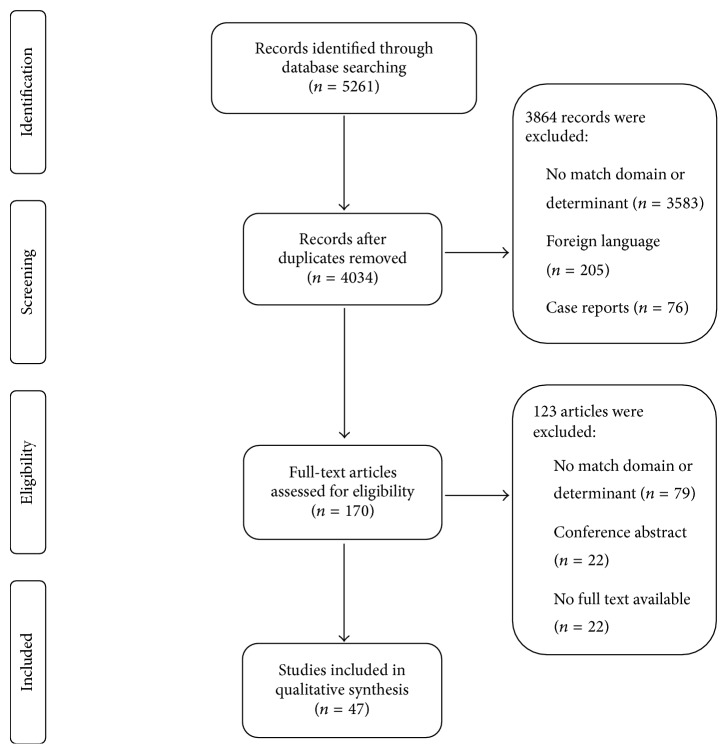
Figure 1
Figure 1
Preferred Reporting Items for Systematic Reviews and Meta-Analyses (PRISMA) flow diagram for study selection [10].
Figure 2
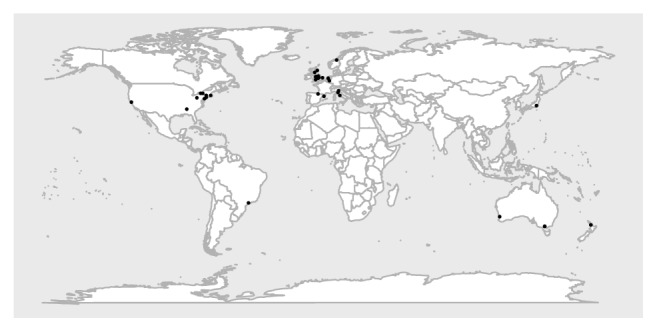
Figure 2
Distribution of reported Intermediate Care Units around the world. This world map demonstrates the location of Intermediate Care Units as reported by our included studies. Most reported Intermediate Care Units are situated in Europe and around the east coast of the United States.
Figure 3
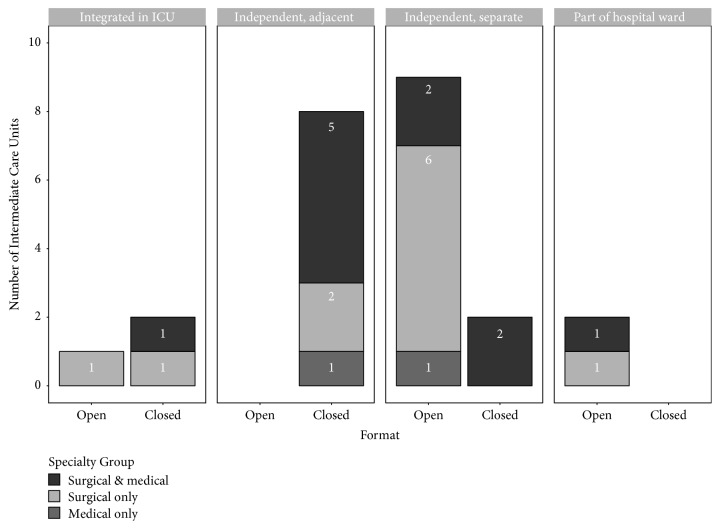
Figure 3
Number of Intermediate Care Units per location, format, and admitting specialties. This chart shows that most of the Intermediate Care Units were either (1) closed format, adjacent to the Intensive Care Unit and treating surgical and medical patients, or (2) open format, independently located and treating surgical patients only.
Figure 4
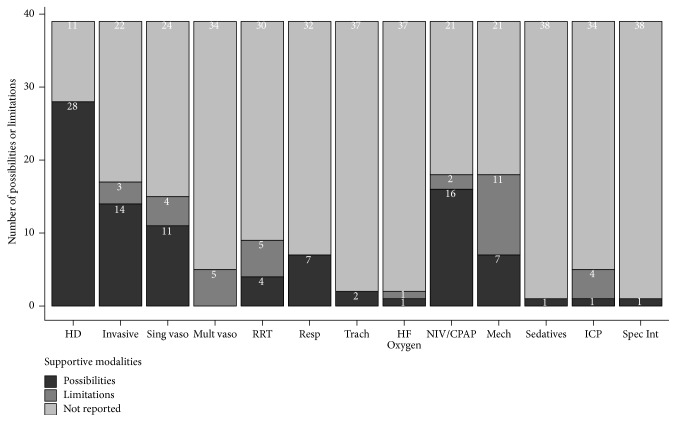
Figure 4
Possibilities and limitations of Intermediate Care Units. This chart shows that Intermediate Care Units always provided haemodynamic monitoring and respiratory support, while common limitations were mechanical ventilation, multiple vasoactive medications, renal replacement therapy, and intracranial pressure management. HD = hemodynamic monitoring; Invasive = invasive monitoring; Sing vaso = single vasoactive medication; Mult vaso = multiple vasoactive medications; RRT = renal replacement therapy; Resp = respiratory support; Trach = tracheostomy care; HF Oxygen = high-flow oxygen therapy; NIV/CPAP = noninvasive ventilation/continuous positive airway pressure; Mech = mechanical ventilation (ventilation of weaning); ICP = intracranial pressure measurement; Spec Int = specific interventions.

References

    1. Vincent J., Rubenfeld G. D. Does intermediate care improve patient outcomes or reduce costs? Critical Care. 2015;19(1):p. 89. doi: 10.1186/s13054-015-0813-0. - DOI - PMC - PubMed
    1. Stacy K. M. Progressive Care Units: Different but the Same. Critical Care Nurse. 2011;31(3):77–83. doi: 10.4037/ccn2011644. - DOI - PubMed
    1. Prin M., Wunsch H. The Role of Stepdown Beds in Hospital Care. American Journal of Respiratory and Critical Care Medicine. 2014;190(11):1210–1216. doi: 10.1164/rccm.201406-1117PP. - DOI - PMC - PubMed
    1. Ridley S. A. Intermediate care. Possibilities, requirements and solutions. Anaesthesia. 1998;53(7):654–664. doi: 10.1046/j.1365-2044.1998.466-az0557.x. - DOI - PubMed
    1. Armstrong E., De Waard M. C., De Grooth H.-J. S., et al. Using nursing activities score to assess nursing workload on a medium care unit. Anesthesia and Analgesia. 2015;121(5):1274–1280. doi: 10.1213/ANE.0000000000000968. - DOI - PubMed

LinkOut - more resources