


The tip-of-the-tongue state and curiosity
- PMID: 28776003
- PMCID: PMC5514176
- DOI: 10.1186/s41235-017-0065-4
The tip-of-the-tongue state and curiosity
Abstract
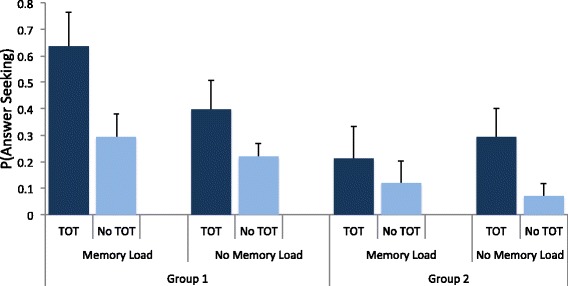
Theories of study time allocation and of curiosity suggest that people are most engaged with and want to devote their time to materials that are not completely mastered but also are not so difficult that they might be impossible. Their curiosity is thought to be triggered by items that are almost known, or are in what is sometimes called the region of proximal learning. Answers that are on the tip-of-the-tongue (TOT)-not immediately recallable but nevertheless evoking a feeling of imminent recall-seem, intuitively, to be materials that have this characteristic of being almost, but not quite, fully known. We therefore, hypothesized that people would be particularly curious to see the answers to questions for which the answers were on the tips of their tongues. To test the TOT curiosity hypothesis, we gave participants 82 general information questions and quickly asked whether the answers were or were not on the tips of their tongues and whether they wanted to see the answers later. Overwhelmingly, items that were accompanied by a TOT feeling were those which evoked participants' curiosity, regardless of whether the feeling occurred in conjunction with an error of commission, an error of omission, or even with the correct answer.
Keywords: Curiosity; Google; Metacognition; Region of proximal learning; Tip-of-the-tongue.
Figures


References
-
- Atkinson RC. Ingredients for a theory of instruction. American Psychologist. 1972;27:921–931. doi: 10.1037/h0033572. - DOI
-
- Berlyne DE. A theory of human curiosity. British Journal of Psychology. 1954;45:180–191. - PubMed
-
- Bjork RA, Linn MC. The science of learning and the learning of science: Introducing desirable difficulties. Association for Psychological Science Observer. 2006;19:1–2.
-
- Brown, A. S., & Croft, K. (2014). There it is again on my tongue: Tracking repeat TOTs. In B. L. Schwartz & A. S. Brown (Eds.), Tip of the tongue states and related phenomena (pp. 32–49). Cambridge: Cambridge University Press.
LinkOut - more resources
Full Text Sources
Other Literature Sources