Comparison of Baseline Characteristics between Community-based and Hospital-based Suicidal Ideators and Its Implications for Tailoring Strategies for Suicide Prevention: Korean Cohort for the Model Predicting a Suicide and Suicide-related Behavior
- PMID: 28776350
- PMCID: PMC5546974
- DOI: 10.3346/jkms.2017.32.9.1522
Comparison of Baseline Characteristics between Community-based and Hospital-based Suicidal Ideators and Its Implications for Tailoring Strategies for Suicide Prevention: Korean Cohort for the Model Predicting a Suicide and Suicide-related Behavior
Abstract
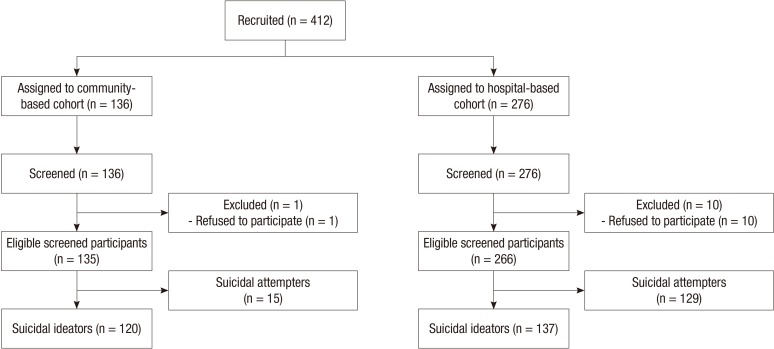
In this cross-sectional study, we aimed to identify distinguishing factors between populations with suicidal ideation recruited from hospitals and communities to make an efficient allocation of limited anti-suicidal resources according to group differences. We analyzed the baseline data from 120 individuals in a community-based cohort (CC) and 137 individuals in a hospital-based cohort (HC) with suicidal ideation obtained from the Korean Cohort for the Model Predicting a Suicide and Suicide-related Behavior (K-COMPASS) study. First, their sociodemographic factors, histories of medical and psychiatric illnesses, and suicidal behaviors were compared. Second, diagnosis by the Korean version of the Mini International Neuropsychiatric Interview, scores of psychometric scales were used to assess differences in clinical severity between the groups. The results revealed that the HC had more severe clinical features: more psychiatric diagnosis including current and recurrent major depressive episodes (odds ratio [OR], 4.054; P < 0.001 and OR, 11.432; P < 0.001, respectively), current suicide risk (OR, 4.817; P < 0.001), past manic episodes (OR, 9.500; P < 0.001), past hypomanic episodes (OR, 4.108; P = 0.008), current alcohol abuse (OR, 3.566; P = 0.020), and current mood disorder with psychotic features (OR, 20.342; P < 0.001) besides significantly higher scores in depression, anxiety, alcohol problems, impulsivity, and stress. By comparison, old age, single households, and low socioeconomic status were significantly associated with the CC. These findings indicate the necessity of more clinically oriented support for hospital visitors and more socioeconomic aid for community-dwellers with suicidality.
Keywords: Community Mental Health Centers; Cross-sectional Studies; Epidemiologic Studies; Hospitals; Korea; Suicide.
© 2017 The Korean Academy of Medical Sciences.
Conflict of interest statement
The authors have no potential conflicts of interest to disclose.
Figures
References
-
- World Health Organization. Suicide: fact sheet [Internet] [accessed on 4 May 2017]. Available at http://www.who.int/mediacentre/factsheets/fs398/en.
-
- Statistics Korea. Annual report on the cause of death statistics 2015 [Internet] [accessed on 4 May 2017]. Available at http://kosis.kr/ups/ups_01List.jsp?pubcode=YD.
-
- Organisation for Economic Co-operation and Development. OECD Health Statistics 2016. Paris: Organisation for Economic Co-operation and Development; 2016.
-
- Miret M, Ayuso-Mateos JL, Sanchez-Moreno J, Vieta E. Depressive disorders and suicide: epidemiology, risk factors, and burden. Neurosci Biobehav Rev. 2013;37:2372–2374. - PubMed
MeSH terms
LinkOut - more resources
Full Text Sources
Other Literature Sources
Medical
Miscellaneous