


Warfarin monitoring in nursing homes assessed by case histories. Do recommendations and electronic alerts affect judgements?
- PMID: 28776437
- PMCID: PMC5592358
- DOI: 10.1080/02813432.2017.1358857
Warfarin monitoring in nursing homes assessed by case histories. Do recommendations and electronic alerts affect judgements?
Abstract
Purpose: Older adults treated with warfarin are prone to complications, and high-quality monitoring is essential. The aim of this case history based study was to assess the quality of warfarin monitoring in a routine situation, and in a situation with an antibiotic-warfarin interaction, before and after receiving an electronic alert.
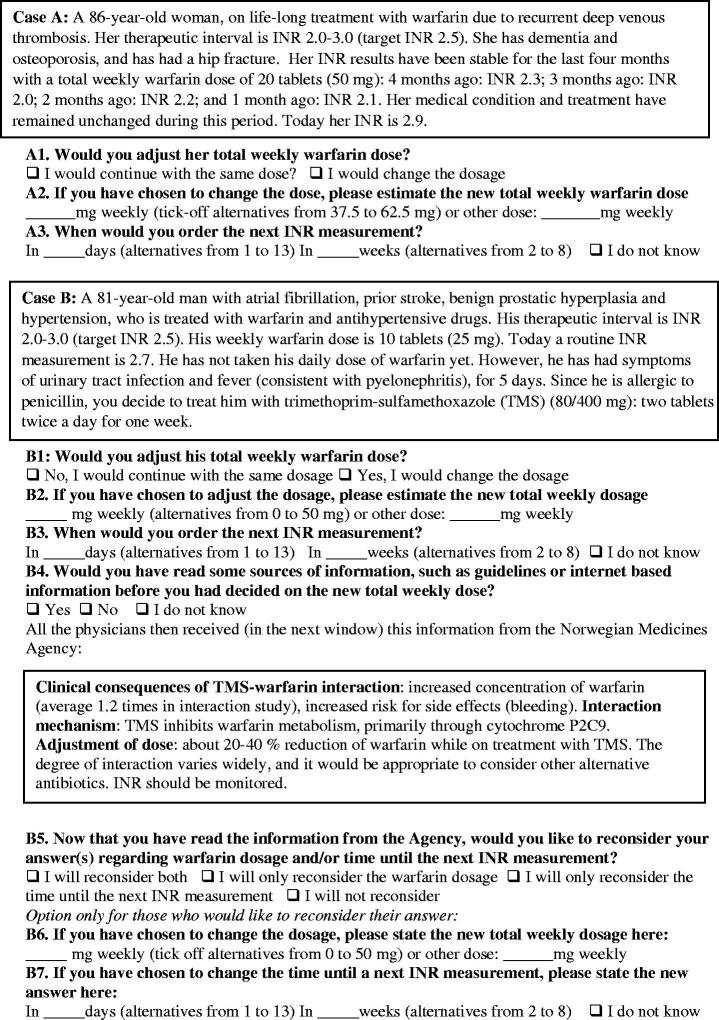
Materials and methods: In April 2014, a national web-based survey with two case histories was distributed among Norwegian nursing home physicians and general practitioners working part-time in nursing homes. Case A represented a patient on stable warfarin treatment, but with a substantial INR increase within the therapeutic interval. Case B represented a more challenging patient with trimethoprim sulfamethoxazole (TMS) treatment due to pyelonephritis. In both cases, the physicians were asked to state the next warfarin dose and the INR recall interval. In case B, the physicians could change their suggestions after receiving an electronic alert on the TMS-warfarin interaction.
Results: Three hundred and ninety eight physicians in 292 nursing homes responded. Suggested INR recall intervals and warfarin doses varied substantially in both cases. In case A, 61% gave acceptable answers according to published recommendations, while only 9% did so for case B. Regarding the TMS-warfarin interaction in case history B, the electronic alert increased the percentage of respondents correctly suggesting a dose reduction from 29% to 53%. Having an INR instrument in the nursing home was associated with shortened INR recall times.
Conclusions: Practical advice on handling of warfarin treatment and drug interactions is needed. Electronic alerts as presented in electronic medical records seem insufficient to change practice. Availability of INR instruments may be important regarding recall time.
Keywords: Warfarin; anticoagulants; drug interactions; electronic alerts; international normalized ratio; nursing homes; reminder systems.
References
-
- Kristoffersen AH, Thue G, Ajzner E, et al. Interpretation and management of INR results: a case history based survey in 13 countries. Thromb Res. 2012;130:309–315. - PubMed
-
- Kristoffersen AH, Thue G, Sandberg S.. Postanalytical external quality assessment of warfarin monitoring in primary healthcare. Clin Chem. 2006;52:1871–1878. - PubMed
-
- Rose AJ. Improving the management of warfarin may be easier than we think. Circulation. 2012;126:2277–2279. - PubMed
-
- Stewart A, Ganguli A, FitzGerald R, et al. Variation in warfarin prescribing and dosing in the UK: a national survey of anticoagulation clinics. J Clin Pharm Ther. 2015;40:466–471. - PubMed
Publication types
MeSH terms
Substances
LinkOut - more resources
Full Text Sources
Other Literature Sources
Medical
Miscellaneous
