


An exploratory genome-wide analysis of genetic risk for alcoholic hepatitis
- PMID: 28776448
- PMCID: PMC5773288
- DOI: 10.1080/00365521.2017.1359664
An exploratory genome-wide analysis of genetic risk for alcoholic hepatitis
Abstract
Objectives: To elucidate the genetic variability between heavy drinkers with and without alcoholic hepatitis (AH).
Materials and methods: An exploratory genome-wide association study (GWAS; NCT02172898) was conducted comparing 90 AH cases with 93 heavy drinking matched controls without liver disease in order to identify variants or genes associated with risk for AH. Individuals were genotyped using the multi-ethnic genotyping array, after which the data underwent conventional quality control. Using bioinformatics tools, pathways associated with AH were explored on the basis of individual variants, and based on genes with a higher 'burden' of functional variation.
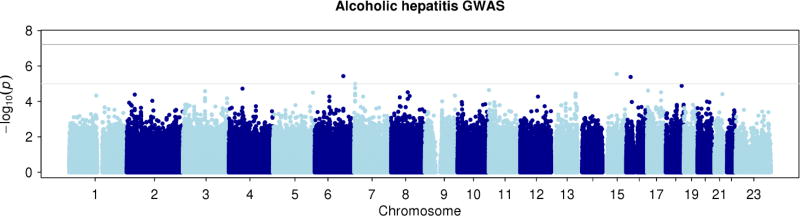
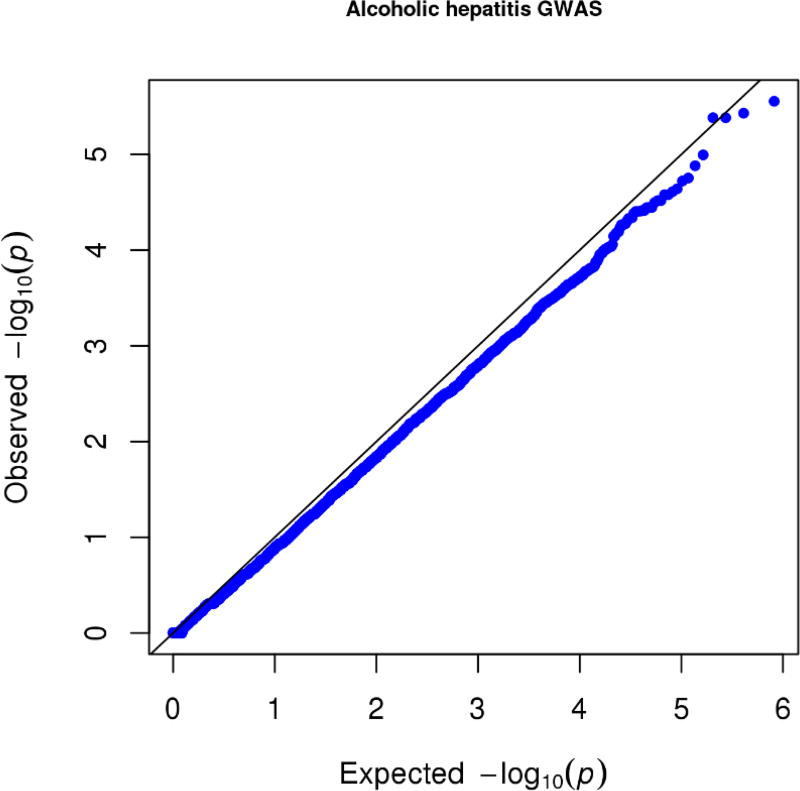
Results: Although no single variant reached genome-wide significance, an association signal was observed for PNPLA3 rs738409 (p = .01, OR 1.9, 95% CI 1.1-3.1), a common single nucleotide polymorphism that has been associated with a variety of liver-related pathologies including alcoholic cirrhosis. Using the improved gene set enrichment analysis for GWAS tool, it was shown that, based on the single variants' trait-association p-values, multiple pathways were associated with risk for AH with high confidence (false discovery rate [FDR] < 0.05), including several pathways involved in lymphocyte activation and chemokine signaling, which coincides with findings from other research groups. Several Tox Functions and Canonical Pathways were highlighted using Ingenuity Pathway Analysis, with an especially conspicuous role for pathways related to ethanol degradation, which is not surprising considering the phenotype of the genotyped individuals.
Conclusion: This preliminary analysis suggests a role for PNPLA3 variation and several gene sets/pathways that may influence risk for AH among heavy drinkers.
Keywords: Alcoholic hepatitis; genetic risk; genome-wide association study; pathway enrichment; single nucleotide polymorphism.
Conflict of interest statement
The authors report no conflicts of interest.
Figures
References
-
- Louvet A, Labreuche J, Artru F, Boursier J, Kim DJ, O'Grady J, Trepo E, Nahon P, Ganne-Carrie N, Naveau S, Diaz E, Gustot T, Lassailly G, Cannesson-Leroy A, Canva-Delcambre V, Dharancy S, Park SH, Moreno C, Morgan TR, Duhamel A, Mathurin P. Combining Data From Liver Disease Scoring Systems Better Predicts Outcomes of Patients With Alcoholic Hepatitis. Gastroenterology. 2015;149:398–406 e8. quiz e16–7. - PubMed
-
- Sozio MS, Liangpunsakul S, Crabb D. The role of lipid metabolism in the pathogenesis of alcoholic and nonalcoholic hepatic steatosis. Semin Liver Dis. 2010;30:378–90. - PubMed
-
- Liangpunsakul S, Puri P, Shah VH, Kamath P, Sanyal A, Urban T, Ren X, Katz B, Radaeva S, Chalasani N, Crabb DW, Translational R Evolving Alcoholic Hepatitis Treatment C. Effects of Age, Sex, Body Weight, and Quantity of Alcohol Consumption on Occurrence and Severity of Alcoholic Hepatitis. Clin Gastroenterol Hepatol. 2016 - PMC - PubMed
-
- Crabb DW, Bataller R, Chalasani NP, Kamath PS, Lucey M, Mathurin P, McClain C, McCullough A, Mitchell MC, Morgan TR, Nagy L, Radaeva S, Sanyal A, Shah V, Szabo G, Consortia NAH. Standard Definitions and Common Data Elements for Clinical Trials in Patients With Alcoholic Hepatitis: Recommendation From the NIAAA Alcoholic Hepatitis Consortia. Gastroenterology. 2016;150:785–90. - PMC - PubMed
Publication types
MeSH terms
Substances
Grants and funding
LinkOut - more resources
Full Text Sources
Other Literature Sources
