


Risk factors can classify individuals who develop accelerated knee osteoarthritis: Data from the osteoarthritis initiative
- PMID: 28776751
- PMCID: PMC5797506
- DOI: 10.1002/jor.23675
Risk factors can classify individuals who develop accelerated knee osteoarthritis: Data from the osteoarthritis initiative
Abstract
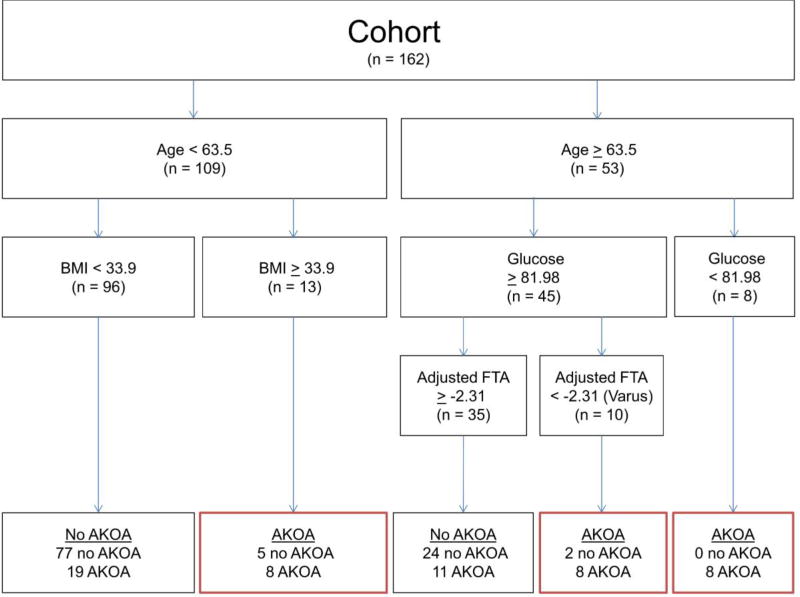
We assessed which combinations of risk factors can classify adults who develop accelerated knee osteoarthritis (KOA) or not and which factors are most important. We conducted a case-control study using data from baseline and the first four annual visits of the Osteoarthritis Initiative. Participants had no radiographic KOA at baseline (Kellgren-Lawrence [KL]<2). We classified three groups (matched on sex): (i) accelerated KOA: >1 knee developed advance-stage KOA (KL = 3 or 4) within 48 months; (ii) typical KOA: >1 knee increased in radiographic scoring (excluding those with accelerated KOA); and (iii) No KOA: no change in KL grade by 48 months. We selected eight predictors: Serum concentrations for C-reactive protein, glycated serum protein (GSP), and glucose; age; sex; body mass index; coronal tibial slope, and femorotibial alignment. We performed a classification and regression tree (CART) analysis to determine rules for classifying individuals as accelerated KOA or not (no KOA and typical KOA). The most important baseline variables for classifying individuals with incident accelerated KOA (in order of importance) were age, glucose concentrations, BMI, and static alignment. Individuals <63.5 years were likely not to develop accelerated KOA, except when overweight. Individuals >63.5 years were more likely to develop accelerated KOA except when their glucose levels were >81.98 mg/dl and they did not have varus malalignment. The unexplained variance of the CART = 69%. These analyses highlight the complex interactions among four risk factors that may classify individuals who will develop accelerated KOA but more research is needed to uncover novel risk factors. © 2017 Orthopaedic Research Society. Published by Wiley Periodicals, Inc. J Orthop Res 36:876-880, 2018.
Keywords: classification; knee; osteoarthritis; risk factors.
© 2017 Orthopaedic Research Society. Published by Wiley Periodicals, Inc.
Conflict of interest statement
The authors have no other conflicts of interest with regard to this work.
Figures
References
Publication types
MeSH terms
Grants and funding
LinkOut - more resources
Full Text Sources
Other Literature Sources
Research Materials
