Review
. 2017 Aug;92(8):1291-1303.
doi: 10.1016/j.mayocp.2017.04.016.

Current Understanding of Neurodegenerative Diseases Associated With the Protein Tau

Affiliations
Review

Current Understanding of Neurodegenerative Diseases Associated With the Protein Tau

Keith A Josephs. Mayo Clin Proc. 2017 Aug.

Abstract

Primary tauopathies are a group of neurodegenerative diseases in which tau is believed to be the major contributing factor of the neurodegenerative process. In primary tauopathies, there is a disassociation between tau (a microtubule-associated protein) and microtubules as a result of tau hyperphosphorylation. This disassociation between tau and microtubules results in tau fibrillization and inclusion formation as well as in microtubule dysfunction. There are different clinical syndromes associated with different primary tauopathies, and some clinical syndromes can be associated with multiple primary tauopathies. Hence, although some clinical syndromes are highly specific and almost diagnostic of a primary tauopathy, many are not, making it difficult to diagnose a primary tauopathy. Recently, radioligands that bind to tau and can be combined with positron emission tomography to detect fibrillary tau antemortem have been developed, although preliminary data suggest that these ligands may not be sensitive in detecting tau associated with many primary tauopathies. Another recent advancement in the field is evidence suggesting that tau may exhibit properties similar to those of prions, although infective transmission has not been shown. There have been a few clinical trials targeting tau and microtubule dysfunction, although none have had any disease-modifying effects. Understanding tau biology is critical to the development of pharmacological agents that could have disease-modifying effects on primary tauopathies.


Conflict of interest statement

Conflict of interest disclosure: The author reports no conflicts of interest.

Figures

Figure 1
Figure 1
T1 weighted MRI features suggestive of an underlying primary tauopathy include the humming bird sign resulting from atrophy of the dorsal midbrain and preserved pons (A, bottom image) suggestive of progressive supranuclear palsy, asymmetric parietal atrophy, right greater than left, suggestive of corticobasal degeneration (B, bottom image) and striking atrophy of the prefrontal cortex and anterior temporal lobe with secondary ventricular enlargement, worse of the left (C, bottom image) suggestive of Pick’s disease. Top images are normal MRI scans for comparison.
Figure 2
Figure 2
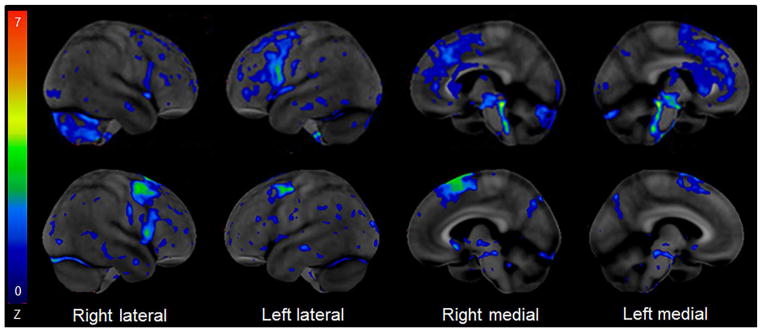
[18F] Fluorodeoxyglucose PET scan using the Cortex Suite software reveals mild hypometabolism of the left posterior frontal cortex, bilateral supplemental motor cortices, midbrain, superior cerebellar peduncle and right cerebellum in a case of Richardson’s syndrome (top row) and mild hypometabolism in bilateral posterior frontal cortices, and right supplemental motor cortex in a patient with primary progressive apraxia of speech (bottom row) suggestive of an underlying primary tauopathy.
Figure 3
Figure 3
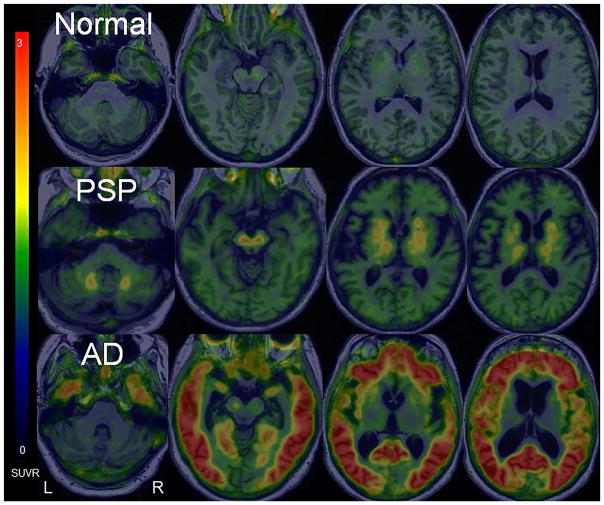
[18F] AV-1451 tau-PET shows minimal uptake in a normal control patient (top row), mild-moderate uptake in the dentate nucleus of the cerebellum, midbrain and basal ganglia in a patient with progressive supranuclear palsy (PSP), a primary 4R tauopathy (2nd row), and striking uptake in the cortex in a patient with typical Alzheimer’s disease (AD), a 3R + 4R tauopathy, for comparison (bottom row).

References

    1. Josephs KA, Hodges JR, Snowden J, et al. Neuropathological background of phenotypical variability in frontotemporal dementia. Acta Neuropathol. 2011;122(2):137–153. - PMC - PubMed
    1. Arendt T, Stieler JT, Holzer M. Tau and tauopathies. Brain Res Bull. 2016;126(Pt 3):238–292. - PubMed
    1. Spillantini MG, Goedert M, Crowther RA, Murrell JR, Farlow MR, Ghetti B. Familial multiple system tauopathy with presenile dementia: a disease with abundant neuronal and glial tau filaments. Proc Natl Acad Sci U S A. 1997;94(8):4113–4118. - PMC - PubMed
    1. Braak H, Braak E. Neuropathological stageing of Alzheimer-related changes. Acta Neuropathol. 1991;82(4):239–259. - PubMed
    1. Hyman BT, Phelps CH, Beach TG, et al. National Institute on Aging-Alzheimer’s Association guidelines for the neuropathologic assessment of Alzheimer’s disease. Alzheimers Dement. 2012;8(1):1–13. - PMC - PubMed

Publication types