. 2017 Sep 29;83(20):e01320-17.
doi: 10.1128/AEM.01320-17. Print 2017 Oct 15.

Unleashing Natural Competence in Lactococcus lactis by Induction of the Competence Regulator ComX

Affiliations

Unleashing Natural Competence in Lactococcus lactis by Induction of the Competence Regulator ComX

Joyce Mulder et al. Appl Environ Microbiol. .

Abstract

In biotechnological workhorses like Streptococcus thermophilus and Bacillus subtilis, natural competence can be induced, which facilitates genetic manipulation of these microbes. However, in strains of the important dairy starter Lactococcus lactis, natural competence has not been established to date. However, in silico analysis of the complete genome sequences of 43 L. lactis strains revealed complete late competence gene sets in 2 L. lactis subsp. cremoris strains (KW2 and KW10) and at least 10 L. lactis subsp. lactis strains, including the model strain IL1403 and the plant-derived strain KF147. The remainder of the strains, including all dairy isolates, displayed genomic decay in one or more of the late competence genes. Nisin-controlled expression of the competence regulator comX in L. lactis subsp. lactis KF147 resulted in the induction of expression of the canonical competence regulon and elicited a state of natural competence in this strain. In contrast, comX expression in L. lactis NZ9000, which was predicted to encode an incomplete competence gene set, failed to induce natural competence. Moreover, mutagenesis of the comEA-EC operon in strain KF147 abolished the comX-driven natural competence, underlining the involvement of the competence machinery. Finally, introduction of nisin-inducible comX expression into nisRK-harboring derivatives of strains IL1403 and KW2 allowed the induction of natural competence in these strains also, expanding this phenotype to other L. lactis strains of both subspecies.IMPORTANCE Specific bacterial species are able to enter a state of natural competence in which DNA is taken up from the environment, allowing the introduction of novel traits. Strains of the species Lactococcus lactis are very important starter cultures for the fermentation of milk in the cheese production process, where these bacteria contribute to the flavor and texture of the end product. The activation of natural competence in this industrially relevant organism can accelerate research aiming to understand industrially relevant traits of these bacteria and can facilitate engineering strategies to harness the natural biodiversity of the species in optimized starter strains.

Keywords: Lactococcus lactis; comparative genomics; natural competence.


Figures

FIG 1
FIG 1
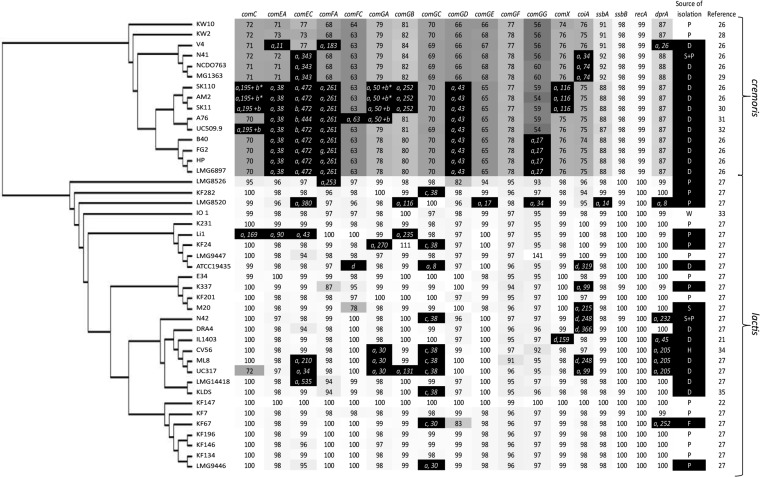
Genomic analysis of 43 L. lactis strains to assess genetic capacity to develop natural competence. A concatenated core genome single-nucleotide polymorphism (SNP) tree of 43 L. lactis strain was combined with full-length protein identity scores (%) for the selected subset of late-competence-associated proteins in comparison to their homologues in L. lactis strain KF147, which was used as a reference. Protein identity scores are depicted within each cell and reflected by gray scales based on the L. lactis KF147 query protein sequences, in which at least 90% full-length alignment is considered indicative of gene presence. Genetic events leading to competence gene decay (black cells in the figure) are specified as a premature stop codon within the first 90% of the gene (a), transposon insertion (b), prophage insertion (c), or absence of gene, a mutated/alternative start, or lengthened/fused protein at least more than 25% of its total length (d), followed by the position within the protein sequence where the event is detected relative to its N terminus. Source of isolation: P, plant; D, dairy; S, soil; W, water; H, human body; F, fruit (72). References for the genome sequences are given when available.
FIG 2
FIG 2
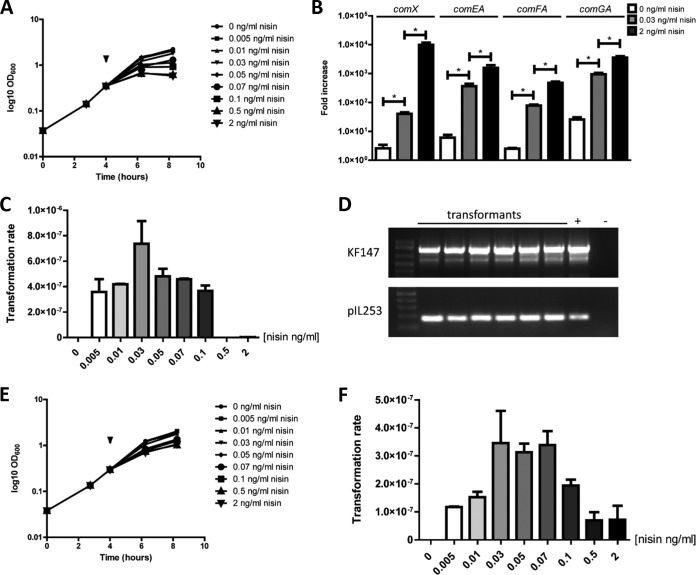
Impact of ComX expression on growth, late competence gene expression, and natural competence phenotype in L. lactis KF147. (A) Dose-dependent growth inhibition upon nisin induction of L. lactis KF147 harboring pNZ6200. The arrowhead indicates the time point of nisin induction. (B) comX, comEA, comFA, and comGA expression levels after nisin induction. *, significant differences (P < 0.05). (C and D) Number of colonies obtained (C) and confirmation of their genetic identity (D). (E and F) Same analysis for strain L. lactis KF147 harboring pNZ6201.
FIG 3
FIG 3
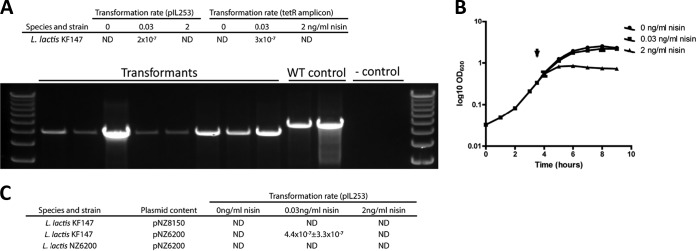
Natural competence of L. lactis KF147 depends on the late competence operon comEA-EC. (A) By use of a linear mutagenesis fragment, a comEA-EC-negative derivative of KF147 harboring pNZ6200 (NZ6200) could be obtained with high efficiency. (B and C) NZ6200 displayed a similar growth defect upon full nisin induction (B), but transformation with pIL253 is not feasible (C).

References

    1. Lerat E, Daubin V, Ochman H, Moran NA. 2005. Evolutionary origins of genomic repertoires in bacteria. PLoS Biol 3:807–814. doi: 10.1371/journal.pbio.0030130. - DOI - PMC - PubMed
    1. Dagan T, Artzy-Randrup Y, Martin W. 2008. Modular networks and cumulative impact of lateral transfer in prokaryote genome evolution. Proc Natl Acad Sci U S A 105:10039–10044. doi: 10.1073/pnas.0800679105. - DOI - PMC - PubMed
    1. Treangen TJ, Rocha EPC. 2011. Horizontal transfer, not duplication, drives the expansion of protein families in prokaryotes. PLoS Genet 7:e1001284. doi: 10.1371/journal.pgen.1001284. - DOI - PMC - PubMed
    1. Takeuchi N, Kaneko K, Koonin EV. 2014. Horizontal gene transfer can rescue prokaryotes from Muller's Ratchet: benefit of DNA from dead cells and population subdivision. G3 4:325–339. doi: 10.1534/g3.113.009845. - DOI - PMC - PubMed
    1. Griffith F. 1928. The significance of pneumococcal types. J Hyg (Lond) 27:113–159. doi: 10.1017/S0022172400031879. - DOI - PMC - PubMed