. 2017 Aug 4;7(1):7325.
doi: 10.1038/s41598-017-07436-w.

Aspergillus Secondary Metabolite Database, a resource to understand the Secondary metabolome of Aspergillus genus

Affiliations

Aspergillus Secondary Metabolite Database, a resource to understand the Secondary metabolome of Aspergillus genus

Varahalarao Vadlapudi et al. Sci Rep. .

Abstract

Aspergillus is a genus of ubiquitous fungi that are pathologically & therapeutically important. Aspergillus Secondary Metabolites Database (A2MDB) is a curated compendium of information on Aspergillus & its secondary metabolome. A2MDB catalogs 807 unique non-redundantsecondary metabolites derived from 675 Aspergillus species. A2MDB has a compilation of 100 cellular targets of secondary metabolites, 44 secondary metabolic pathways, 150 electron and light microscopy images of various Aspergillus species. A phylogenetic representation of over 2500 strains has been provided. A2MDB presents a detailed chemical information of secondary metabolites and their mycotoxins. Molecular docking models of metabolite-target protein interactions have been put together. A2MDB also has epidemiological data representing Aspergillosis and global occurrence of Aspergillus species. Furthermore a novel classification of Aspergillosis along with 370 case reports with images, were made available. For each metabolite catalogued, external links to related databases have been provided. All this data is available on A2MDB, launched through Indian Institute of Chemical Technology, Hyderabad, India, as an open resource http://www.iictindia.org/A2MDB . We believe A2MDB is of practical relevance to the scientific community that is in pursuit of novel therapeutics.


Conflict of interest statement

The authors declare that they have no competing interests.

Figures
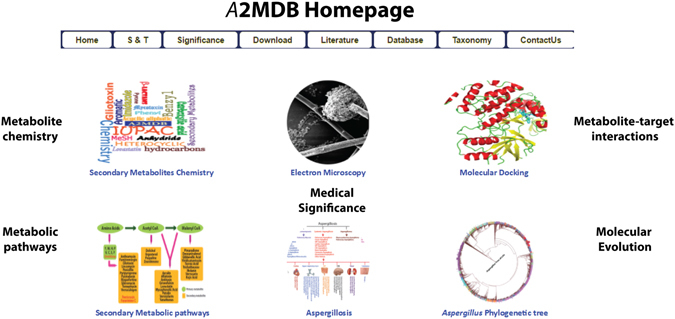
Figure 1
Figure 1
A screenshot of A2MDB showing multiple features in the homepage. The figure shows how clicking on various icons can navigate to the required option. Main page has icons for secondary metabolites chemistry, biological targets, Secondary metabolic pathways, microscopy images, molecular docking, Aspergillosis and phylogenetic analysis, apart from buttons which when clicked, explain science and significance of the project, database pages where one can surf and download data, taxonomy and contact us pages. The database has been officially launched through CSIR-IICT, India webpages.
Figure 2
Figure 2
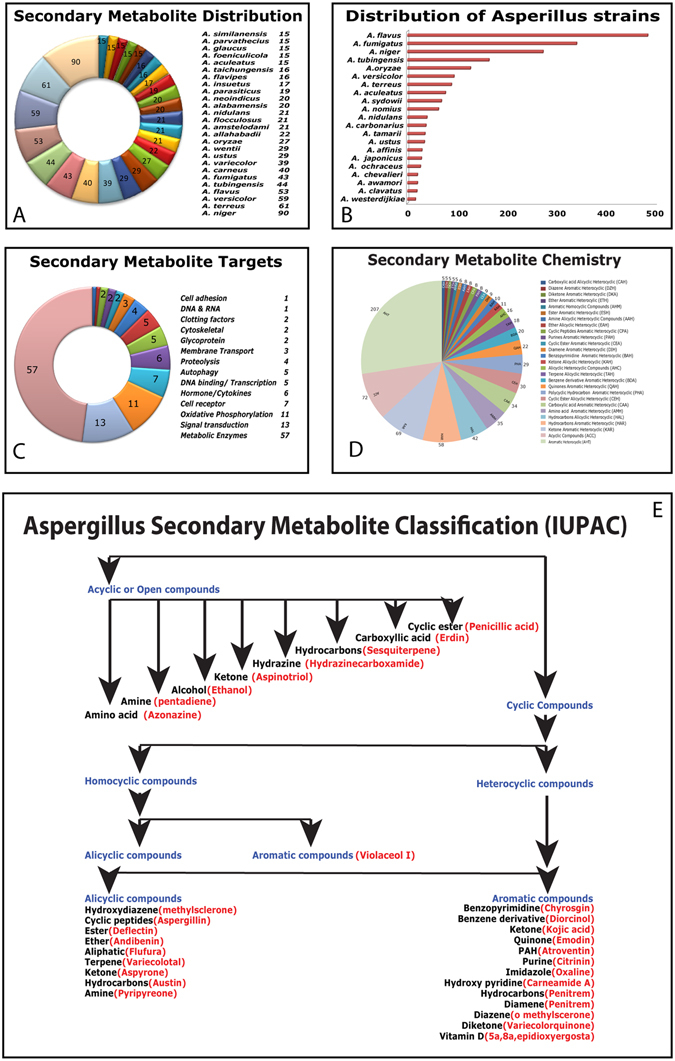
Analysis of the data collected for assimilation in to A2MDB: (A) pie chart representing the number of metabolites identified from major Aspergillus species, (B) bar graph shows the clinical distribution of biologically, medically and important strains of major Aspergillus species, (C) gene ontology based classification of cellular targets based on molecular function, (D) Distribution of secondary metabolites based on their chemical property, (E) IUPAC based classification of secondary metabolites in to various chemical compounds shown with examples under each category.
Figure 3
Figure 3
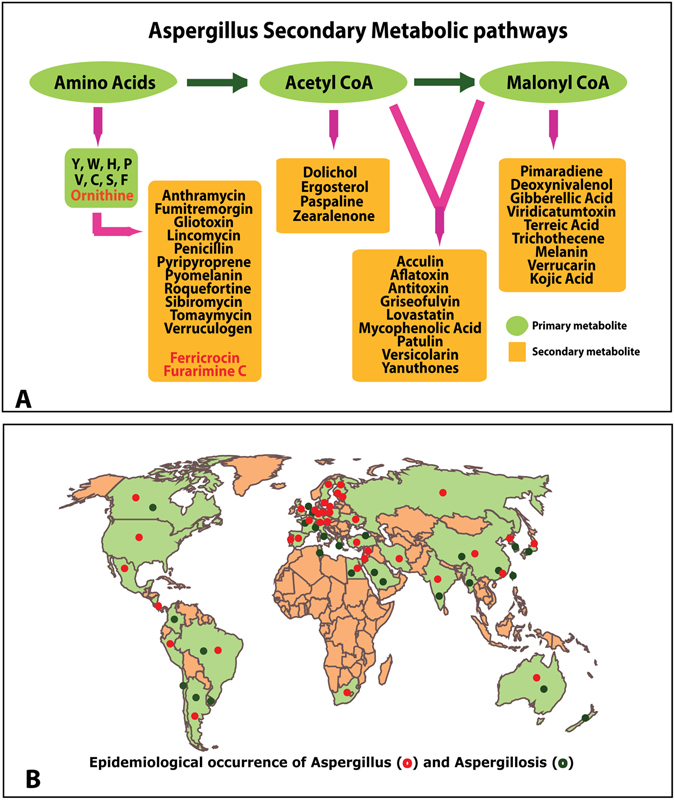
(A) A representation of metabolic pathways where in the primary metabolic intermediates serve as precursors for secondary metabolite production in Aspergillus, (B) A qualitative epidemiological distribution map was created using a R-package “rworldmap” (version 1.3–6) to showcase the incidence of Aspergillus spp. and Aspergillosis.
Figure 4
Figure 4
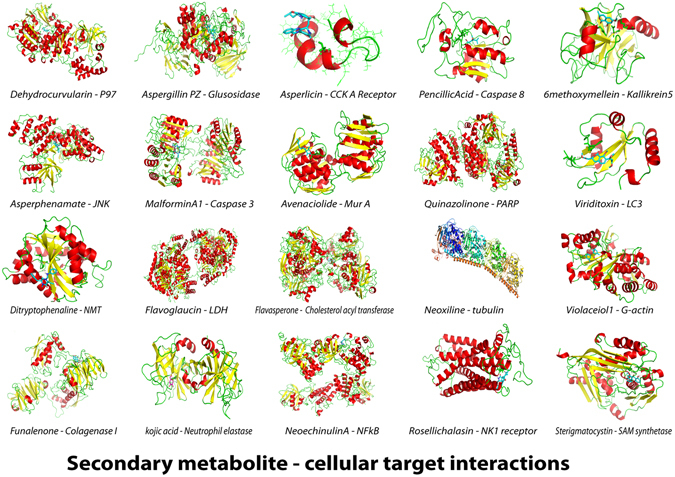
Molecular docking models representing secondary metabolite and cellular target interactions as reported in literature. Docking was performed using Auto Dock Vena. The protein structure was from PDB, metabolite structure from one of the chemical databases as explained in the text and binding energies are also represented.
Figure 5
Figure 5
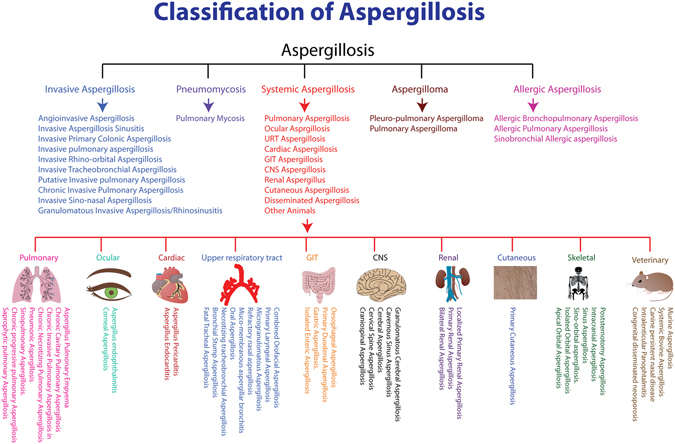
A detailed classification of Aspergillosis with case reports and related images from the literature available so far from humans and animals with DOI literature references. All the organ systems have been drawn using the software Edraw (Version 8.6) trial version.
Figure 6
Figure 6
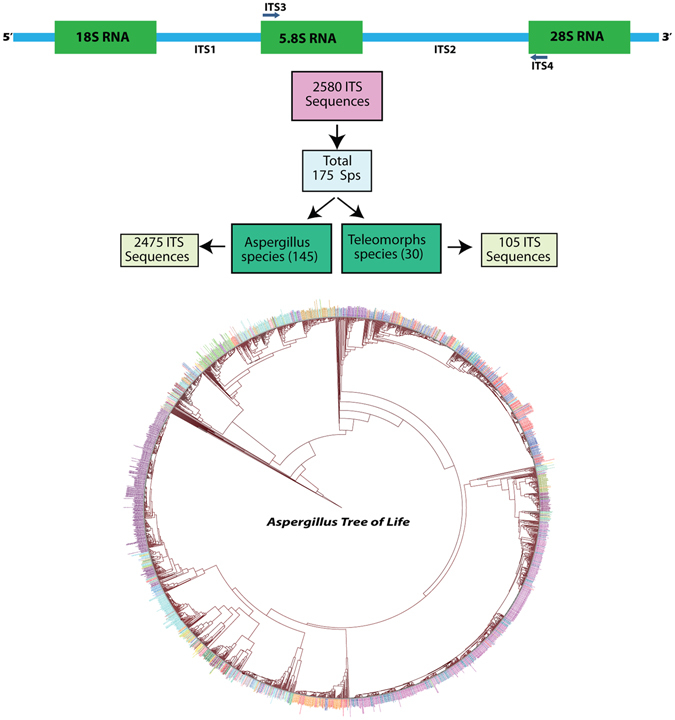
Phylogenetic tree of life for 2850 Aspergillus strains using ITS sequences. All the sequences are unique, various strains of Aspergillus belong mainly to 175 species.

References

    1. Samson RA, et al. Phylogeny, identification and nomenclature of the genus Aspergillus. Studies in mycology. 2014;78:141–173. doi: 10.1016/j.simyco.2014.07.004. - DOI - PMC - PubMed
    1. You YH, Kwak TW, Kang SM, Lee MC, Kim JG. Aspergillus clavatus Y2H0002 as a New Endophytic Fungal Strain Producing Gibberellins Isolated from Nymphoides pe ltata in Fresh Water. Mycobiology. 2015;43:87–91. doi: 10.5941/MYCO.2015.43.1.87. - DOI - PMC - PubMed
    1. Dagenais TR, Keller NP. Pathogenesis of Aspergillus fumigatus in Invasive Aspergillosis. Clinical microbiology reviews. 2009;22:447–465. doi: 10.1128/CMR.00055-08. - DOI - PMC - PubMed
    1. Ogawa A, et al. Pseudodeflectusin, a novel isochroman derivative from Aspergillus pseudodeflectus a parasite of the sea weed, Sargassum fusiform, as a selective human cancer cytotoxin. Bioorganic & medicinal chemistry letters. 2004;14:3539–3543. doi: 10.1016/j.bmcl.2004.04.050. - DOI - PubMed
    1. Hedayati MT, Pasqualotto AC, Warn PA, Bowyer P, Denning DW. Aspergillus flavus: human pathogen, allergen and mycotoxin producer. Microbiology. 2007;153:1677–1692. doi: 10.1099/mic.0.2007/007641-0. - DOI - PubMed

Publication types

LinkOut - more resources