


Drug treatment effects on outcomes in heart failure with preserved ejection fraction: a systematic review and meta-analysis
- PMID: 28780577
- PMCID: PMC5861385
- DOI: 10.1136/heartjnl-2017-311652
Drug treatment effects on outcomes in heart failure with preserved ejection fraction: a systematic review and meta-analysis
Abstract
Background: Clinical drug trials in patients with heart failure and preserved ejection fraction have failed to demonstrate improvements in mortality.
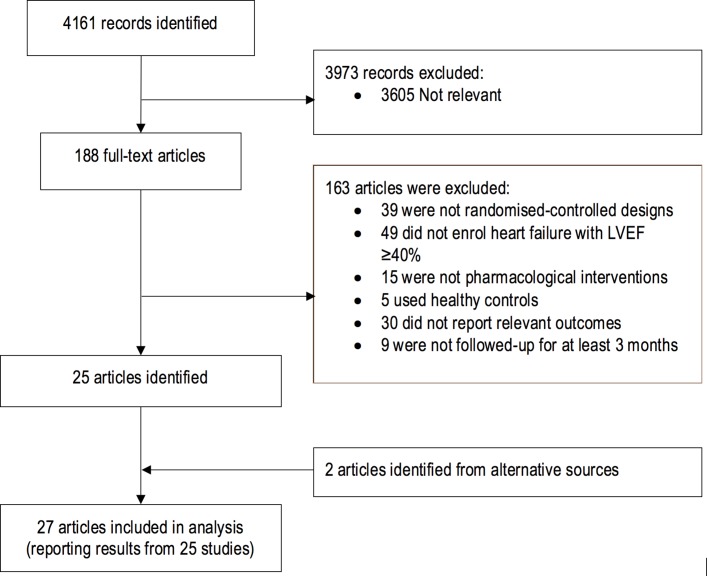
Methods: We systematically searched Medline, Embase and the Cochrane Central Register of Controlled Trials for randomised controlled trials (RCT) assessing pharmacological treatments in patients with heart failure with left ventricular (LV) ejection fraction≥40% from January 1996 to May 2016. The primary efficacy outcome was all-cause mortality. Secondary outcomes were cardiovascular mortality, heart failure hospitalisation, exercise capacity (6-min walk distance, exercise duration, VO2 max), quality of life and biomarkers (B-type natriuretic peptide, N-terminal pro-B-type natriuretic peptide). Random-effects models were used to estimate pooled relative risks (RR) for the binary outcomes, and weighted mean differences for continuous outcomes, with 95% CI.
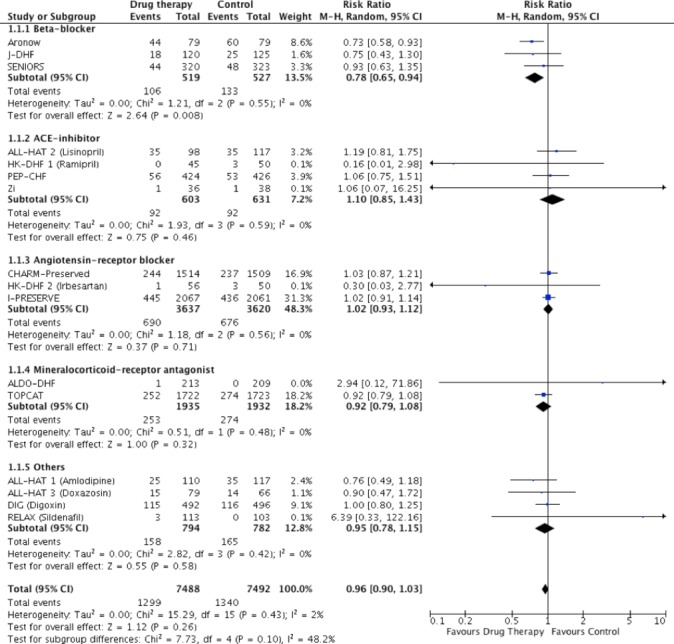
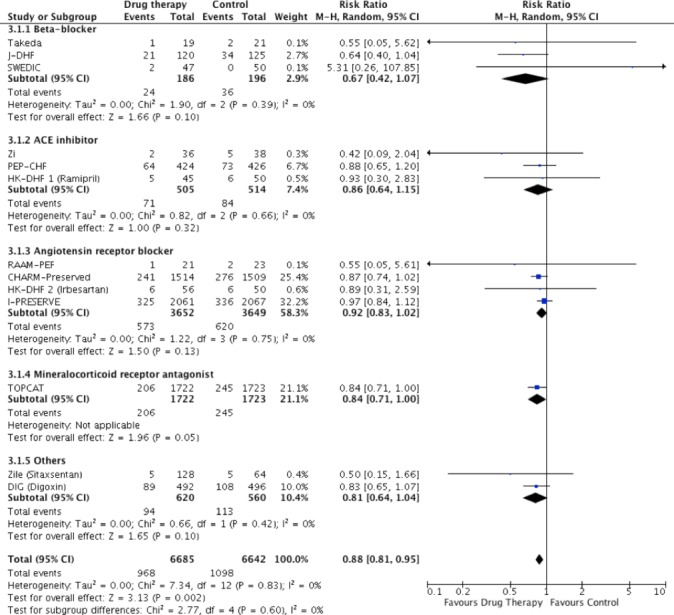
Results: We included data from 25 RCTs comprising data for 18101 patients. All-cause mortality was reduced with beta-blocker therapy compared with placebo (RR: 0.78, 95%CI 0.65 to 0.94, p=0.008). There was no effect seen with ACE inhibitors, aldosterone receptor blockers, mineralocorticoid receptor antagonists and other drug classes, compared with placebo. Similar results were observed for cardiovascular mortality. No single drug class reduced heart failure hospitalisation compared with placebo.
Conclusion: The efficacy of treatments in patients with heart failure and an LV ejection fraction≥40% differ depending on the type of therapy, with beta-blockers demonstrating reductions in all-cause and cardiovascular mortality. Further trials are warranted to confirm treatment effects of beta-blockers in this patient group.
Keywords: diastolic dysfunction; heart failure; meta-analysis; mid-range ejection fraction; preserved ejection fraction; systematic review.
© Article author(s) (or their employer(s) unless otherwise stated in the text of the article) 2018. All rights reserved. No commercial use is permitted unless otherwise expressly granted.
Conflict of interest statement
Competing interests: None declared.
Figures

Comment in
-
Pharmacological strategies in heart failure with preserved ejection fraction: time for an individualised treatment strategy?Heart. 2018 Mar;104(5):365-366. doi: 10.1136/heartjnl-2017-312119. Epub 2017 Aug 18. Heart. 2018. PMID: 28821563 No abstract available.
-
Review: In HF with preserved EF, β-blockers reduced mortality; drug treatment overall did not.Ann Intern Med. 2017 Dec 19;167(12):JC68. doi: 10.7326/ACPJC-2017-167-12-068. Ann Intern Med. 2017. PMID: 29255858 No abstract available.
-
Does the purported mortality benefit of beta-blocker therapy in heart failure with a preserved ejection fraction apply to patients without prior myocardial infarction?Heart. 2018 Jul;104(13):1135. doi: 10.1136/heartjnl-2018-313079. Heart. 2018. PMID: 29895672 No abstract available.
References
-
- Ponikowski P, Voors AA, Anker SD, et al. ESC guidelines for the diagnosis and treatment of acute and chronic heart failure: the Task Force for the diagnosis and treatment of acute and chronic heart failure of the european Society of Cardiology (ESC)Developed with the special contribution of the Heart failure association (HFA) of the ESC. European heart journal 2016. (Epub ahead of print). - PubMed
-
- Yancy CW, Jessup M, Bozkurt B, et al. American College of Cardiology Foundation American Heart Association Task Force on Practice Guidelines. 2013 ACCF/AHA guideline for the management of heart failure: a report of the American College of Cardiology Foundation/American Heart Association Task Force on Practice Guidelines. J Am Coll Cardiol 2013;62:e147–239. 10.1016/j.jacc.2013.05.019 - DOI - PubMed
Publication types
MeSH terms
Substances
Grants and funding
LinkOut - more resources
Full Text Sources
Other Literature Sources
Medical
Miscellaneous
