


Performance of self-reported HIV status in determining true HIV status among older adults in rural South Africa: a validation study
- PMID: 28782333
- PMCID: PMC5577734
- DOI: 10.7448/IAS.20.1.21691
Performance of self-reported HIV status in determining true HIV status among older adults in rural South Africa: a validation study
Abstract
Introduction: In South Africa, older adults make up a growing proportion of people living with HIV. HIV programmes are likely to reach older South Africans in home-based interventions where testing is not always feasible. We evaluate the accuracy of self-reported HIV status, which may provide useful information for targeting interventions or offer an alternative to biomarker testing.
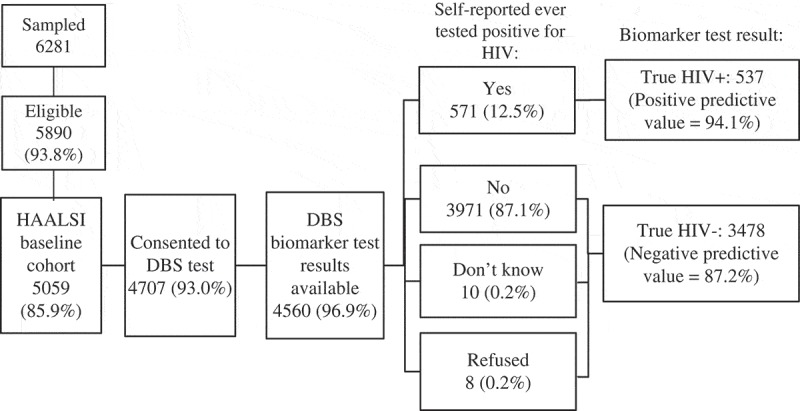
Methods: Data were taken from the Health and Aging in Africa: A Longitudinal Study of an INDEPTH Community in South Africa (HAALSI) baseline survey, which was conducted in rural Mpumalanga province, South Africa. A total of 5059 participants aged ≥40 years were interviewed from 2014 to 2015. Self-reported HIV status and dried bloodspots for HIV biomarker testing were obtained during at-home interviews. We calculated sensitivity, specificity, positive predictive value (PPV) and negative predictive value (NPV) for self-reported status compared to "gold standard" biomarker results. Log-binomial regression explored associations between demographic characteristics, antiretroviral therapy (ART) status and sensitivity of self-report.
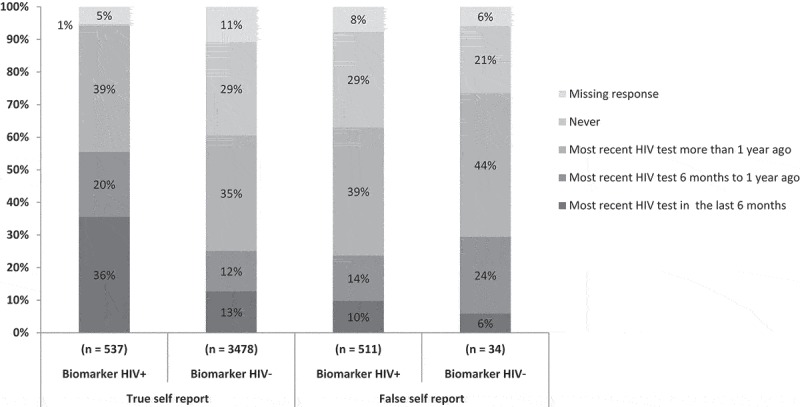
Results: Most participants (93%) consented to biomarker testing. Of those with biomarker results, 50.9% reported knowing their HIV status and accurately reported it. PPV of self-report was 94.1% (95% confidence interval (CI): 92.0-96.0), NPV was 87.2% (95% CI: 86.2-88.2), sensitivity was 51.2% (95% CI: 48.2-54.3) and specificity was 99.0% (95% CI: 98.7-99.4). Participants on ART were more likely to report their HIV-positive status, and participants reporting false-negatives were more likely to have older HIV tests.
Conclusions: The majority of participants were willing to share their HIV status. False-negative reports were largely explained by lack of testing, suggesting HIV stigma is retreating in this setting, and that expansion of HIV testing and retesting is still needed in this population. In HIV interventions where testing is not possible, self-reported status should be considered as a routine first step to establish HIV status.
Keywords: HIV status; South Africa; Validation study; older adults; public health; self-report.
Conflict of interest statement
The authors declare that they have no competing interests.
Figures
References
-
- UNAIDS South Africa HIV and AIDS estimates. 2014. [cited 2015 December1]. Available from: www.unaids.org/en/regionscountries/countries/southafrica
-
- Mutevedzi PC, Newell M.. The changing face of the HIV epidemic in sub-Saharan Africa. Tmih. 2014;19(9):1015–7. - PubMed
Publication types
MeSH terms
Grants and funding
- 058893/Z/99/A/WT_/Wellcome Trust/United Kingdom
- P01-AG041710/NH/NIH HHS/United States
- D43 TW009775/TW/FIC NIH HHS/United States
- R01 HD084233/HD/NICHD NIH HHS/United States
- R01-AI124389/NH/NIH HHS/United States
- R01 AI124389/AI/NIAID NIH HHS/United States
- P01 AG041710/AG/NIA NIH HHS/United States
- R01 AI112339/AI/NIAID NIH HHS/United States
- 085477/B/08/Z/WT_/Wellcome Trust/United Kingdom
- R01-HD084233/NH/NIH HHS/United States
- 069683/Z/02/Z/WT_/Wellcome Trust/United Kingdom
- 085477/Z/08/Z/WT_/Wellcome Trust/United Kingdom
LinkOut - more resources
Full Text Sources
Other Literature Sources
Medical
