Review
. 2017 Oct:111:40-50.
doi: 10.1016/j.yjmcc.2017.08.002. Epub 2017 Aug 3.

Exosomes as agents of change in the cardiovascular system

Affiliations
Review

Exosomes as agents of change in the cardiovascular system

A J Poe et al. J Mol Cell Cardiol. 2017 Oct.

Abstract

Exosomes have an evolving role in paracrine and autocrine signaling, which is enhanced because these lipid vesicles are quite stable and can deliver miRNA, DNA, protein and other molecules to cells throughout the body. Most cell types release exosomes, and exosomes are found in all biological fluids, making them accessible biomarkers. Significantly, exosomes can carry a biologically potent cargo, which can alter the phenotype of recipient cells. In the cardiovascular system exosomes have been primarily studied for their role in mediating the beneficial effects of mesenchymal stem cells after myocardial injury. Exosomes released by cardiac cells in disease states, such as myocardial ischemia, can potentially have important pathophysiologic effects on other cardiac cells as well as on distant organs.

Keywords: Biomarker; Cardiac injury; Cardioprotection; Exosome; Mesenchymal stem cell; Microvesicle.


Figures

Figure 1
Figure 1
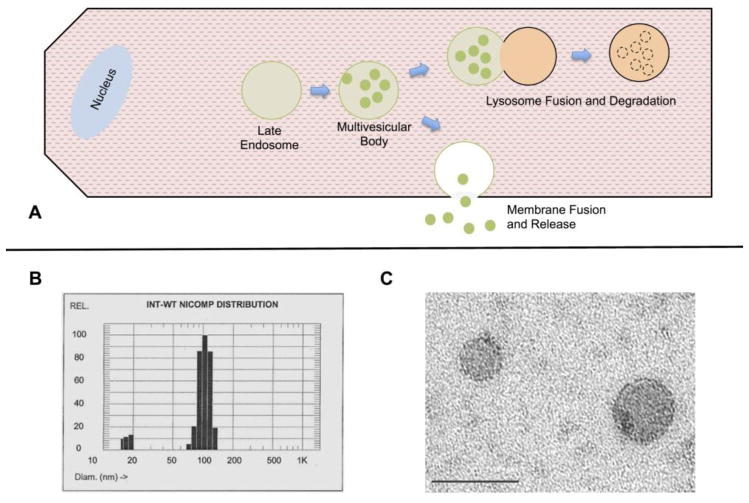
A) Overview of exosome production. Invagination of the multivesicular body (MVB) forms intraluminal vesicles (ILVs). The MVB can either fuse with the lysosome for degradation or fuse with the cell membrane to release the ILVs as exosomes. B) Particle sizing of exosomes from rat cardiac myocytes treated with brief hypoxia/reoxygenation. Exosomes in solution have a peak hydrodynamic radius in the 100nm range. C) Electron micrograph of exosomes isolated from rat plasma, bar is 100nm.
Figure 2
Figure 2
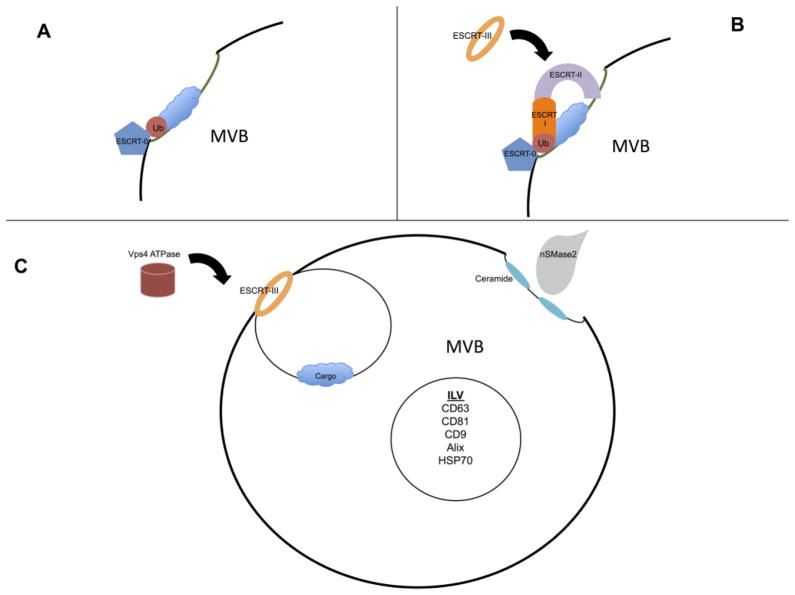
A) ESCRT-0 binds ubiquitinated cargo and localizes to the MVB membrane. B) Subsequently ESCRT-I and ESCRT-II are recruited to the limiting endosomal membrane. The ends of ESCRT-II are then able to recruit and activate the ESCRT-III machinery. C) Activation of ESCRT-III causes budding of the vesicle into the endosome lumen. The ATPase vacuolar protein sorting-associated protein 4 (Vps4) is needed to provide energy to allow for disassembly and recycling of the ESCRT machinery. In a non-ESCRT related pathway, nSMase2 produces ceramide at the endosomal membrane, which results in membrane curvature and ILV budding.

References

    1. Pan BT, Teng K, Wu C, Adam M, Johnstone RM. Electron microscopic evidence for externalization of the transferrin receptor in vesicular form in sheep reticulocytes. J Cell Biol. 1985;101(3):942–8. - PMC - PubMed
    1. Harding C, Heuser J, Stahl P. Receptor-mediated endocytosis of transferrin and recycling of the transferrin receptor in rat reticulocytes. J Cell Biol. 1983;97(2):329–39. - PMC - PubMed
    1. van Niel G, Porto-Carreiro I, Simoes S, Raposo G. Exosomes: a common pathway for a specialized function. J Biochem. 2006;140(1):13–21. - PubMed
    1. Skog J, Wurdinger T, van Rijn S, Meijer DH, Gainche L, Sena-Esteves M, Curry WT, Jr, Carter BS, Krichevsky AM, Breakefield XO. Glioblastoma microvesicles transport RNA and proteins that promote tumour growth and provide diagnostic biomarkers. Nat Cell Biol. 2008;10(12):1470–6. - PMC - PubMed
    1. Meckes DG, Raab-Traub N. Microvesicles and Viral Infection. Journal of Virology. 2011;85(24):12844–12854. - PMC - PubMed

Publication types