


Role of Salivary Biomarkers in Detection of Cardiovascular Diseases (CVD)
- PMID: 28783097
- PMCID: PMC5620538
- DOI: 10.3390/proteomes5030021
Role of Salivary Biomarkers in Detection of Cardiovascular Diseases (CVD)
Abstract
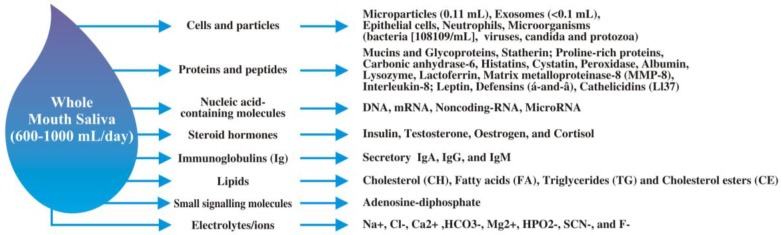
Human whole mouth saliva (WMS) is secreted by salivary glands, namely parotid, submandibular/sublingual and other minor glands of the oral cavity. It is secreted in a systematic way, and contain informative proteins and peptides for the early detection of contagious diseases and organ-related diseases. The role of WMS as a liquid biopsy for the detection of cardiovascular diseases (CVD) through Myoglobin (MYO), Cardiac troponin I (cTnI), Creatine phosphokinase MB (CK-MB), Myeloperoxidase (MPO), brain natriuretic peptide (NT-proBNP), Exosomal miRNA, C-Reactive Protein (CRP), Matrix metalloproteinase-8 (MMP-8), MMP-9 and tissue inhibitor of MMP-8 (TIMP-1), leukotriene B4 has been well reported in last decade, that have been reviewed in the literature comprehensively below.
Keywords: biomarkers; cardiovascular diseases and diagnosis; proteins; saliva.
Conflict of interest statement
The authors declare no conflict of interest.
Figures
References
-
- Miller C.S., Foley J.D., Floriano P.N., Christodoulides N., Ebersole J.L., Campbell C.L., Bailey A.L., Rose B.G., Kinane D.F., Novak M.J., et al. Utility of Salivary Biomarkers for Demonstrating Acute Myocardial Infarction. J. Dent. Res. 2014;93:72S–79S. doi: 10.1177/0022034514537522. - DOI - PMC - PubMed
Publication types
LinkOut - more resources
Full Text Sources
Other Literature Sources
Research Materials
Miscellaneous
