


Virulence of invasive Salmonella Typhimurium ST313 in animal models of infection
- PMID: 28783750
- PMCID: PMC5559095
- DOI: 10.1371/journal.pntd.0005697
Virulence of invasive Salmonella Typhimurium ST313 in animal models of infection
Abstract
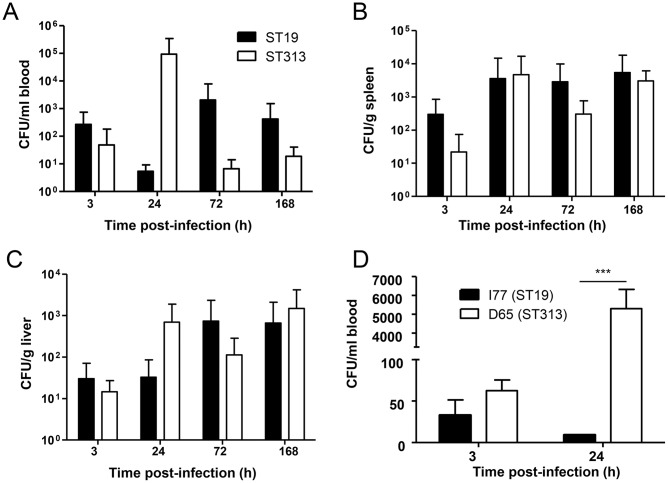
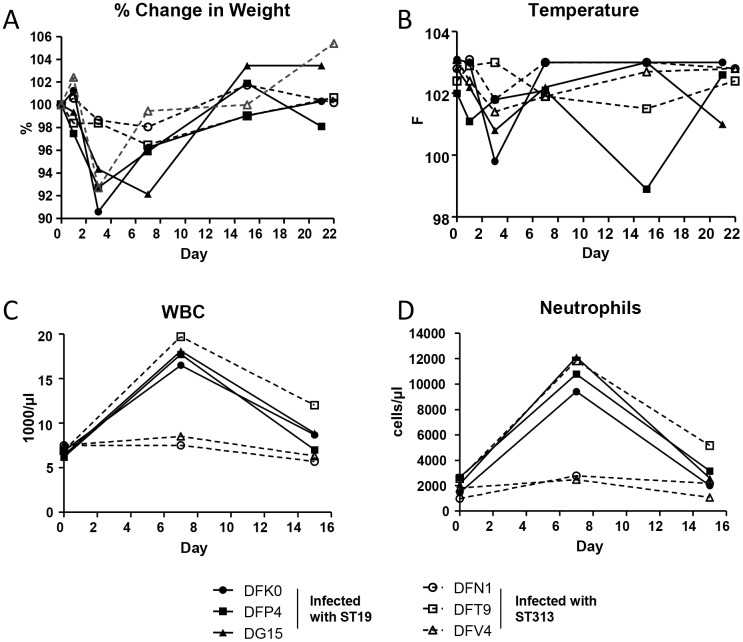
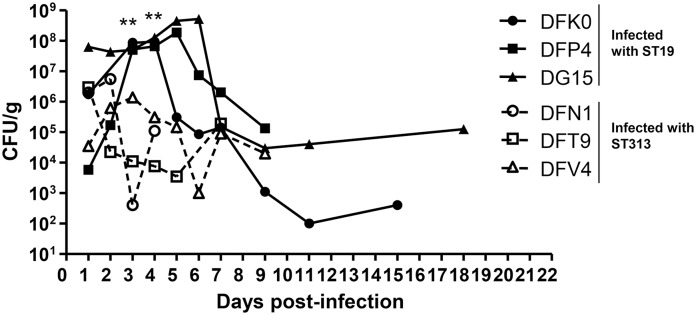
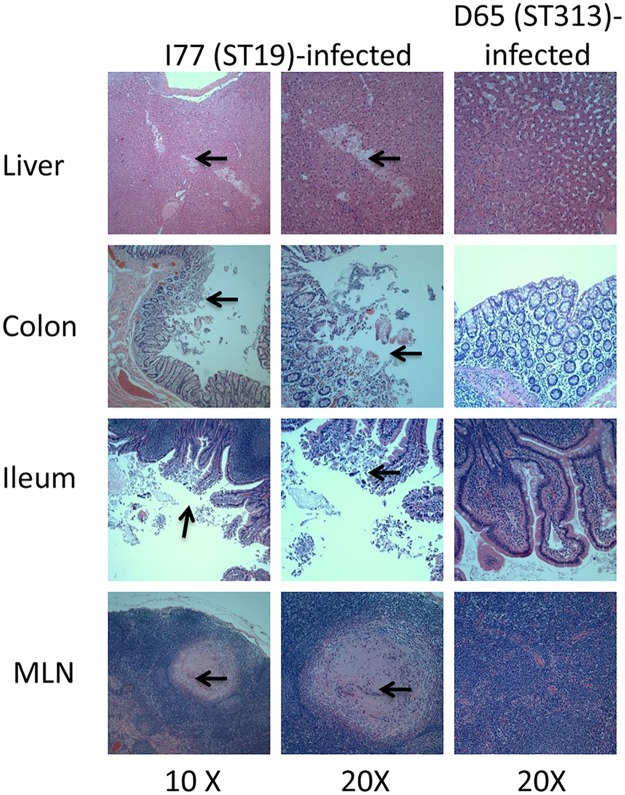
Salmonella Typhimurium sequence type (ST) 313 produces septicemia in infants in sub-Saharan Africa. Although there are known genetic and phenotypic differences between ST313 strains and gastroenteritis-associated ST19 strains, conflicting data about the in vivo virulence of ST313 strains have been reported. To resolve these differences, we tested clinical Salmonella Typhimurium ST313 and ST19 strains in murine and rhesus macaque infection models. The 50% lethal dose (LD50) was determined for three Salmonella Typhimurium ST19 and ST313 strains in mice. For dissemination studies, bacterial burden in organs was determined at various time-points post-challenge. Indian rhesus macaques were infected with one ST19 and one ST313 strain. Animals were monitored for clinical signs and bacterial burden and pathology were determined. The LD50 values for ST19 and ST313 infected mice were not significantly different. However, ST313-infected BALB/c mice had significantly higher bacterial numbers in blood at 24 h than ST19-infected mice. ST19-infected rhesus macaques exhibited moderate-to-severe diarrhea while ST313-infected monkeys showed no-to-mild diarrhea. ST19-infected monkeys had higher bacterial burden and increased inflammation in tissues. Our data suggest that Salmonella Typhimurium ST313 invasiveness may be investigated using mice. The non-human primate results are consistent with clinical data, suggesting that ST313 strains do not cause diarrhea.
Conflict of interest statement
I have read the journal's policy and the authors of this manuscript have the following competing interests: SMT has US patents 9,050,283 and 9,011,871 issued to develop vaccines against invasive NTS.
Figures
References
-
- Feasey NA, Dougan G, Kingsley RA, Heyderman RS, Gordon MA (2012) Invasive non-typhoidal Salmonella disease: an emerging and neglected tropical disease in Africa. Lancet 379: 2489–2499. doi: 10.1016/S0140-6736(11)61752-2 - DOI - PMC - PubMed
-
- Gordon MA (2008) Salmonella infections in immunocompromised adults. J Infect 56: 413–422. doi: 10.1016/j.jinf.2008.03.012 - DOI - PubMed
-
- Kingsley RA, Msefula CL, Thomson NR, Kariuki S, Holt KE, et al. (2009) Epidemic multiple drug resistant Salmonella Typhimurium causing invasive disease in sub-Saharan Africa have a distinct genotype. Genome Res 19: 2279–2287. doi: 10.1101/gr.091017.109 - DOI - PMC - PubMed
-
- Achtman M, Wain J, Weill FX, Nair S, Zhou Z, et al. (2012) Multilocus sequence typing as a replacement for serotyping in Salmonella enterica. PLoS Pathog 8: e1002776 doi: 10.1371/journal.ppat.1002776 - DOI - PMC - PubMed
MeSH terms
Grants and funding
LinkOut - more resources
Full Text Sources
Other Literature Sources
