Associations Between Midlife Vascular Risk Factors and 25-Year Incident Dementia in the Atherosclerosis Risk in Communities (ARIC) Cohort
- PMID: 28783817
- PMCID: PMC5710244
- DOI: 10.1001/jamaneurol.2017.1658
Associations Between Midlife Vascular Risk Factors and 25-Year Incident Dementia in the Atherosclerosis Risk in Communities (ARIC) Cohort
Abstract
Importance: Vascular risk factors have been associated with cognitive decline. Midlife exposure to these factors may be most important in conferring late-life risk of cognitive impairment.
Objectives: To examine Atherosclerosis Risk in Communities (ARIC) participants in midlife and to explore associations between midlife vascular risk factors and 25-year dementia incidence.
Design, setting, and participants: This prospective cohort investigation of the Atherosclerosis Risk in Communities (ARIC) Study was conducted from 1987-1989 through 2011-2013. The dates of this analysis were April 2015 through August 2016. The setting was ARIC field centers (Washington County, Maryland; Forsyth County, North Carolina; Jackson, Mississippi; and Minneapolis suburbs, Minnesota). The study comprised 15 744 participants (of whom 27.1% were black and 72.9% white) who were aged 44 to 66 years at baseline.
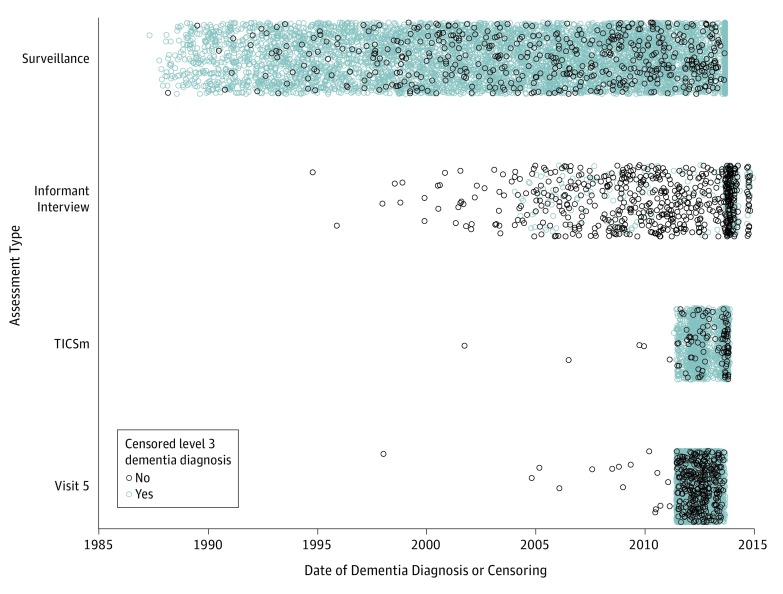
Main outcomes and measures: Demographic and vascular risk factors were measured at baseline (obesity, smoking, diabetes, prehypertension, hypertension, and hypercholesterolemia) as well as presence of the APOE ε4 genotype. After the baseline visit, participants had 4 additional in-person visits, for a total of 5 in-person visits, hospitalization surveillance, telephone calls, and repeated cognitive evaluations. Most recently, in 2011-2013, through the ARIC Neurocognitive Study (ARIC-NCS), participants underwent a detailed neurocognitive battery, informant interviews, and adjudicated review to define dementia cases. Additional cases were identified through the Telephone Interview for Cognitive Status-Modified or informant interview, for participants not attending the ARIC-NCS visit, or by an International Classification of Diseases, Ninth Revision dementia code during a hospitalization. Fully adjusted Cox proportional hazards regression was used to evaluate associations of baseline vascular and demographic risk factors with dementia.
Results: In total, 1516 cases of dementia (57.0% female and 34.9% black, with a mean [SD] age at visit 1 of 57.4 [5.2] years) were identified among 15 744 participants. Black race (hazard ratio [HR], 1.36; 95% CI, 1.21-1.54), older age (HR, 8.06; 95% CI, 6.69-9.72 for participants aged 60-66 years), lower educational attainment (HR, 1.61; 95% CI, 1.28-2.03 for less than a high school education), and APOE ε4 genotype (HR, 1.98; 95% CI, 1.78-2.21) were associated with increased risk of dementia, as were midlife smoking (HR, 1.41; 95% CI, 1.23-1.61), diabetes (HR, 1.77; 95% CI, 1.53-2.04), prehypertension (HR, 1.31; 95% CI, 1.14-1.51), and hypertension (HR, 1.39; 95% CI, 1.22-1.59). The HR for dementia for diabetes was almost as high as that for APOE ε4 genotype.
Conclusions and relevance: Midlife vascular risk factors are associated with increased risk of dementia in black and white ARIC Study participants. Further studies are needed to evaluate the mechanism of and opportunities for prevention of the cognitive sequelae of these risk factors in midlife.
Conflict of interest statement
Figures

References
-
- Swan GE, DeCarli C, Miller BL, et al. Association of midlife blood pressure to late-life cognitive decline and brain morphology. Neurology. 1998;51(4):986-993. - PubMed
-
- Launer LJ, Masaki K, Petrovitch H, Foley D, Havlik RJ. The association between midlife blood pressure levels and late-life cognitive function: the Honolulu-Asia Aging Study. JAMA. 1995;274(23):1846-1851. - PubMed
MeSH terms
Grants and funding
LinkOut - more resources
Full Text Sources
Other Literature Sources
Medical
Miscellaneous