Review
. 2017 Oct 6:33:265-289.
doi: 10.1146/annurev-cellbio-100616-060531. Epub 2017 Aug 7.

The Three-Dimensional Organization of Mammalian Genomes

Affiliations
Review

The Three-Dimensional Organization of Mammalian Genomes

Miao Yu et al. Annu Rev Cell Dev Biol. .

Abstract

Animal development depends on not only the linear genome sequence that embeds millions of cis-regulatory elements, but also the three-dimensional (3D) chromatin architecture that orchestrates the interplay between cis-regulatory elements and their target genes. Compared to our knowledge of the cis-regulatory sequences, the understanding of the 3D genome organization in human and other eukaryotes is still limited. Recent advances in technologies to map the 3D genome architecture have greatly accelerated the pace of discovery. Here, we review emerging concepts of chromatin organization in mammalian cells, discuss the dynamics of chromatin conformation during development, and highlight important roles for chromatin organization in cancer and other human diseases.

Keywords: 3D chromatin organization; TAD; chromosome conformation capture; gene regulation; topologically associating domain.


Figures
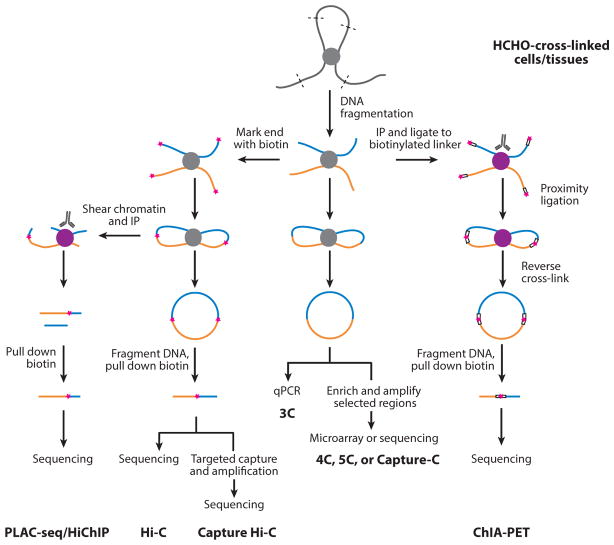
Figure 1
Figure 1
Brief overview of the C-technologies. All C-technologies share the steps of formaldehyde cross-linking, DNA fragmentation, and proximity ligation but may differ in whether to label the fragment end with biotin, the strategy to enrich the regions of interest, and the quantification methods. The biotin label is represented by the pink star. Abbreviation: IP, immunoprecipitation.
Figure 2
Figure 2
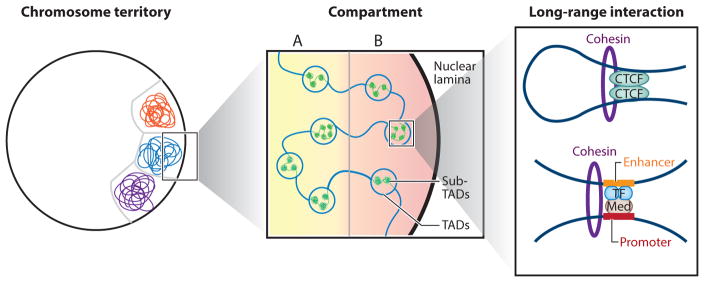
Hierarchical genome organization in mammals. From a large to a fine scale, chromosome territory, compartment A/B, topologically associating domains (TADs), sub-TADs, and long-range interaction can be observed (left to right). (Left) Each chromosome territory is denoted by different colors. Only three chromosomes are shown. (Middle) Compartments A and B are indicated by a yellow and pink background, respectively. Compartment B is correlated with nuclear lamina. TADs are represented by large indigo circles, whereas the inner sub-TADs are shown as smaller green circles. (Right) Two types of long-range interactions are shown: One interaction is a CTCF-CTCF loop mediated by the Cohesin complex, whereas the other is between the promoter and the enhancer that often involves the Mediator (Med) complex, the Cohesin complex, and lineage-specific transcription factors.
Figure 3
Figure 3
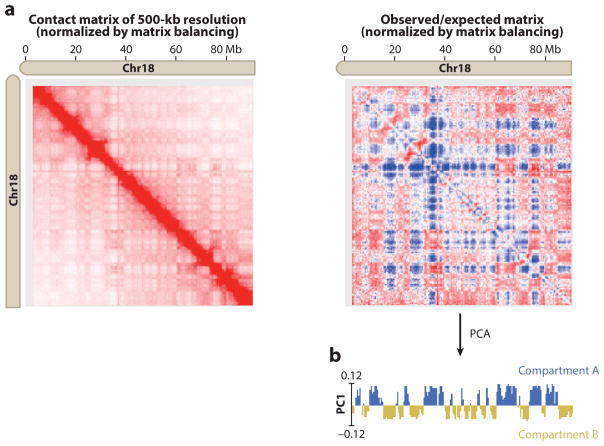
Hi-C data reveal two types of compartments in each chromosome. (a) A plaid pattern emerges after transforming the Hi-C contact matrix (left) to the observed/expected matrix (right), suggesting the presence of two compartments. Contacts within the same compartment are enriched, whereas contacts between different compartments are depleted. The Hi-C data are from mouse embryonic stem cells (Fang et al. 2016) and are visualized with Juicebox (Durand et al. 2016). (b) Principal-component analysis (PCA) on the observed/expected matrix partitions each chromosome into two compartments, A and B, based on the first principal component (PC1).
Figure 4
Figure 4
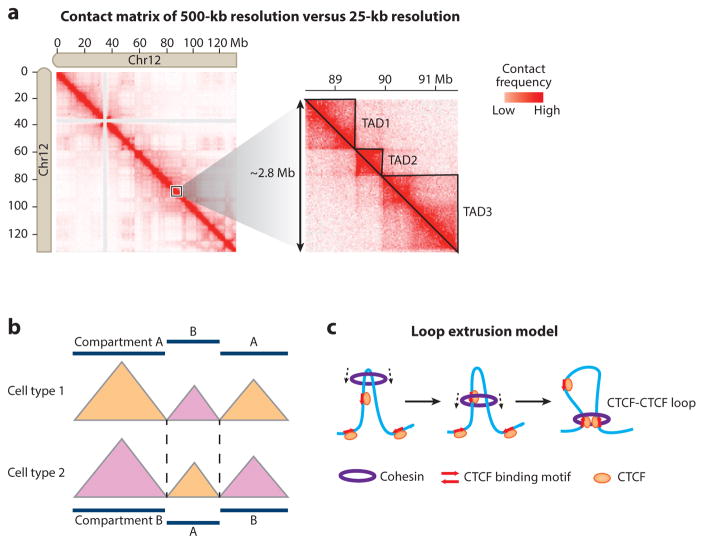
Identification and characterization of topologically associating domains (TADs). (a) (Left) Cis-contact matrix for chromosome 12 from human embryonic stem cells at 500-kb resolution. (Right) A detailed contact matrix of an ~2.8-Mb region at 25-kb resolution reveals TAD organization as triangles. TAD1–3 are manually annotated and indicated by solid lines. The Hi-C data are taken from Dixon et al. (2012) and are visualized with Juicebox (Durand et al. 2016). (b) The position of TAD boundaries is largely conserved between different cell types, but TADs may transit between different compartments. (c) TAD formation by loop extrusion. The Cohesin complex forms a ring structure and travels along the DNA fiber, extruding a progressively larger loop until it is stalled by bound CTCF with convergent orientation (red arrows).
Figure 5
Figure 5
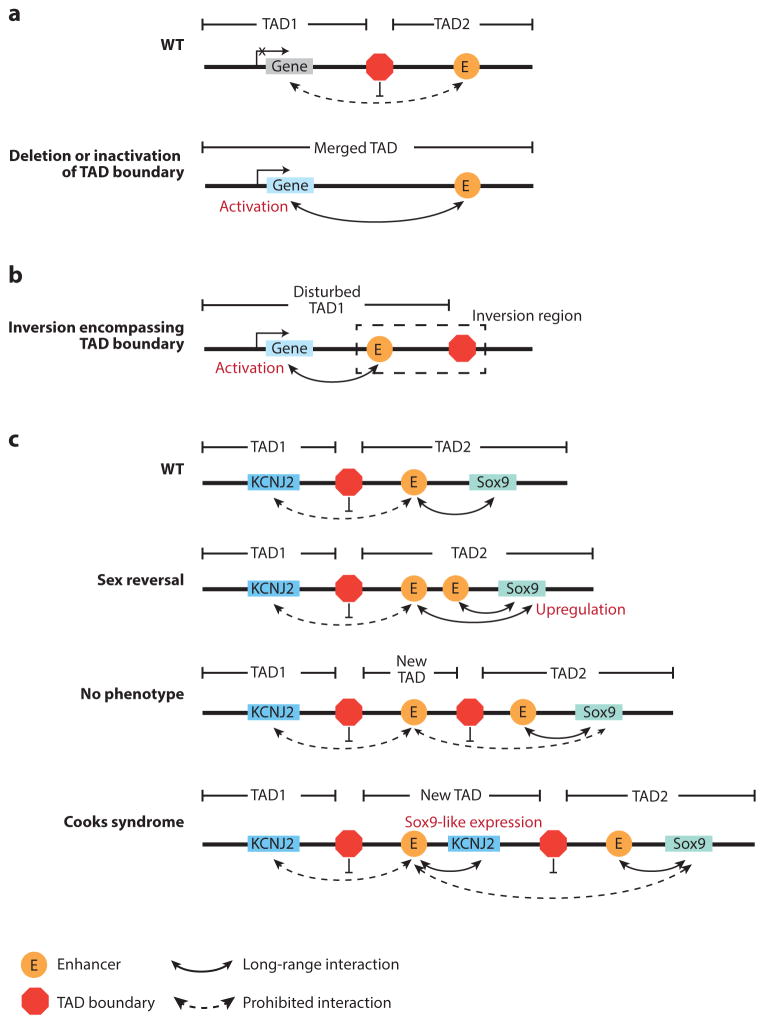
Dysregulation of gene expression by alteration of topologically associating domain (TAD) boundaries. (a) Deletion or inactivation of a TAD boundary can cause the merger of two neighborhood TADs, allowing the enhancer to activate new genes. (b) Similarly, inversion may also bring the enhancer and an irrelevant gene into the same TAD, leading to the gene’s activation. (c) The effect of duplication depends on its size and position, as exemplified around the Sox9 locus (Franke et al. 2016). WT denotes wild type.

References

    1. Apostolou E, Ferrari F, Walsh RM, Bar-Nur O, Stadtfeld M, et al. Genome-wide chromatin interactions of the Nanog locus in pluripotency, differentiation, and reprogramming. Cell Stem Cell. 2013;12(6):699–712. - PMC - PubMed
    1. Battulin N, Fishman VS, Mazur AM, Pomaznoy M, Khabarova AA, et al. Comparison of the three-dimensional organization of sperm and fibroblast genomes using the Hi-C approach. Genome Biol. 2015;16(1):77. - PMC - PubMed
    1. Beagan JA, Gilgenast TG, Kim J, Plona Z, Norton HK, et al. Local genome topology can exhibit an incompletely rewired 3D-folding state during somatic cell reprogramming. Cell Stem Cell. 2016;18(5):611–24. - PMC - PubMed
    1. Beliveau BJ, Apostolopoulos N, Wu C-T. Visualizing genomes with Oligopaint FISH probes. Curr Protoc Mol Biol. 2014;105:14.23.1–20. - PMC - PubMed
    1. Benedetti F, Dorier J, Burnier Y, Stasiak A. Models that include supercoiling of topological domains reproduce several known features of interphase chromosomes. Nucleic Acids Res. 2014;42(5):2848–55. - PMC - PubMed

Publication types