. 2017 Aug 7;16(1):138.
doi: 10.1186/s12934-017-0737-2.

Structure and application of antifreeze proteins from Antarctic bacteria

Affiliations

Structure and application of antifreeze proteins from Antarctic bacteria

Patricio A Muñoz et al. Microb Cell Fact. .

Abstract

Background: Antifreeze proteins (AFPs) production is a survival strategy of psychrophiles in ice. These proteins have potential in frozen food industry avoiding the damage in the structure of animal or vegetal foods. Moreover, there is not much information regarding the interaction of Antarctic bacterial AFPs with ice, and new determinations are needed to understand the behaviour of these proteins at the water/ice interface.

Results: Different Antarctic places were screened for antifreeze activity and microorganisms were selected for the presence of thermal hysteresis in their crude extracts. Isolates GU1.7.1, GU3.1.1, and AFP5.1 showed higher thermal hysteresis and were characterized using a polyphasic approach. Studies using cucumber and zucchini samples showed cellular protection when samples were treated with partially purified AFPs or a commercial AFP as was determined using toluidine blue O and neutral red staining. Additionally, genome analysis of these isolates revealed the presence of genes that encode for putative AFPs. Deduced amino acids sequences from GU3.1.1 (gu3A and gu3B) and AFP5.1 (afp5A) showed high similarity to reported AFPs which crystal structures are solved, allowing then generating homology models. Modelled proteins showed a triangular prism form similar to β-helix AFPs with a linear distribution of threonine residues at one side of the prism that could correspond to the putative ice binding side. The statistically best models were used to build a protein-water system. Molecular dynamics simulations were then performed to compare the antifreezing behaviour of these AFPs at the ice/water interface. Docking and molecular dynamics simulations revealed that gu3B could have the most efficient antifreezing behavior, but gu3A could have a higher affinity for ice.

Conclusions: AFPs from Antarctic microorganisms GU1.7.1, GU3.1.1 and AFP5.1 protect cellular structures of frozen food showing a potential for frozen food industry. Modeled proteins possess a β-helix structure, and molecular docking analysis revealed the AFP gu3B could be the most efficient AFPs in order to avoid the formation of ice crystals, even when gu3A has a higher affinity for ice. By determining the interaction of AFPs at the ice/water interface, it will be possible to understand the process of adaptation of psychrophilic bacteria to Antarctic ice.

Keywords: Antarctica; Antifreeze proteins; Frozen food; Ice binding proteins; Psychrophiles.


Figures
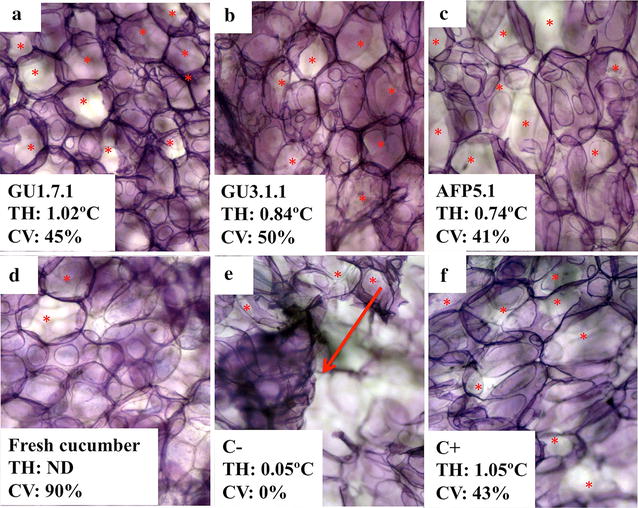
Fig. 1
Fig. 1
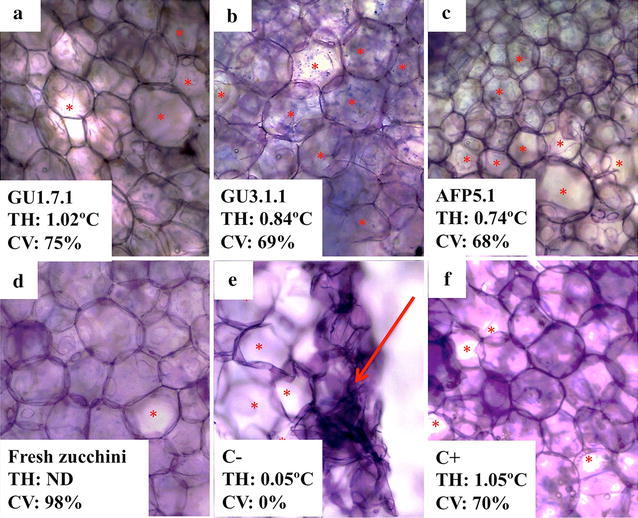
Effect of AFPs from GU1.7.1 (a), GU3.1.1 (b) and AFP5.1 (c) on cucumber. Negative (C−, e) and positive (C+, f) controls correspond to samples treated with buffer and a commercial AFP, respectively. Plant cells were stained with TBO. TH of AFPs from Antarctic isolates and plant cell viability (CV), determined by NR staining, are indicated in each image. A fresh cucumber sample (d) was included in order to compare results. Red asterisks represent small holes formed from small ice crystal; meanwhile, red arrows indicate high cellular damage product of cellular disruption due to the presence of big ice crystals. ND not determined
Fig. 2
Fig. 2
Effect of AFPs from GU1.7.1 (a), GU3.1.1 (b) and AFP5.1 (c) on zucchini. Negative (C−, e) and positive (C+, f) controls correspond to samples treated with buffer and a commercial AFP, respectively. Plant cells were stained with TBO. TH of AFPs from Antarctic isolates and plant cell viability (CV), determined by NR staining, are indicated in each image. A fresh zucchini sample (d) was included in order to compare results. Red asterisks represent small holes formed from small ice crystal; meanwhile, red arrows indicate high cellular damage product of cellular disruption due to the presence of big ice crystals. ND not determined
Fig. 3
Fig. 3
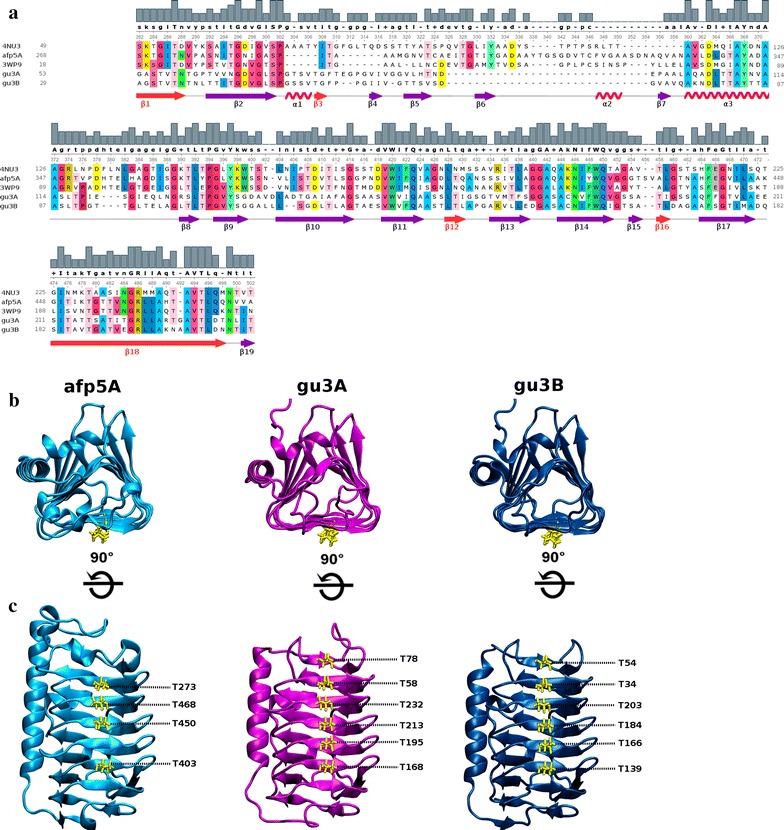
Cartoon representations of AFP models of afp5A (cyan), gu3A (magenta), and gu3B (blue). a Front view of triangular prisms. b Stereoviews showing the putative binding surface with ordered threonine residues (yellow). Images were generated using VMD. c Multiple sequence alignment of class III AFPs of the putative antifreeze proteins gu3A and gu3B (GU3.1.1) and afp5A (AFP5.1) and their respective templates for homology modeling, 3WP9 (hyperactive antifreeze protein from Colwellia sp.) and 4NU3, (hyperactive antifreeze protein from Flavobacterium frigoris). The region shown in the alignment corresponds only to the DUF3494 conserved domains of the sequences. Conserved amino acids in at least three of the aligned sequences are shown in colors, being each amino acid colored with a different color. Histogram bars and uppercase/lowercase letters in the consensus sequence indicate the level of conservation of the residues at each position of the alignment. Arrows and ribbons represent β-strands and α-helices, respectively. β-strands in red (β1, β3, β12, β16, β18) correspond to the β-strands located on the putative ice-binding surface of the AFPs
Fig. 4
Fig. 4
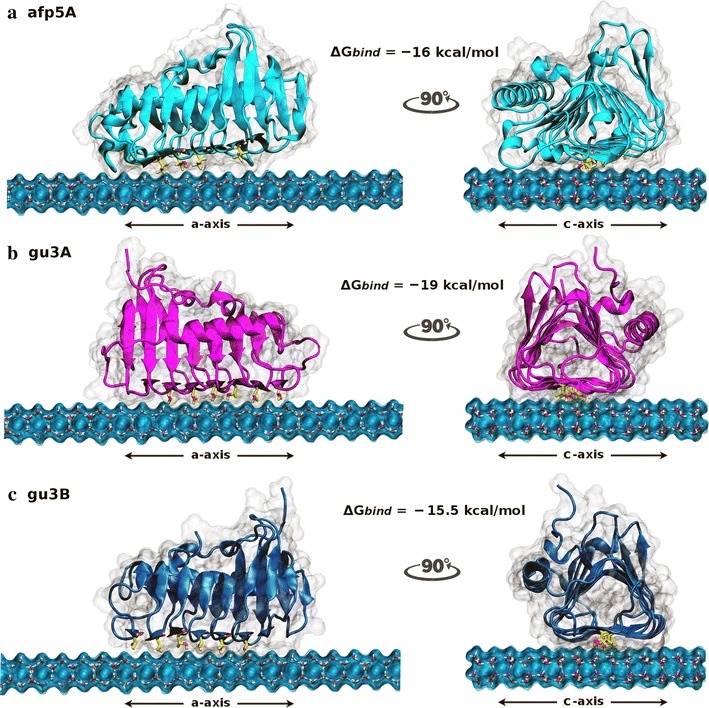
Side views of the final docking orientations of afp5A (a), gu3A (b) y gu3B (c). a-Axis view (left) and c-axis (right) of the docked conformations of AFPs over the primary prism plane of ice. Docking binding energies obtained are shown for each protein. Regularly spaced threonine residues in the ice-binding surface of the proteins are shown in yellow. All docking simulations were performed with Autodock Vina. All images were generated with VMD
Fig. 5
Fig. 5
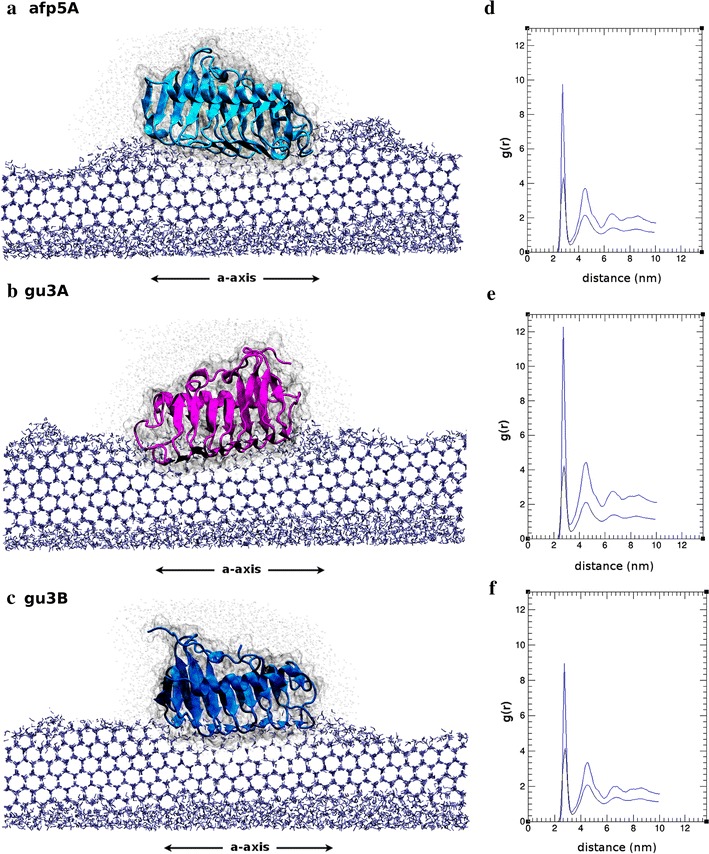
Front view (a-axis) of simulated AFPs afp5A (a), gu3A (b), gu3B (c) and the corresponding oxygen–oxygen radial distribution functions (df). In RDF graphs blue lines correspond to g(r) distribution calculated at the end (150 ns) of each simulation whilst the black lines correspond to the same function calculated at the start of molecular dynamics simulations. Simulations were carried out using NAMD software. All images were generated using VMD

References

    1. Wilkins D, Yau S, Williams TJ, Allen MA, Brown MV, DeMaere MZ, Lauro FM, Cavicchioli R. Key microbial drivers in Antarctic aquatic environments. FEMS Microbiol Rev. 2013;37:303–335. doi: 10.1111/1574-6976.12007. - DOI - PubMed
    1. D’Amico S, Collins T, Marx JC, Feller G, Gerday C. Psychrophilic microorganisms: challenges for life. EMBO Rep. 2006;7:385–389. doi: 10.1038/sj.embor.7400662. - DOI - PMC - PubMed
    1. De Maayer P, Anderson D, Cary C, Cowan DA. Some like it cold: understanding the survival strategies of psychrophiles. EMBO Rep. 2014;15:508–517. doi: 10.1002/embr.201338170. - DOI - PMC - PubMed
    1. Devries A, Wohlschl D. Freezing resistance in some Antarctic fishes. Science. 1969;163:1073–1075. doi: 10.1126/science.163.3871.1073. - DOI - PubMed
    1. Duman J, Devries A. Freezing resistance in winter flounder Pseudopleuronectes americanus. Nature. 1974;247:237–238. doi: 10.1038/247237a0. - DOI

MeSH terms