


Pregnancy, pregnancy loss, and the risk of cardiovascular disease in Chinese women: findings from the China Kadoorie Biobank
- PMID: 28784170
- PMCID: PMC5547470
- DOI: 10.1186/s12916-017-0912-7
Pregnancy, pregnancy loss, and the risk of cardiovascular disease in Chinese women: findings from the China Kadoorie Biobank
Abstract
Background: Pregnancy and pregnancy loss may be linked to cardiovascular disease (CVD). However, the evidence is still inconsistent, especially in East Asians, whose reproductive patterns differ importantly from those in the West. We examined the associations of pregnancy, miscarriage, induced abortion, and stillbirth with CVD incidence among Chinese women.
Methods: In 2004-2008, the nationwide China Kadoorie Biobank recruited 302,669 women aged 30-79 years from ten diverse localities. During 7 years of follow-up, 43,968 incident cases of circulatory disease, 14,440 of coronary heart disease, and 19,925 of stroke (including 11,430 ischaemic and 2170 haemorrhagic strokes), were recorded among 289,573 women without prior CVD at baseline. Cox regression yielded multiple adjusted hazard ratios (HRs) for CVD risks associated with pregnancy outcomes.
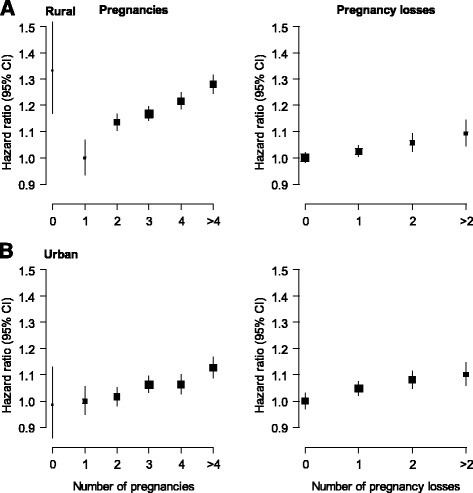
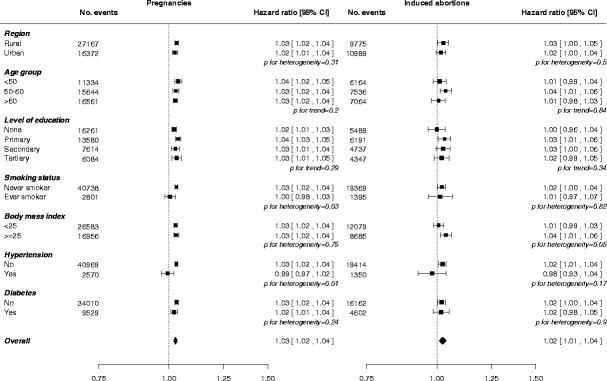
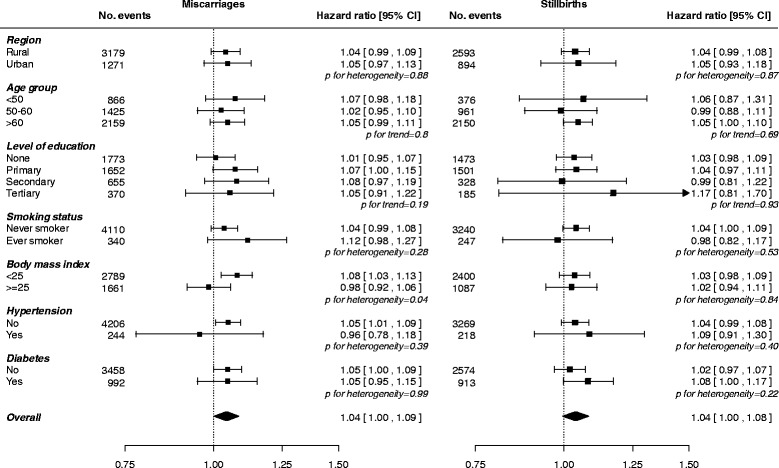
Results: Overall, 99% of women had been pregnant, and among them 10%, 53%, and 7% reported having a history of miscarriage, induced abortion, and stillbirth, respectively. Each additional pregnancy was associated with an adjusted HR of 1.03 (95% confidence interval, CI: 1.02; 1.04) for circulatory disease. A history of miscarriage, induced abortion, and stillbirth, respectively, were associated with adjusted HRs of 1.04 (1.01; 1.07), 1.04 (1.02; 1.07), and 1.07 (1.03; 1.11) for circulatory disease. The relationship was stronger with recurrent pregnancy loss; adjusted HRs for each additional loss being 1.04 (1.00; 1.09) for miscarriage, 1.02 (1.01; 1.04) for induced abortion, and 1.04 (1.00; 1.08) for stillbirth.
Conclusions: Among Chinese women, increases in pregnancy, and a history and recurrence of miscarriage, induced abortion, and stillbirth are each associated with a higher risk of CVD.
Conflict of interest statement
Ethics approval and consent to participate
Central ethical approvals were obtained from Oxford University and the China National CDC. Approvals were also obtained from institutional research boards at the local CDCs in the ten areas; Qingdao, Qingdao CDC; Heilongjiang, Provincial CDC; Hainan, Provincial CDC; Jiangsu, Provincial CDC; Guangxi, Provincial CDC; Sichuan, Provincial CDC; Gansu, Provincial CDC; Henan, Provincial CDC; Zhejiang, Provincial CDC; Hunan, Provincial CDC.
Consent for publication
Not applicable.
Competing interests
The authors declare that they have no competing interests.
Publisher’s Note
Springer Nature remains neutral with regard to jurisdictional claims in published maps and institutional affiliations.
Figures
References
MeSH terms
Grants and funding
LinkOut - more resources
Full Text Sources
Other Literature Sources
Medical
