. 2017 Aug 7;7(1):7433.
doi: 10.1038/s41598-017-07964-5.

JAM-A overexpression is related to disease progression in diffuse large B-cell lymphoma and downregulated by lenalidomide

Affiliations

JAM-A overexpression is related to disease progression in diffuse large B-cell lymphoma and downregulated by lenalidomide

Peng-Peng Xu et al. Sci Rep. .

Abstract

Cancer stem cells play an important role on tumor progression. Biomarkers of stem cell property and their relationship to extranodal involvement of malignant lymphocytes are undefined in diffuse large B-cell lymphoma (DLBCL). Here we showed that junctional adhesion molecule-A (JAM-A) was highly expressed in DLBCL patients with multiple extranodal lesions. JAM-A maintained B-lymphoma cell stemness and was associated with cell invasion and epithelial-to-mesenchymal transition both in vitro and in vivo. As mechanism of action, JAM-A overexpression selectively activated transforming growth factor-β (TGF-β)/NODAL signaling, thereby enhanced B-lymphoma cell aggressiveness and induced extranodal involvement to mesoendoderm-derived organs in DLBCL. Lenalidomide downregulated JAM-A and downstream NODAL expression, resulting in inhibition of B-lymphoma cell invasion and epithelial-to-mesenchymal transition. In a murine xenograft model established with subcutaneous injection of JAM-A-overexpressing B-lymphoma cells, lenalidomide retarded tumor growth and prevented cell invasion to mesoendoderm-derived organs, consistent with the downregulation of JAM-A and NODAL expression. Collectively, these findings indicated that JAM-A was related to extranodal involvement in DLBCL through modulating TGF-β/NODAL signaling. Identified as a biomarker of stem cell property, JAM-A indicated the sensitivity of B-lymphoma cells to lenalidomide. Therapeutic targeting of JAM-A/NODAL axis could thus be a promising clinical strategy to impede tumor progression in DLBCL.


Conflict of interest statement

The authors declare that they have no competing interests.

Figures
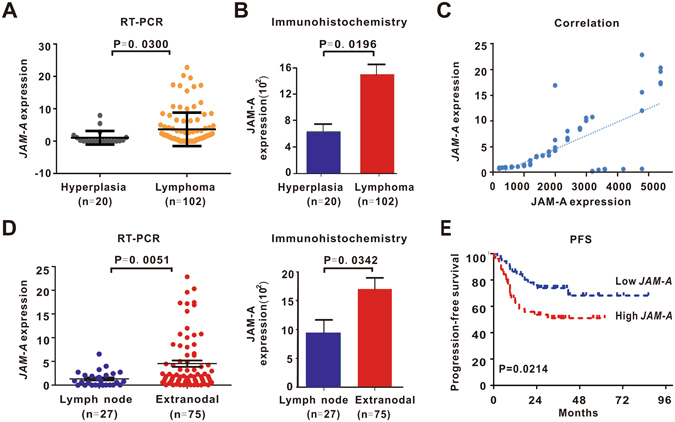
Figure 1
Figure 1
JAM-A overexpression was related to extranodal involvement and poor disease outcome in DLBCL. (A,B) JAM-A gene (A) and JAM-A protein (B) were overexpressed in DLBCL. (C) JAM-A gene expression correlated well with JAM-A protein expression. (D) DLBCL patients with extranodal involvement had higher JAM-A gene and JAM-A protein expression than those only with nodal lesions. (E) Patients in high JAM-A expression group had poor progression-free survival (PFS).
Figure 2
Figure 2
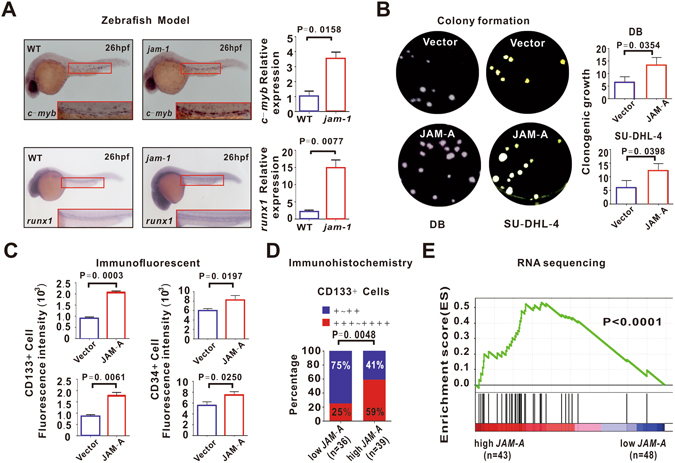
JAM-A indicated B-lymphoma cell stemness. (A) As assessed by Whole-mount in Situ Hybridization and real-time quantitative RT-PCR, c-myb and runx1 were overexpressed after 26 h microinjecting jam-1 mRNA (jam-1) in Zebrafish embryos. WT, wild type. (B,C) B-lymphoma cell line DB and SU-DHL-4 were transfected with control vector (Vector) and JAM-A vector (JAM-A). Ectopic expression of JAM-A was associated with increased colony formation (B) and stem-cell marker CD133 and CD34 expression (C). (D) DLBCL patients with high JAM-A expression displayed increased CD133 positivity. (E) Patients in high JAM-A expression group were enriched for a stem cell gene signature, as revealed by RNA sequencing. Data in (A), (B) and (C) are representative of three independent experiments.
Figure 3
Figure 3
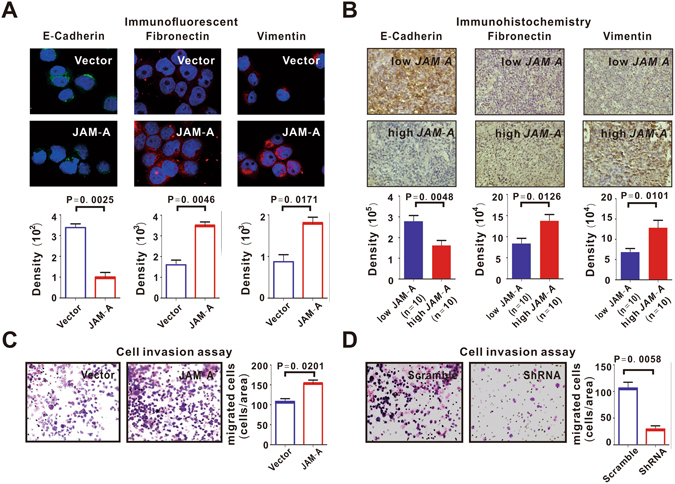
JAM-A induced B-lymphoma cell invasion. (A,B) Epithelial-mesenchymal transition (EMT) was observed in JAM-A-overexpressing DB cells (A) and in DLBCL patients with high JAM-A expression (B). (C,D) JAM-A-transfected DB cells acquired increased cell invasion (C), which was inhibited in JAM-A-ShRNA-transfected cells (D). Data in (A,C and D) are representative of three independent experiments.
Figure 4
Figure 4
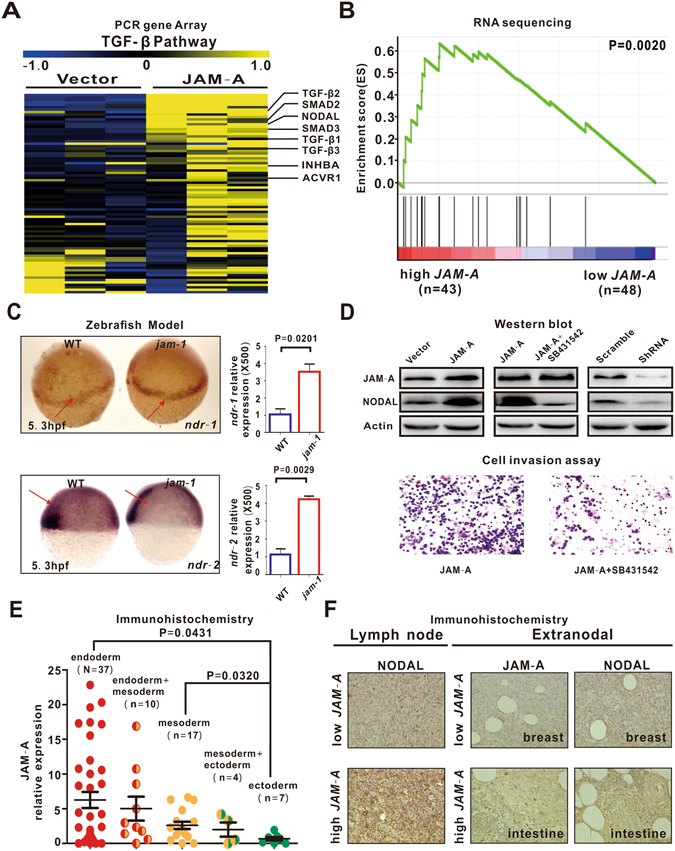
JAM-A activated TGF-β/NODAL signaling. (A,B) In JAM-A-transfected DB cells (A) and DLBCL patients (B), JAM-A overexpression was related to activation of TGF-β/NODAL signaling. (C) As assessed by Whole-mount in Situ Hybridization and real-time quantitative RT-PCR, ndr-1 and ndr-2 were increased in jam-1-overexpressing zebrafish. WT, wild type. (D) JAM-A upregulated NODAL expression, which was restored by specific TGF-β/NODAL/Smad inhibitor SB431542 or JAM-A ShRNA. SB431542 abrogated JAM-A-induced lymphoma cell invasion (E) JAM-A was the highest in patients with involvement of endoderm-derived organs, followed by those with involvement of mesoderm- and ectoderm-derived organs. (F) JAM-A correlated with increased NODAL expression in primary lymph nodes, as well as in secondary lesions. Data in (C) are representative of three independent experiments.
Figure 5
Figure 5
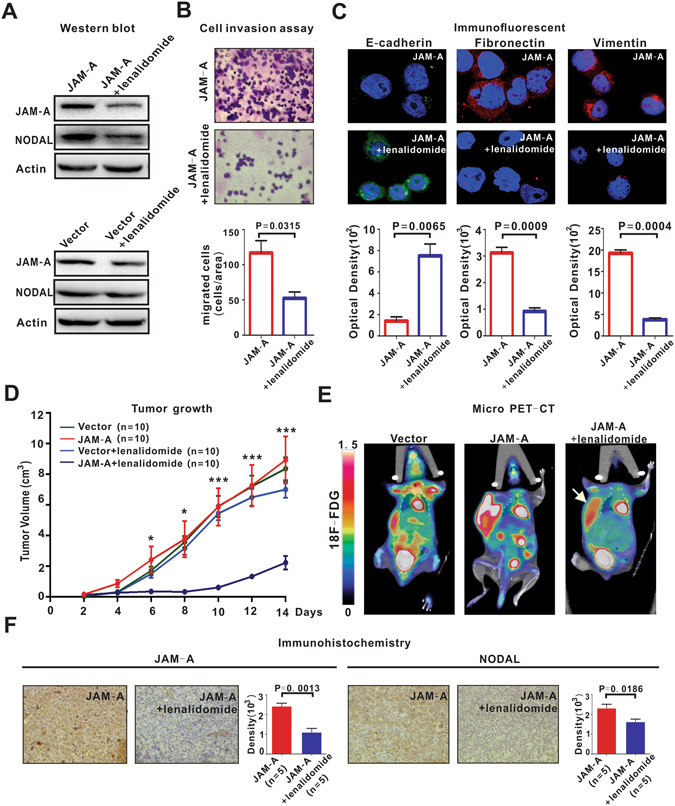
Lenalidomide inhibited lymphoma progression. (A) Lenalidomide (1 μM) downregulated JAM-A and NODAL expression more significantly in JAM-A-transfected DB cells as compared to vector-transfected cells. (B,C) Lenalidomide (1 μM) inhibited JAM-A-transfected cell invasion (B) and EMT (C). (D) In murine xenograft model established with subcutaneous injection of DB cells, tumor size was similar between vector-transfected (Vector) and JAM-A-transfected (JAM-A) group. Lenalidomide (25 mg/kg/day, JAM-A + lenalidomide) retarded tumor growth. *P < 0.05 and ***P < 0.001 comparing with the JAM-A group. (E) By micro-PET-CT, JAM-A overexpression contributed to tumor metastasis, all involving endoderm- and mesoderm-associated organs, which was inhibited by lenalidomide. (F) Lenalidomide downregulated JAM-A and NODAL expression. Data in (B) and (C) are representative of three independent experiments.

References

    1. Lenz G, Staudt LM. Aggressive lymphomas. The New England journal of medicine. 2010;362:1417–1429. doi: 10.1056/NEJMra0807082. - DOI - PMC - PubMed
    1. Zhou Z, et al. An enhanced International Prognostic Index (NCCN-IPI) for patients with diffuse large B-cell lymphoma treated in the rituximab era. Blood. 2014;123:837–842. doi: 10.1182/blood-2013-09-524108. - DOI - PMC - PubMed
    1. Sehn LH, Gascoyne RD. Diffuse large B-cell lymphoma: optimizing outcome in the context of clinical and biologic heterogeneity. Blood. 2015;125:22–32. doi: 10.1182/blood-2014-05-577189. - DOI - PubMed
    1. Leech AO, Cruz RG, Hill AD, Hopkins AM. Paradigms lost-an emerging role for over-expression of tight junction adhesion proteins in cancer pathogenesis. Annals of translational medicine. 2015;3:184. - PMC - PubMed
    1. Zhao C, et al. Dysregulation of JAM-A plays an important role in human tumor progression. International journal of clinical and experimental pathology. 2014;7:7242–7248. - PMC - PubMed

Publication types

MeSH terms