. 2017 Aug 2:4:17039.
doi: 10.1038/hortres.2017.39. eCollection 2017.

The WRKY transcription factor HpWRKY44 regulates CytP450-like1 expression in red pitaya fruit (Hylocereus polyrhizus)

Affiliations

The WRKY transcription factor HpWRKY44 regulates CytP450-like1 expression in red pitaya fruit (Hylocereus polyrhizus)

Mei-Nv Cheng et al. Hortic Res. .

Abstract

Red pitaya (Hylocereus polyrhizus) fruit is a high-value, functional food, containing a high level of betalains. Several genes potentially related to betalain biosynthesis, such as cytochrome P450-like (CytP450-like), have been identified in pitaya fruit, while their transcriptional regulation remains unclear. In this work, the potential involvement of a WRKY transcription factor, HpWRKY44, in regulating CytP450-like1 expression in pitaya fruit was examined. HpWRKY44, a member of the Group 1 WRKY family, contains two conserved WRKY motifs and is localized in the nucleus. HpWRKY44 also exhibits trans-activation ability. Gene expression analysis showed that the expression of HpCytP450-like1 and HpWRKY44 increased steadily during pitaya fruit coloration, which corresponded with the production of elevated betalain levels in the fruit. HpWRKY44 was also demonstrated to directly bind to and activate the HpCytP450-like1 promoter via the recognition of the W-box element present in the promoter. Collectively, our findings indicate that HpWRKY44 transcriptionally activates HpCytP450-like1, which perhaps, at least in part, contributes to betalain biosynthesis in pitaya fruit. The information provided in the current study provides novel insights into the regulatory network associated with betalain biosynthesis during pitaya fruit coloration.


Conflict of interest statement

The authors declare no conflict of interest.

Figures
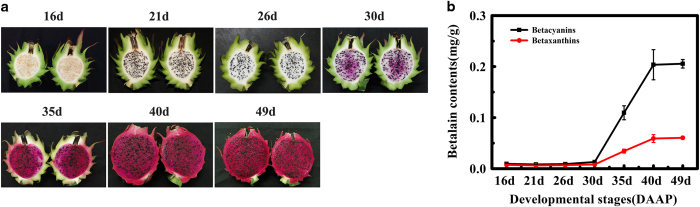
Figure 1
Figure 1
Pitaya fruit pulp at different developmental stages (a) and changes in betalain content (b) during fruit pulp color formation. Fruits were sampled for subsequent analyses at 16th, 21st, 26th, 30th, 35th, 40th and 49th days after artificial pollination (DAAP). Data represent mean±s.e.m. of three biological replicates (n=3).
Figure 2
Figure 2
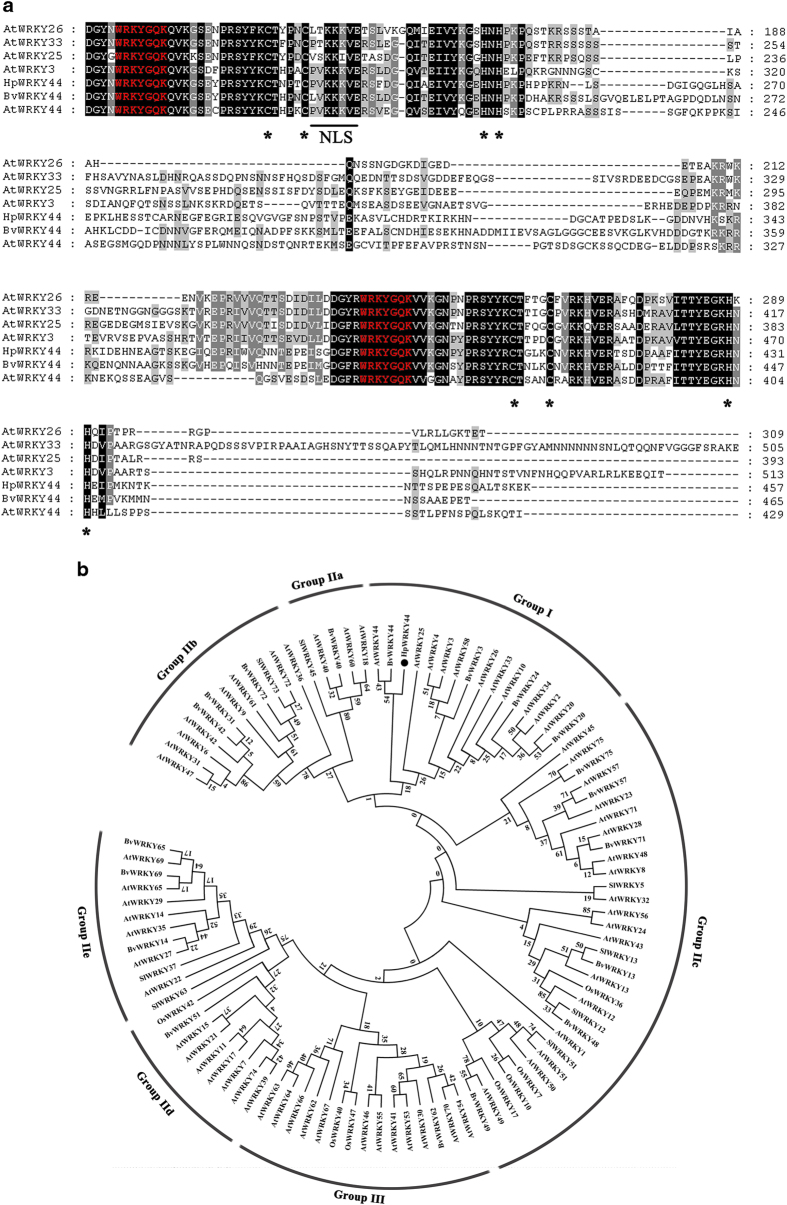
Bioinformatic analysis of HpWRKY44. (a) Multiple alignment of HpWRKY44 with sugar beet BvWRKY44, and Arabidopsis thaliana AtWRKY3, AtWRKY25, AtWRKY26, AtWRKY33 and AtWRKY44. Identical and similar amino acids are represented by black and gray shading, respectively. The two WRKY motifs and the zinc-finger structures are indicated by red letters and asterisks, respectively. A nuclear localization signal (NLS) is underlined. (b) Phylogenetic tree of HpWRKY44, sugar beet, Arabidopsis thaliana, rice and tomato WRKYs. WRKYs are divided into three major groups and seven sub-families. HpWRKY44 (black circles), along with sugar beet, BvWRKY44, Arabidopsis thaliana AtWRKY25, AtWRKY44 and tomato SlWRKY5 cluster in Group I. The phylogenetic tree was constructed with MEGA5.0 using a bootstrap test of phylogeny with UPGMA test and default parameters.
Figure 3
Figure 3
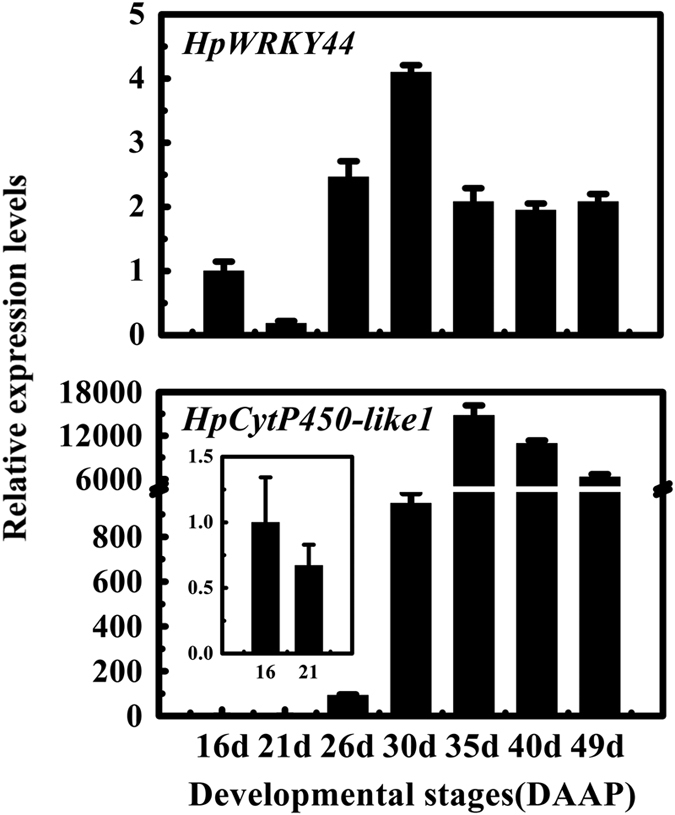
Expression pattern of HpCytP450-like1 and HpWRKY44 during fruit pulp coloration. Fruits were sampled at 16th, 21st, 26th, 30th, 35th, 40th and 49th days after artificial pollination (DAAP). The expression level of each gene is expressed as a ratio relative to 16 DAAP, which was set at 1. Each value represents the mean±s.e.m. of three replicates (n=3).
Figure 4
Figure 4
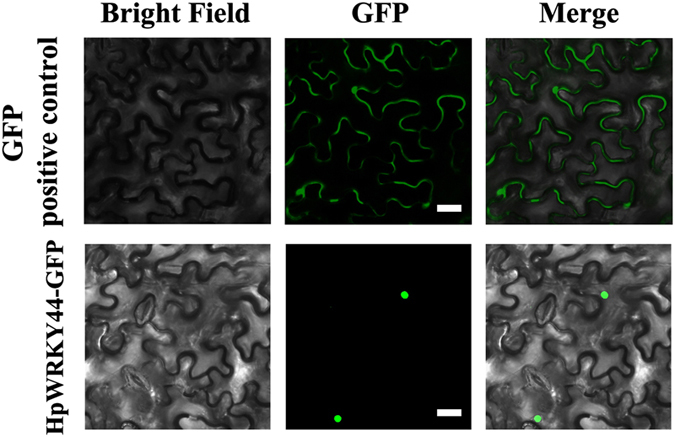
Subcellular localization of HpWRKY44 in tobacco leaves. Agrobacterium tumefaciens carrying HpWRKY44-GFP or a GFP positive control vector were infiltrated into tobacco leaves. After 48 h, the fluorescence of HpWRKY44-GFP protein was localized exclusively in the nucleus, while the fluorescence of the GFP positive control was distributed in both the nucleus and cytoplasm. Bar=30 μm.
Figure 5
Figure 5
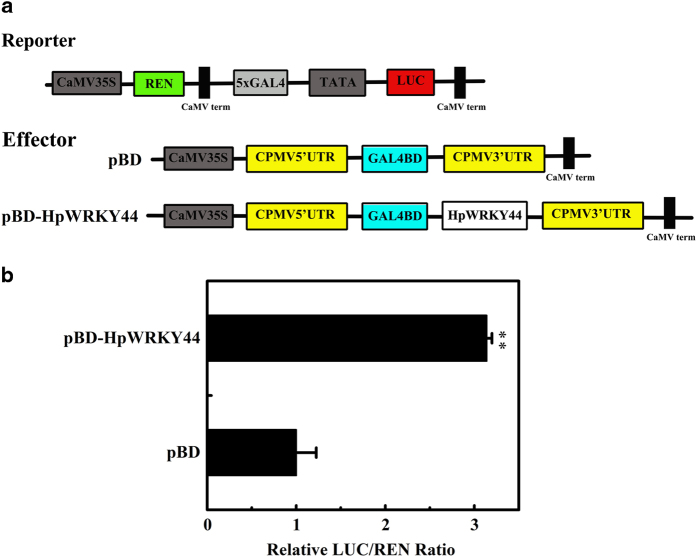
Analysis of transcriptional activity of HpWRKY44. (a) Reporter and effector constructs. The dual luciferase reporter construct contained the firefly luciferase (LUC) reporter gene fused with five copies of the GAL4 DNA-binding element (5×GAL4) plus the mini-35S (TATA box). The Renilla luciferase (REN) driven by CaMV 35S in the same vector was used as an internal control. The effector plasmid contained the HpWRKY44 gene fused to the yeast GAL4 DNA-binding domain (GAL4BD) driven by CaMV35S, CPMV, (Cowpea mosaic virus). (b) Transcriptional activation activity of HpWRKY44. The trans-activation ability of HpWRKY44 was assessed as the ratio of LUC to REN. Each presented value represents the mean±s.e.m. six biological replicates (n=6). The ratio of LUC/REN of the empty pBD vector was used as calibrator and set at 1. ** indicates a significant difference between the sample (transcriptional activator vector) and the control (empty pBD vector) at P<0.01, based on the Student’s t-test.
Figure 6
Figure 6
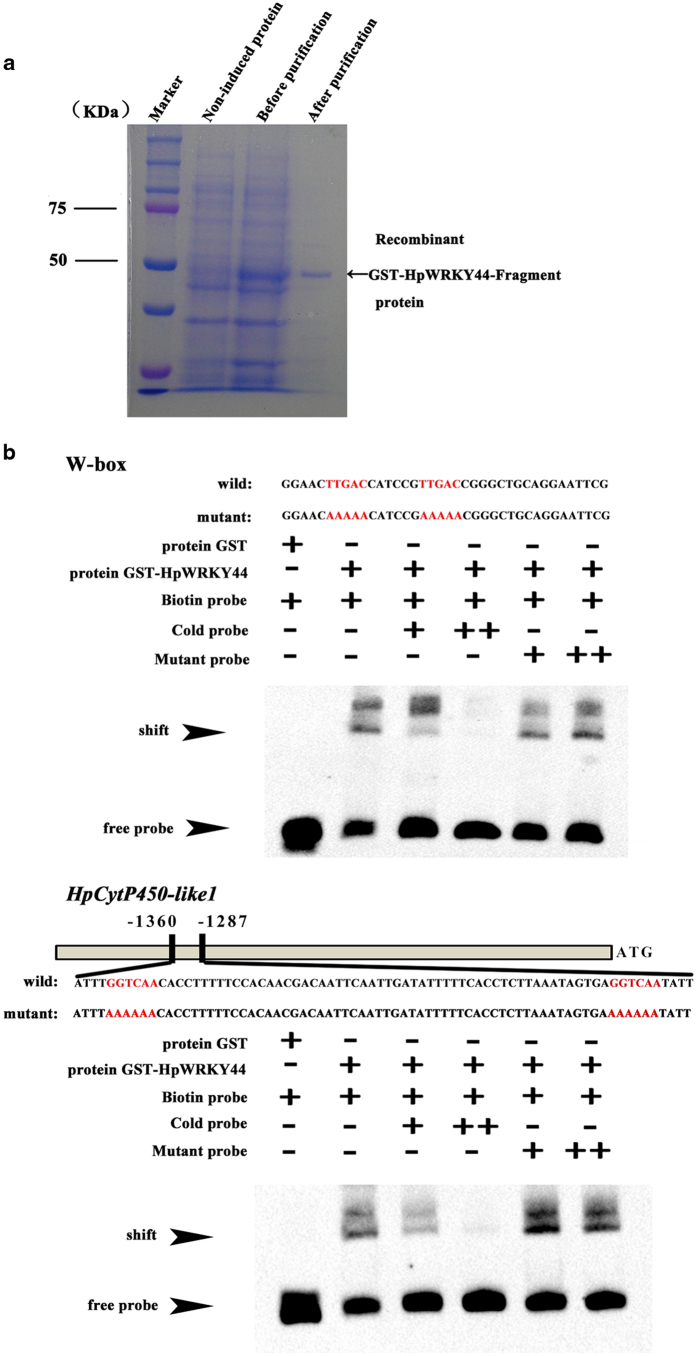
Electrophoretic mobility shift assay (EMSA) demonstrating the in vitro binding of HpWRKY44 to a W-box element and the HpCytP450-like1 promoter containing a W-box element. (a) SDS–PAGE gel stained with Coomassie blue demonstrating affinity purification of the recombinant HpWRKY44 protein used for the EMSA. (b) EMSA. Biotin-labeled DNA probe from the promoter or mutant probe was incubated with GST-HpWRKY44 protein, and the DNA-protein complexes were separated on a 6% native polyacrylamide gel. GST protein alone was used as the negative control.+or ++ indicate increasing amounts of unlabeled or mutant probe used for competition and testing of binding specificity. Arrows indicate the position of the shifted bands.
Figure 7
Figure 7
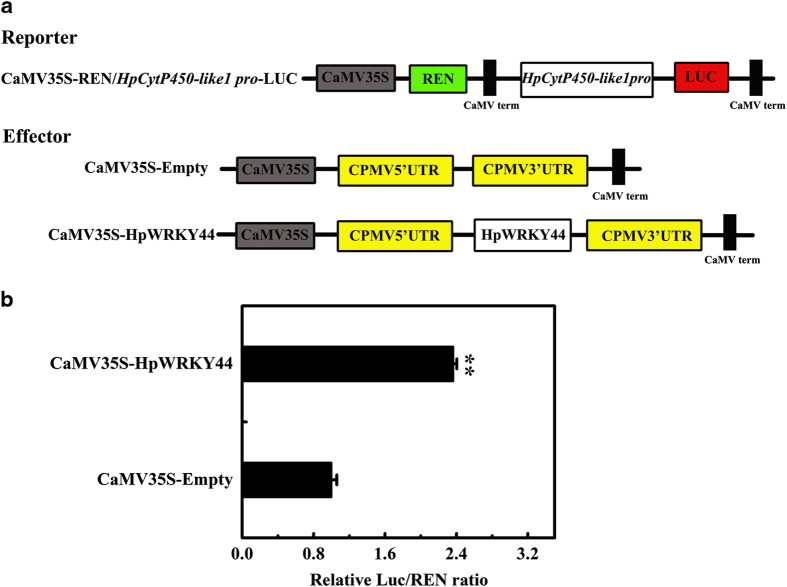
HpWRKY44 directly activates the expression of HpCytP450-like1. (a) Diagrammatic illustrations of the reporter and effector constructs used in the transient dual-luciferase reporter assay in tobacco leaves. LUC, firefly luciferase; REN, renilla luciferase; CPMV, Cowpea mosaic virus. (b) HpWRKY44 trans-activates the HpCytP450-like1 promoter. The activation was assessed by the ratio of LUC to REN. The ratio of LUC/REN of the empty vector plus promoter was used as a calibrator and set at 1. Each presented value represents the mean±s.e.m. six biological replicates (n=6). ** Indicates statistically significant differences at P<0.01, as determined by Student’s t-test.

References

    1. Gandía-Herrero F, García-Carmona F. Biosynthesis of betalains: yellow and violet plant pigments. Trends Plant Sci 2013; 18: 334–343. - PubMed
    1. Khan MI, Giridhar P. Plant betalains: chemistry and biochemistry. Phytochem 2015; 117: 267–295. - PubMed
    1. Gandía-Herrero F, Escribano J, García-Carmona F. Biological activities of plant pigments betalains. Crit Rev Food Sci Nutr 2016; 56: 937–945. - PubMed
    1. Gandía-Herrero F, Escribano J, García-Carmona F. Purification and antiradical properties of the structural unit of betalains. J Nat Prod 2012; 75: 1030–1036. - PubMed
    1. Stafford HA. Anthocyanins and betalains: evolution of the mutually exclusive pathways. Plant Sci 1994; 101: 91–98.