. 2017 Apr 26;3(4):e000110.
doi: 10.1099/mgen.0.000110. eCollection 2017 Apr.

Diversity, virulence, and antimicrobial resistance of the KPC-producing Klebsiella pneumoniae ST307 clone

Affiliations

Diversity, virulence, and antimicrobial resistance of the KPC-producing Klebsiella pneumoniae ST307 clone

Laura Villa et al. Microb Genom. .

Abstract

The global spread of Klebsiella pneumoniae producing Klebsiella pneumoniae carbapenemase (KPC) has been mainly associated with the dissemination of high-risk clones. In the last decade, hospital outbreaks involving KPC-producing K. pneumoniae have been predominantly attributed to isolates belonging to clonal group (CG) 258. However, results of recent epidemiological analysis indicate that KPC-producing sequence type (ST) 307, is emerging in different parts of the world and is a candidate to become a prevalent high-risk clone in the near future. Here we show that the ST307 genome encodes genetic features that may provide an advantage in adaptation to the hospital environment and the human host. Sequence analysis revealed novel plasmid-located virulence factors, including a cluster for glycogen synthesis. Glycogen production is considered to be one of the possible adaptive responses to long-term survival and growth in environments outside the host. Chromosomally-encoded virulence traits in the clone comprised fimbriae, an integrative conjugative element carrying the yersiniabactin siderophore, and two different capsular loci. Compared with the ST258 clone, capsulated ST307 isolates showed higher resistance to complement-mediated killing. The acquired genetic features identified in the genome of this new emerging clone may contribute to increased persistence of ST307 in the hospital environment and shed light on its potential epidemiological success.

Keywords: KPC; ST259; ST307; WGS; capsule; plasmid.


Figures
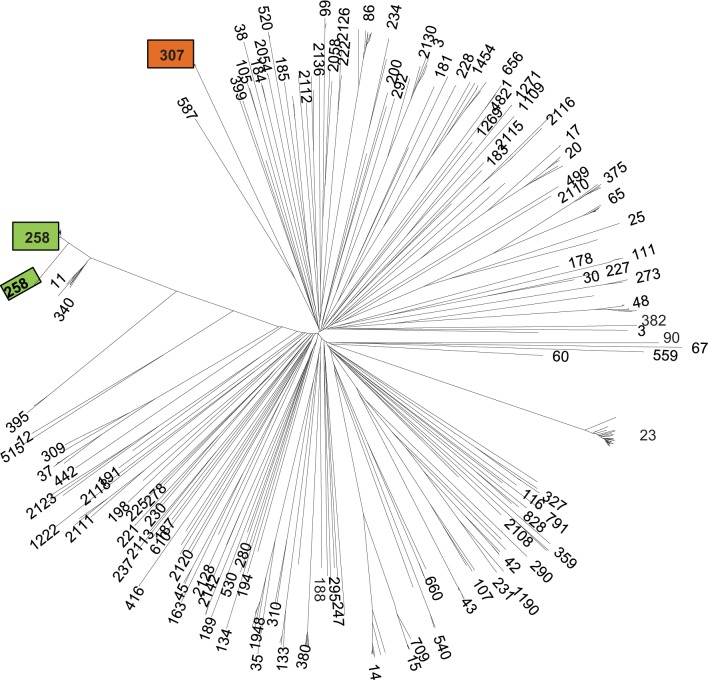
Fig. 1.
Fig. 1.
Unrooted neighbor-joining tree of K. pneumoniae core genome. The tree is based on the proportion of mismatches among allelic profiles of the strict core genome MLST scheme. Numbers at the tips of branches are sequence types. The positions of ST307 and the two ST258 clades are indicated by orange and green boxes, respectively.
Fig. 2.
Fig. 2.
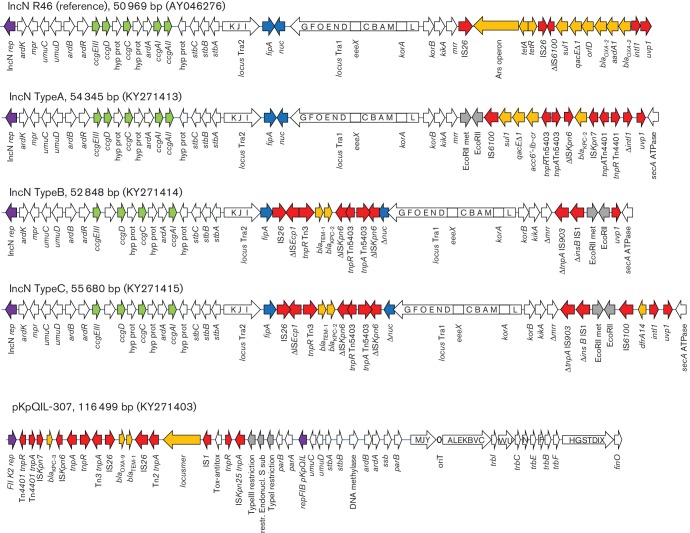
KPC-positive plasmids identified in ST307. White arrows indicate plasmid scaffold genes and their direction of transcription. The locus Tra is indicated by a squared white arrow with capital letters indicating the respective tra genes (i.e.: traG, G; traF, F; traO, O etc.). Resistance genes are indicated by orange arrows. Transposon-related genes (tnpA, tnpR and tnpM], class 1 integrase and insertion sequences are indicated by red arrows. Other genes are indicated by coloured arrows as follows: violet, replicase genes; grey, restriction enzyme and DNA methylase genes; green, ccg cluster; blue, fipA and nuc genes.
Fig. 3.
Fig. 3.
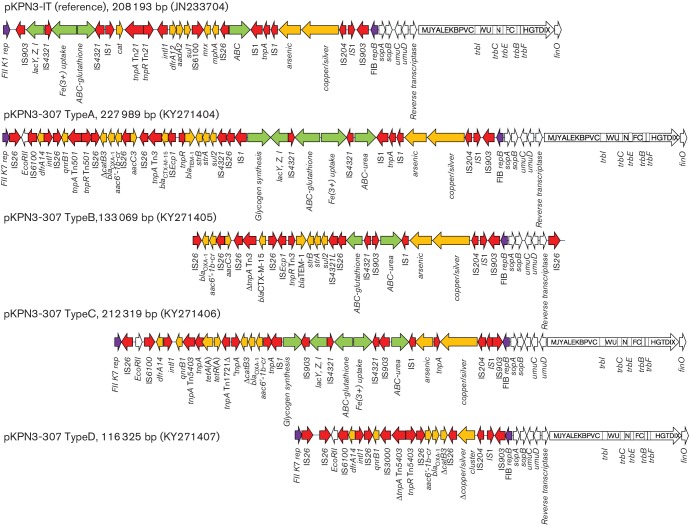
Variant pKPN-307 plasmids identified in ST307. White arrows indicate plasmid scaffold genes and their direction of transcription. The locus Tra is indicated by a squared white arrow with capital letters indicating the respective tra genes (i.e.: traG, G; traF, F; traO, O etc.). Resistance genes are indicated by orange arrows. Transposon-related genes (tnpA, tnpR, tnpM), class 1 integrase and insertion sequences are indicated by red arrows. Other genes are indicated by coloured arrows as follows: violet, replicase genes; green, clusters encoding putative virulence determinants.
Fig. 4.
Fig. 4.
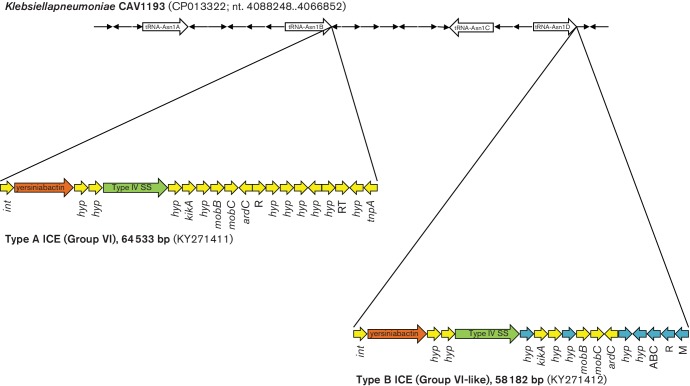
Integrative conjugative elements mobilizing the yersiniabactin cluster. Type A ICE (group VI as defined by Marcoleta et al. [32]) identified in strain 48-IT and type B ICE (group VI-like) identified in strain H151440671-UK are drawn indicating their integration sites with respect to the tRNA genes (tRNA Asn1A, 1B, 1C and 1D as described in Marcoleta et al. [32]) as detected in the complete genome sequence of strain CAV1193, which does not contain ICEs. Arrows indicate genes and their direction of transcription. Colours indicate clusters encoding the yersiniabactin system (brown), Type IV secretion system (green), hypothetical proteins (blue) and other ICE-associated genes (yellow), respectively. R, restriction; M, methylation; RT, reverse transcriptase.
Fig. 5.
Fig. 5.
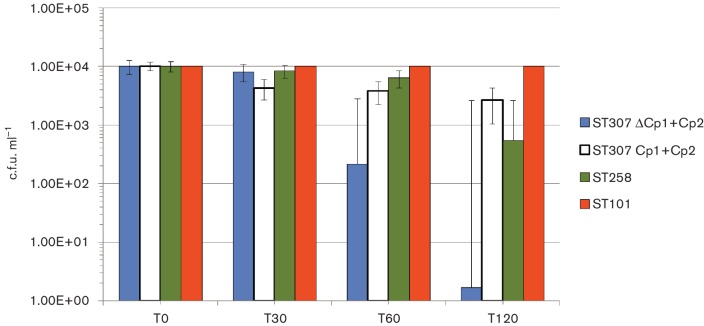
Complement resistance of ST307. Bars represent serum resistance tested using fresh, non-heated human sera obtained from healthy volunteers on ST307 strains 48-IT (blue, representative of strains carrying both Cp1 and Cp2 capsular loci), and CIV4-IT (white, representative of strains carrying ΔCp1 and Cp2 clusters). As comparators strains ST258 (green) and ST101 (orange) were also tested. Colony-forming units were measured immediately after 1 : 3 mixture with sera (T0) and after 30 (T30), 60 (T60) and 120 (T120) min of incubation.

References

    1. Wyres KL, Holt KE. Klebsiella pneumoniae population genomics and antimicrobial-resistant clones. Trends Microbiol. 2016;24:944–956. doi: 10.1016/j.tim.2016.09.007. - DOI - PubMed
    1. Chen L, Chavda KD, Melano RG, Jacobs MR, Koll B, et al. Comparative genomic analysis of KPC-encoding pKpQIL-like plasmids and their distribution in New Jersey and New York hospitals. Antimicrob Agents Chemother. 2014;58:2871–2877. doi: 10.1128/AAC.00120-14. - DOI - PMC - PubMed
    1. Bowers JR, Kitchel B, Driebe EM, Maccannell DR, Roe C, et al. Genomic analysis of the emergence and rapid global dissemination of the clonal group 258 Klebsiella pneumoniae pandemic. PLoS One. 2015;10:e0133727. doi: 10.1371/journal.pone.0133727. - DOI - PMC - PubMed
    1. Bialek-Davenet S, Criscuolo A, Ailloud F, Passet V, Jones L, et al. Genomic definition of hypervirulent and multidrug-resistant Klebsiella pneumoniae clonal groups. Emerg Infect Dis. 2014;20:1812–1820. doi: 10.3201/eid2011.140206. - DOI - PMC - PubMed
    1. Struve C, Roe CC, Stegger M, Stahlhut SG, Hansen DS, et al. Mapping the evolution of hypervirulent Klebsiella pneumoniae. MBio. 2015;6:e00630. doi: 10.1128/mBio.00630-15. - DOI - PMC - PubMed

Publication types

MeSH terms

LinkOut - more resources