


The Central Symbiosis of Molecular Biology: Molecules in Mutualism
- PMID: 28785970
- PMCID: PMC5579163
- DOI: 10.1007/s00239-017-9804-x
The Central Symbiosis of Molecular Biology: Molecules in Mutualism
Abstract
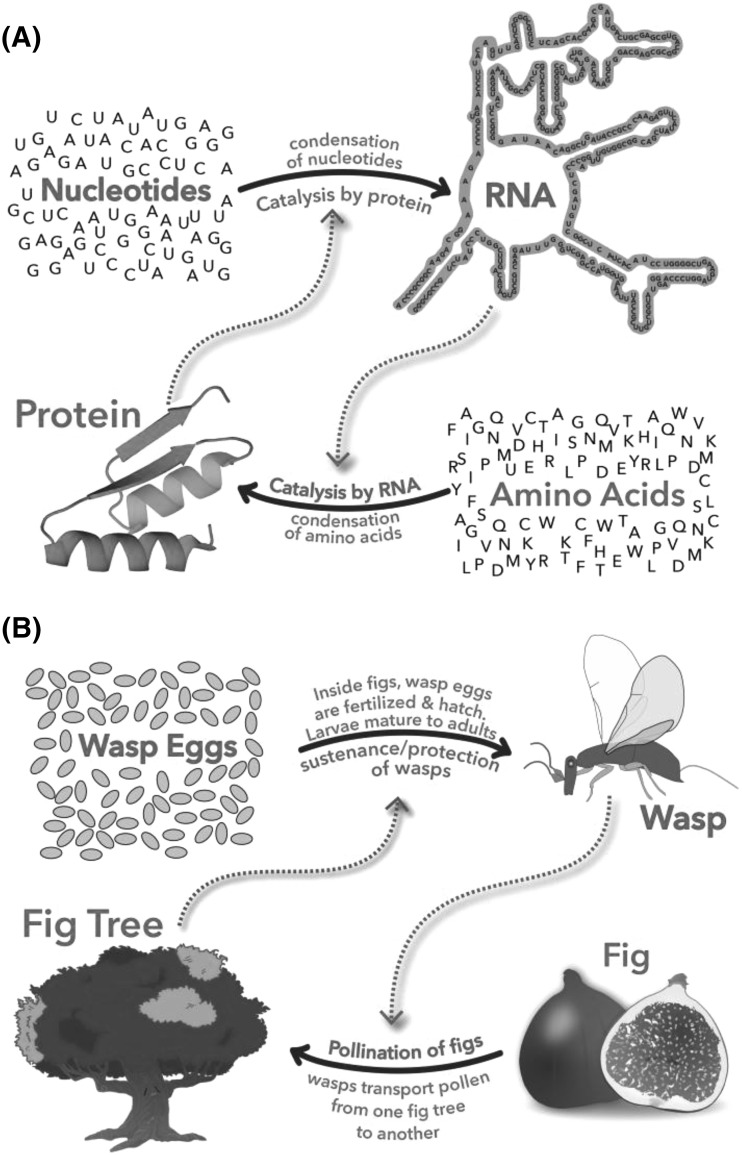
As illustrated by the mitochondrion and the eukaryotic cell, little in biology makes sense except in light of mutualism. Mutualisms are persistent, intimate, and reciprocal exchanges; an organism proficient in obtaining certain benefits confers those on a partner, which reciprocates by conferring different benefits. Mutualisms (i) increase fitness, (ii) inspire robustness, (iii) are resilient and resistant to change, (iv) sponsor co-evolution, (v) foster innovation, and (vi) involve partners that are distantly related with contrasting yet complementary proficiencies. Previous to this work, mutualisms were understood to operate on levels of cells, organisms, ecosystems, and even societies and economies. Here, the concepts of mutualism are extended to molecules and are seen to apply to the relationship between RNA and protein. Polynucleotide and polypeptide are Molecules in Mutualism. RNA synthesizes protein in the ribosome and protein synthesizes RNA in polymerases. RNA and protein are codependent, and trade proficiencies. Protein has proficiency in folding into complex three-dimensional states, contributing enzymes, fibers, adhesives, pumps, pores, switches, and receptors. RNA has proficiency in direct molecular recognition, achieved by complementary base pairing interactions, which allow it to maintain, record, and transduce information. The large phylogenetic distance that characterizes partnerships in organismal mutualism has close analogy with large distance in chemical space between RNA and protein. The RNA backbone is anionic and self-repulsive and cannot form hydrophobic structural cores. The protein backbone is neutral and cohesive and commonly forms hydrophobic cores. Molecules in Mutualism extends beyond RNA and protein. A cell is a consortium of molecules in which nucleic acids, proteins, polysaccharides, phospholipids, and other molecules form a mutualism consortium that drives metabolism and replication. Analogies are found in systems such as stromatolites, which are large consortia of symbiotic organisms. It seems reasonable to suggest that 'polymers in mutualism relationships' is a useful and predictive definition of life.
Keywords: Assembly; Co-evolution; Mutualism; Origin of life; Proficiency; Protein; RNA; Translation.
Figures
References
-
- Bronstein JL. The study of mutualism. In: Bronstein JL, editor. Mutualism. Oxford: Oxford Press; 2015. pp. 3–19.
Publication types
MeSH terms
Substances
Grants and funding
LinkOut - more resources
Full Text Sources
Other Literature Sources
