doi: 10.1099/jgv.0.000871.
Epub 2017 Aug 8.
ICTV Virus Taxonomy Profile: Circoviridae
Affiliations
- PMID: 28786778
- PMCID: PMC5656780
- DOI: 10.1099/jgv.0.000871
Item in Clipboard
ICTV Virus Taxonomy Profile: Circoviridae
J Gen Virol.
2017 Aug.
Abstract
The family Circoviridae comprises viruses with small, circular, single-stranded DNA (ssDNA) genomes, including the smallest known animal viruses. Members of this family are classified into two genera, Circovirus and Cyclovirus, which are distinguished by the position of the origin of replication relative to the coding regions and the length of the intergenic regions. Within each genus, the species demarcation threshold is 80 % genome-wide nucleotide sequence identity. This is a summary of the International Committee on Taxonomy of Viruses (ICTV) Report on the taxonomy of the Circoviridae, which is available at www.ictv.global/report/circoviridae.
Figures
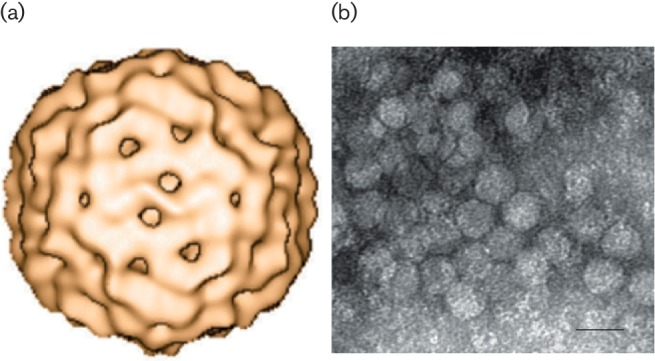
(a) 3D reconstruction of porcine circovirus 2 using cryo-electron microscopy.
A structural model comprising 60 subunits (T=1) arranged in
12 pentameric morphological units has been proposed [1]. (b) Negative-stained transmission electron
micrograph of porcine circovirus 2 (provided by Carolina
Rodríguez-Cariño and Joaquim Segalés, CReSA, Spain).
Scale bar=20 nm.
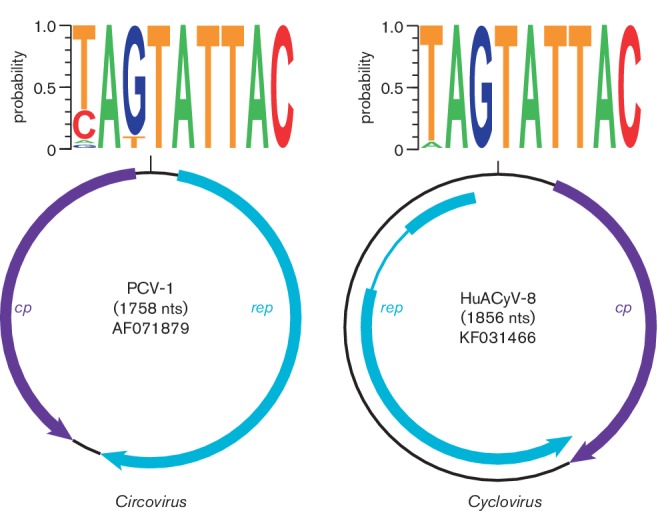
Genome schematics illustrating the major open reading frames (ORFs)
characteristic of members of the family Circoviridae.
Members of the family have two major ORFs encoding replication-associated
(Rep) and capsid (Cp) proteins, as well as a conserved nonanucleotide motif
marking the origin of replication. The nonanucleotide motif sequence is
depicted through sequence probability logos generated in Weblogo 3. The
rep gene of human-associated cyclovirus 8, a
representative of the Cyclovirus type species, is
interrupted by an intron.
References
-
- Ritchie BW, Niagro FD, Latimer KS, Lukert PD, Steffens WL 3rd, et al. Ultrastructural, protein composition, and antigenic comparison of psittacine beak and feather disease virus purified from four genera of psittacine birds. J Wildl Dis. 1990;26:196–203. doi: 10.7589/0090-3558-26.2.196. - DOI - PubMed
MeSH terms
Grants and funding
LinkOut - more resources
Full Text Sources
Other Literature Sources