Clinical Trial
. 2017 Aug 8;318(6):557-566.
doi: 10.1001/jama.2017.9938.

Effect of Azithromycin on Airflow Decline-Free Survival After Allogeneic Hematopoietic Stem Cell Transplant: The ALLOZITHRO Randomized Clinical Trial

Affiliations
Clinical Trial

Effect of Azithromycin on Airflow Decline-Free Survival After Allogeneic Hematopoietic Stem Cell Transplant: The ALLOZITHRO Randomized Clinical Trial

Anne Bergeron et al. JAMA. .

Abstract

Importance: Bronchiolitis obliterans syndrome has been associated with increased morbidity and mortality after allogeneic hematopoietic stem cell transplant (HSCT). Previous studies have suggested that azithromycin may reduce the incidence of post-lung transplant bronchiolitis obliterans syndrome.

Objective: To evaluate if the early administration of azithromycin can improve airflow decline-free survival after allogeneic HSCT.

Design, setting, and participants: The ALLOZITHRO parallel-group trial conducted in 19 French academic transplant centers and involving participants who were at least 16 years old, had undergone allogeneic HSCT for a hematological malignancy, and had available pretransplant pulmonary function test results. Enrollment was from February 2014 to August 2015 with follow-up through April 26, 2017.

Interventions: Patients were randomly assigned to receive 3 times a week either 250 mg of azithromycin (n = 243) or placebo (n = 237) for 2 years, starting at the time of the conditioning regimen.

Main outcomes and measures: The primary efficacy end point was airflow decline-free survival at 2 years after randomization. Main secondary end points were overall survival and bronchiolitis obliterans syndrome at 2 years.

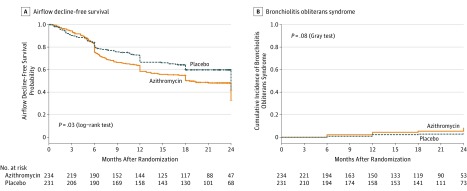
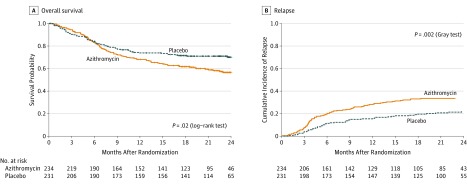
Results: Thirteen months after enrollment, the independent data and safety monitoring board detected an unanticipated imbalance across blinded groups in the number of hematological relapses, and the treatment was stopped December 26, 2016. Among 480 randomized participants, 465 (97%) were included in the modified intention-to-treat analysis (mean age, 52 [SD, 14] years; 75 women [35%]). At the time of data cutoff, 104 patients (22%; 54 azithromycin vs 50 placebo) had experienced an airflow decline; 138 patients (30%) died (78 azithromycin vs 60 placebo). Two-year airflow decline-free survival was 32.8% (95% CI, 25.9%-41.7%) with azithromycin and 41.3% (95% CI, 34.1%-50.1%) with placebo (unadjusted hazard ratio [HR], 1.3; 95% CI, 1.02-1.70; P = .03). Of the 22 patients (5%) who experienced bronchiolitis obliterans syndrome, 15 (6%) were in the azithromycin group and 7 (3%) in the placebo group (P = .08). The azithromycin group had increased mortality, with a 2-year survival of 56.6% (95% CI, 50.2%-63.7%) vs 70.1% (95% CI, 64.2%-76.5%) in the placebo group (unadjusted HR, 1.5; 95% CI, 1.1-2.0; P = .02). In a post hoc analysis, the 2-year cumulative incidence of hematological relapse was 33.5% (95% CI, 27.3%-39.7%) with azithromycin vs 22.3% (95% CI, 16.4%-28.2%) with placebo (unadjusted cause-specific HR, 1.7; 95% CI, 1.2-2.4; P = .002).

Conclusions and relevance: Among patients undergoing allogeneic HSCT for hematological malignancy, early administration of azithromycin resulted in worse airflow decline-free survival than did placebo; these findings are limited by early trial termination. The potential for harm related to relapse requires further investigation.

Trial registration: clinicaltrials.gov Identifier: NCT01959100.


Conflict of interest statement

Conflict of Interest Disclosures: All authors have completed and submitted the ICMJE Form for Disclosure of Potential Conflicts of Interest. Dr Bergeron reported receiving unrestricted research grant funding for the ALLOZITHRO trial from the French Ministry of Health, SFGM-TC Capucine association, and SOS Oxygène; speaker fees from Merck, Gilead, and Pfizer; and serving on the advisory board from Merck. Dr Thepot reported serving on the advisory board of Celgene, serving as a consultant for Sanofi, receiving nonfinancial support from Jazz Pharmaceutical. No other disclosures were reported.

Figures

Figure 1.
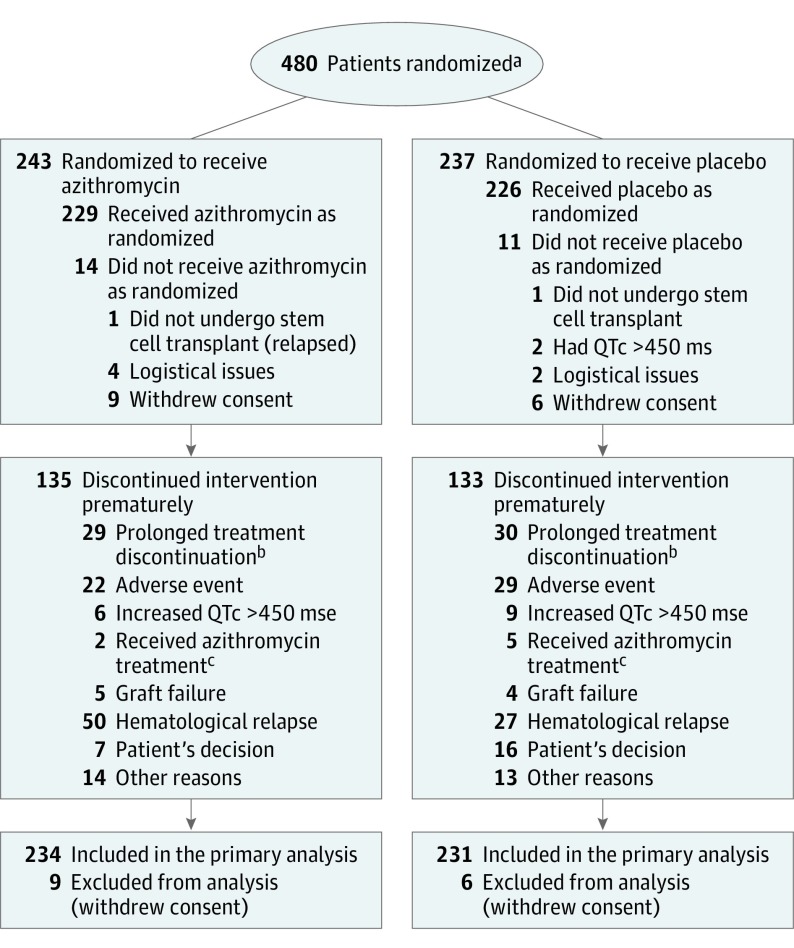
Figure 1.. Flow of Patients Through the ALLOZITHRO Trial
QTc indicates corrected QT interval. aThe number of patients screened for eligibility was not available. bThe protocol required that the intervention treatment not be discontinued for more than 4 weeks. cSome patients received azithromycin as a curative treatment.
Figure 2.
Figure 2.. Airflow Decline–Free Survival and Bronchiolitis Obliterans Syndrome
In this modified intention-to-treat analysis set, data cutoff was April 26, 2017. A, Crosses on the curves indicate censored observations. The median (interquartile range [IQR]) follow-up for the occurrence of airflow decline–free survival among those in the azithromycin group was 15.5 months (IQR, 4.4-23.1) and was 18.8 months (IQR, 6.0-23.8) for those in the placebo group. B, The median (IQR) follow-up for occurrence of bronchiolitis obliterans syndrome among those in the azithromycin group was 10.0 (IQR, 7.0-23.0) months and 19.0 (IQR, 9.0-24.0) for those in the placebo group.
Figure 3.
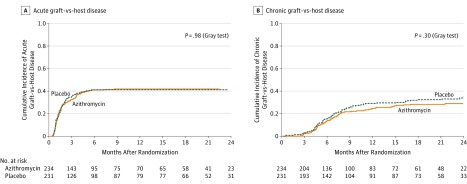
Figure 3.. Graft-vs-Host Disease
In this modified intention-to-treat analysis set, data cutoff was April 26, 2017. A, The median (interquartile range [IQR]) follow-up for the occurrence of acute graft-vs-host disease in the azithromycin group was 8.5 months (IQR, 1.4-17.6) and 3.7 months (IQR, 1.4- 18.9) in the placebo group. Acute graft-vs-host disease includes symptoms of erythema, maculopapular rash, nausea, vomiting, anorexia, profuse diarrhea, ileus, or cholestatic liver disease. B, The median (IQR) follow-up for the occurrence of chronic graft-vs-host disease, 7.1 months (IQR, 4.2-18.6) for the azithromycin group and was 7.9 months (IQR, 4.5-21.0) for the placebo group. Chronic graft-vs-host disease is a syndrome of variable clinical features resembling autoimmune and other immunologic disorders such as scleroderma, Sjögren syndrome, primary biliary cirrhosis, wasting syndrome, bronchiolitis obliterans, immune cytopenias, and chronic immunodeficiency; manifestations of chronic graft-vs-host disease may be restricted to a single organ or site or may be widespread.
Figure 4.
Figure 4.. Overall Survival and Hematological Relapse
In this modified intention-to-treat analysis set, data cutoff was April 26, 2017. Crosses on the curves indicate censored observations. A, The median (interquartile range [IQR]) follow-up for overall survival in the azithromycin group was 18.6 months (IQR, 7.2-23.5) and was 20.6 months (IQR, 9.0-24.1) for placebo group. B, The median (IQR) follow-up for hematologic relapse was 15.5 months (IQR, 4.4-23.1) for the azithromycin group and was 18.8 months (IQR, 6.0-23.8) for the placebo group.

Comment in

References

    1. Barker AF, Bergeron A, Rom WN, Hertz MI. Obliterative bronchiolitis. N Engl J Med. 2014;370(19):1820-1828. - PubMed
    1. Jagasia MH, Greinix HT, Arora M, et al. . National Institutes of Health Consensus Development Project on Criteria for Clinical Trials in Chronic Graft-versus-Host Disease, I: the 2014 Diagnosis and Staging Working Group report. Biol Blood Marrow Transplant. 2015;21(3):389-401.e1. - PMC - PubMed
    1. Bergeron A. Late-onset noninfectious pulmonary complications after allogeneic hematopoietic stem cell transplantation. Clin Chest Med. 2017;38(2):249-262. - PubMed
    1. Au BK, Au MA, Chien JW. Bronchiolitis obliterans syndrome epidemiology after allogeneic hematopoietic cell transplantation. Biol Blood Marrow Transplant. 2011;17(7):1072-1078. - PMC - PubMed
    1. Bergeron A, Godet C, Chevret S, et al. . Bronchiolitis obliterans syndrome after allogeneic hematopoietic SCT: phenotypes and prognosis. Bone Marrow Transplant. 2013;48(6):819-824. - PMC - PubMed

Publication types

MeSH terms

Associated data