


Imaging Techniques and Scanning Electron Microscopy as Tools for Characterizing a Si-Based Material Used in Air Monitoring Applications
- PMID: 28787908
- PMCID: PMC5456495
- DOI: 10.3390/ma9020109
Imaging Techniques and Scanning Electron Microscopy as Tools for Characterizing a Si-Based Material Used in Air Monitoring Applications
Abstract
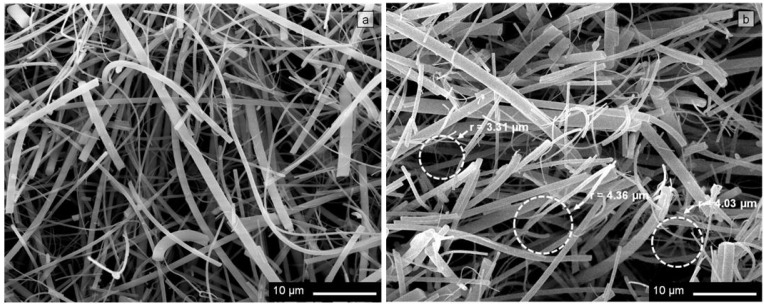
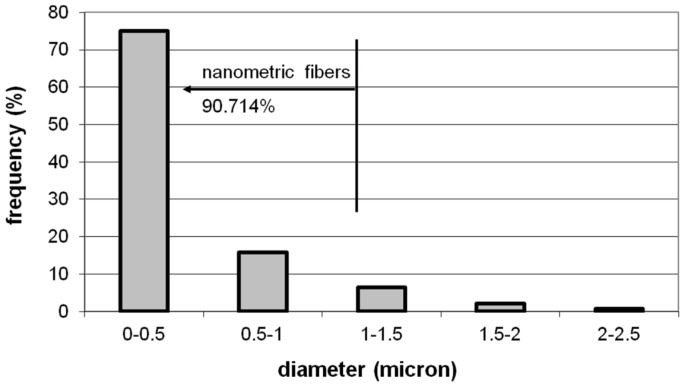
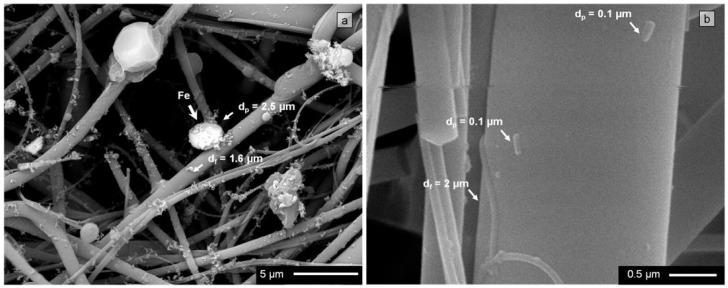
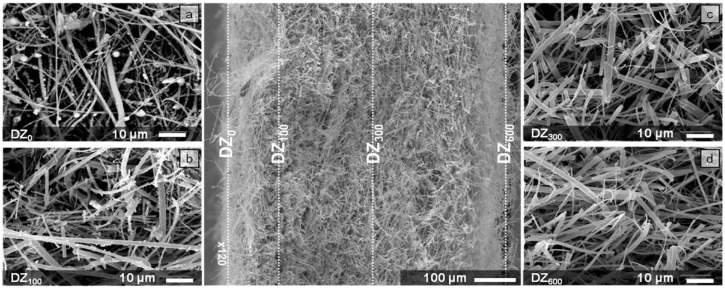
This paper presents a study of the quartz fibrous filters used as a substrate for capturing the particulate matter (PM) present in the air. Although these substrates are widely used in environmental applications, their microstructure has been barely studied. The behavior of these devices during the filtration process was investigated in terms of their microstructure and the quartz fibers. Surface and cross sections were monitored. Scanning electronic microscopy with energy dispersive X-ray spectroscopy (SEM-EDX), imaging and stereology techniques were used as tools for this purpose. The results show that most of the quartz filter fibers have sizes that allow them to be classified as nanofibers. It was also observed that, while the mechanisms of the mechanical capture of particles via impaction, interception and diffusion operate simultaneously in the outer zones of the filter cross section, the mechanism of capture by impaction is virtually non-existent in the innermost zones. Particles between 0.1 and 0.5 μm are known to be the most difficult to have captured by means of fibrous substrates. The fibers in inner zones were highly efficient in capturing this type of particle.
Keywords: Si-based materials; air monitoring applications; filtration behavior; imaging; microstructure characterization; scanning electron microscopy.
Conflict of interest statement
The authors declare that they do not have conflicts of interest.
Figures
References
-
- Wang C., Otani Y. Removal of nanoparticles from gas streams by fibrous filters: A review. Ind. Eng. Chem. Res. 2013;52:5–17. doi: 10.1021/ie300574m. - DOI
-
- Spindler G., Müller K., Brüggemann E., Gnauk T., Herrmann H. Long-term size-segregated characterization of PM10, PM2.5, and PM1 at the IfT research station Melpitz downwind of Leipzig (Germany) using high and low-volume filter samplers. Atmos. Environ. 2004;38:5333–5347.
-
- Negral L., Moreno-Grau S., Moreno J., Querol X., Viana M.M., Alastuey A. Natural and anthropogenic contributions to PM10 and PM2.5 in an urban area in the western Mediterranean coast. Water Air Soil Poll. 2008;192:227–238.
-
- Querol X., Alastuey A., Moreno T., Viana M.M., Castillo S., Pey J., Rodríguez S., Artiñano B., Salvador P., Sánchez M., et al. Spatial and temporal variations in airborne particulate matter (PM10 and PM2.5) across Spain 1999–2005. Atmos. Environ. 2008;42:3964–3979.
-
- Bauer H., Claeys M., Vermeylen R., Schueller E., Weinke G., Berger A., Puxbaum H. Arabitol and mannitol as tracers for the quantification of airborne fungal spores. Atmos. Environ. 2008;42:588–593.
LinkOut - more resources
Full Text Sources
Other Literature Sources
