


Comment
doi: 10.1016/j.molmed.2017.07.010.
Epub 2017 Aug 5.
A Topical Solution to the Sunless Tanning Problem
Affiliations
- PMID: 28789829
- PMCID: PMC5599127
- DOI: 10.1016/j.molmed.2017.07.010
Item in Clipboard
Comment
A Topical Solution to the Sunless Tanning Problem
Trends Mol Med.
2017 Sep.
Abstract
Skin cancer is the most commonly diagnosed type of cancer and is strongly associated with UV exposure and skin pigmentation. Recent advances in pharmacologic non-UV tanning methods open the possibility of preventing melanoma and non-melanoma skin cancer, especially in people who do not tan in the sun.
Published by Elsevier Ltd.
Figures
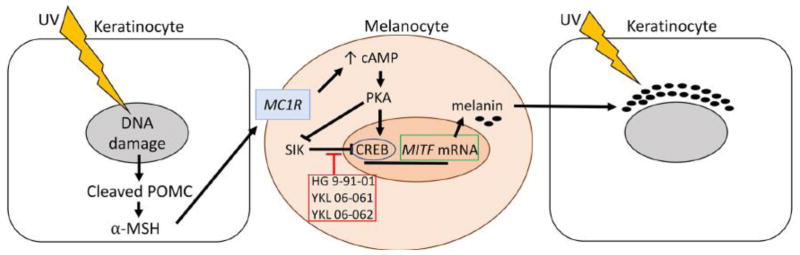
Ultraviolet (UV)-associated DNA damage in keratinocytes leads to cleavage of pre-opiomelanocortin (POMC) and production of alpha-melanocyte stimulating hormone (α-MSH), which binds to the melanocortin 1 receptor (MC1R) in melanocytes. MC1R binding results in increased cAMP, activation of protein kinase A (PKA), and phosphorylation of the c-AMP responsive element binding protein (CREB). CREB phosphorylation leads to increased transcription of MITF, which initiates the melanin production cascade resulting in increased melanin. Melanin is packaged in melanosomes and then transferred to keratinocytes to protect their nuclei against further UV damage. SIK inhibits MITF transcription in the absence of UV-damage, preventing melanin production. Pharmacological inhibition of SIK with HG 9-91-01, YKL 06-061, or YKL-060062 leads to UV-independent tanning [2].
Comment on
-
A UV-Independent Topical Small-Molecule Approach for Melanin Production in Human Skin.Cell Rep. 2017 Jun 13;19(11):2177-2184. doi: 10.1016/j.celrep.2017.05.042. Cell Rep. 2017. PMID: 28614705 Free PMC article.
References
-
- AAD. [accessed July 10, 2017];Skin cancer Incidence rates. 2017 https://www.aad.org/media/stats/conditions/skin-cancer.
-
- Valverde P, et al. Variants of the melanocyte-stimulating hormone receptor gene are associated with red hair and fair skin in humans. Nat Genet. 1995;11(3):328–30. - PubMed
-
- D’Orazio JA, et al. Topical drug rescue strategy and skin protection based on the role of Mc1r in UV-induced tanning. Nature. 2006;443(7109):340–4. - PubMed
Publication types
MeSH terms
Grants and funding
LinkOut - more resources
Full Text Sources
Other Literature Sources
Medical
