. 2017 Sep 29;292(39):16044-16054.
doi: 10.1074/jbc.M117.798207. Epub 2017 Aug 8.

Multiple DNA-binding modes for the ETS family transcription factor PU.1

Affiliations

Multiple DNA-binding modes for the ETS family transcription factor PU.1

Shingo Esaki et al. J Biol Chem. .

Abstract

The eponymous DNA-binding domain of ETS (E26 transformation-specific) transcription factors binds a single sequence-specific site as a monomer over a single helical turn. Following our previous observation by titration calorimetry that the ETS member PU.1 dimerizes sequentially at a single sequence-specific DNA-binding site to form a 2:1 complex, we have carried out an extensive spectroscopic and biochemical characterization of site-specific PU.1 ETS complexes. Whereas 10 bp of DNA was sufficient to support PU.1 binding as a monomer, additional flanking bases were required to invoke sequential dimerization of the bound protein. NMR spectroscopy revealed a marked loss of signal intensity in the 2:1 complex, and mutational analysis implicated the distal surface away from the bound DNA as the dimerization interface. Hydroxyl radical DNA footprinting indicated that the site-specifically bound PU.1 dimers occupied an extended DNA interface downstream from the 5'-GGAA-3' core consensus relative to its 1:1 counterpart, thus explaining the apparent site size requirement for sequential dimerization. The site-specifically bound PU.1 dimer resisted competition from nonspecific DNA and showed affinities similar to other functionally significant PU.1 interactions. As sequential dimerization did not occur with the ETS domain of Ets-1, a close structural homolog of PU.1, 2:1 complex formation may represent an alternative autoinhibitory mechanism in the ETS family at the protein-DNA level.

Keywords: DNA-binding protein; DNA-protein interaction; ETS transcription factor family; Negative cooperativity; PU.1; nuclear magnetic resonance (NMR); protein-DNA interaction.


Conflict of interest statement

The authors declare that they have no conflicts of interest with the contents of this article

Figures
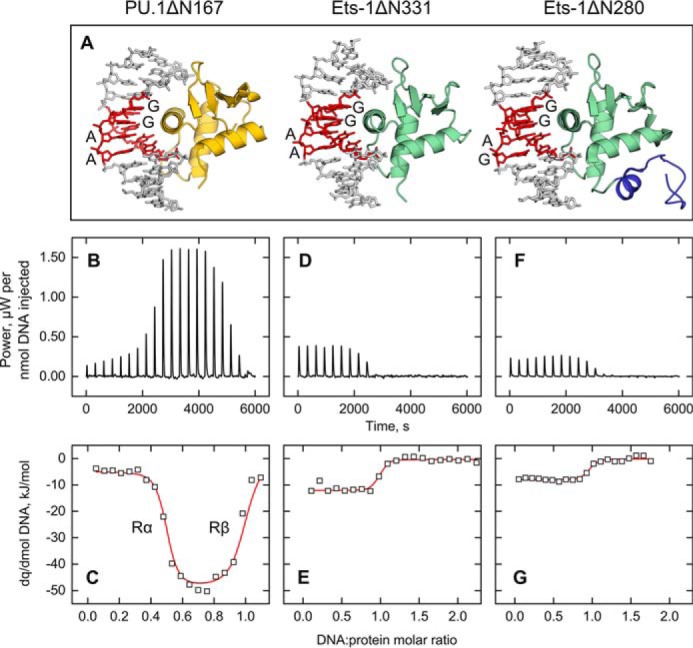
Figure 1.
Figure 1.
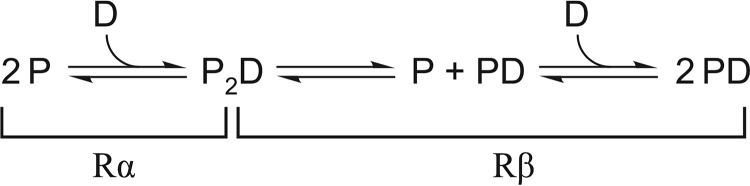
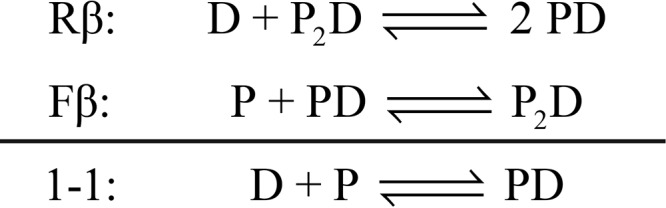
Dimerization at a single cognate binding site is intrinsic to the ETS domain of PU.1, but not its structural homolog Ets-1. A, the co-crystal structures of PU.1 (gold; PDB code 1PUE) and Ets-1 (green), the latter with (1MDM) or without (1K79) part of its autoinhibitory domain (blue). All three structures show the canonical 1:1 binding stoichiometry with oligomeric DNA harboring a core 5′-GGAX-3′ consensus (red), as labeled. Note that the cognate DNA sequences in the co-crystal structures are not sequence-identical to the experimental sequences in this study. B, D, and F, representative ITC thermograms at 25 °C of DNA-into-protein titrations for the ETS domains of PU.1 (B) and Ets-1 (minimal = ΔN331 (D); autoinhibited = ΔN280 (F)). The ordinate is baseline-subtracted and normalized to the amount of DNA delivered per injection to aid comparison; exothermic response is upward. C, E, and G, the titration data for PU.1ΔN167 was empirically fitted as a negatively cooperative interaction. The two phases in the PU.1 titration (marked Rα and Rβ in C) represent the successive formation of a protein/DNA = 2:1 complex (protein in excess) followed by the 1:1 complex. For Ets-1ΔN331 (E) and Ets-1ΔN280 (G), a 1:1 model was empirically fitted to the data. The stronger and more complex apparent heats associated with the PU.1ΔN167 titrations included the dimerization and binding of PU.1ΔN167 as a 2:1 complex, which dissociates to two 1:1 complexes as DNA reached molar equivalence, in addition to more enthalpically driven 1:1 binding than Ets-1. The details of the thermodynamic deconvolution are provided under “Materials and methods.”
Figure 2.
Figure 2.
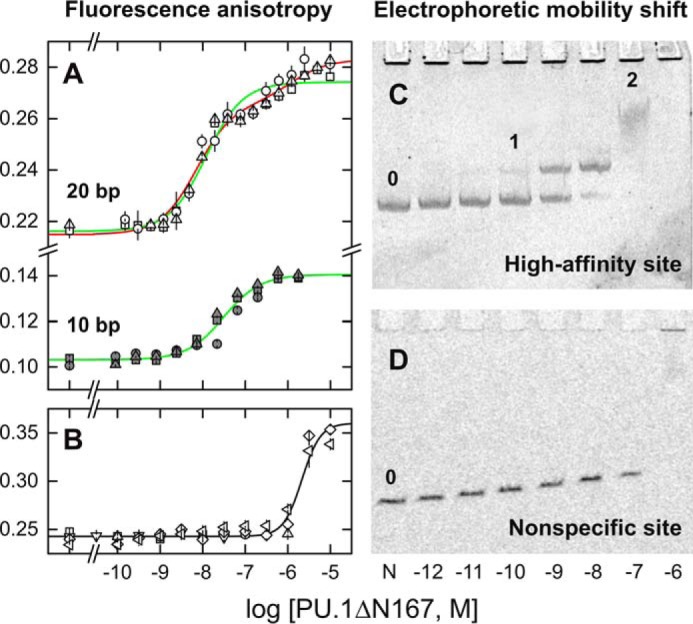
Sequence and site size requirements for sequential dimerization of the specific DNA-bound ETS domain of PU.1. A and B, fluorescence polarization titrations of Cy3-labeled 20-bp DNA probes (22) harboring the high-affinity site (A) 5′-AGCGGAAGTG-3′ or its isomeric nonspecific variant (B) 5′-AGCGAGAGTG-3′ with PU.1ΔN167. The 10-bp duplex in A was constructed by annealing the labeled strand with a 10-bp complement encoding only the core ETS-binding site. Symbols represent data from independent replicate experiments. Curves represent a least-square fit of the data from triplicate experiments to a sequential 2:1 binding model (red) or constrained to a 1:1 model (green). The latter afforded a significantly poorer fit of the data (p < 1 × 10⁻⁴, Fisher's F-test on sums of squares). The nonspecific data were fitted with the Hill equation (black). Error bars, S.E. C, electrophoretic mobility shift titration of a 209-bp DNA fragment (1 nm, marked 0) harboring a single copy of the high-affinity site with PU.1ΔN167. Following formation of the 1:1 complex (marked 1), a discrete, low-mobility species was present at 0.1 μm protein (labeled 2). At 1 μm protein (103-fold excess), a nonspecific complex finally formed, which did not enter the gel, as confirmed with a fragment harboring the nonspecific sequence (D). The shadows lining the wells in C represent an irregular imaging artifact of the stained gel, not protein-bound DNA, as it was observed even in the negative-control lane containing no PU.1 (marked 0).
Figure 3.
Figure 3.
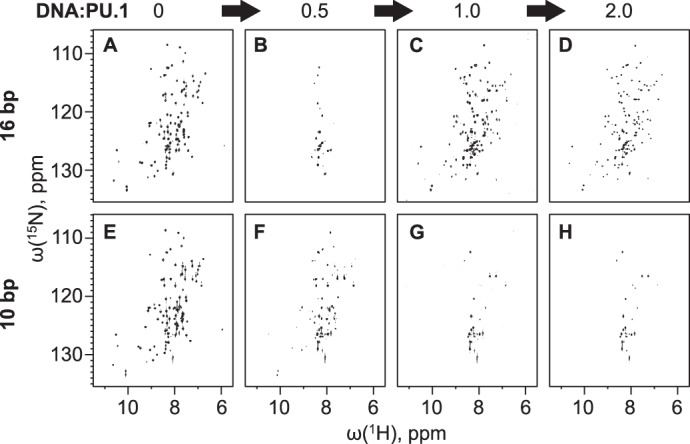
1H-15N HSQC NMR spectroscopy of PU.1/DNA complexes. Uniformly 15N-labeled PU.1ΔN167 was titrated with a 16-bp (A–D) or 10-bp (E–H) unlabeled high-affinity DNA (5′-GCAAGCGGAAGTGAGC-3′) at the indicated molar ratios. Each series of spectra was acquired with the same sample and intensity adjusted to the same noise level.
Figure 4.
Figure 4.
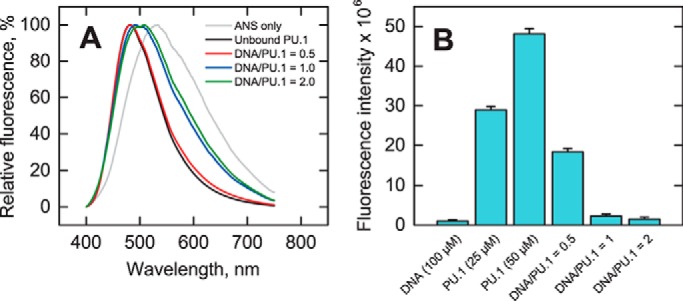
Biochemical characterization of PU.1/DNA complex conformation. A, fluorescence spectra of 50 μm PU.1ΔN167 alone or with 0.5, 1.0, or 2.0 molar eq of 16-bp site-specific DNA after mixing with 200 μm ANS. Samples were excited at 375 nm. B, fluorescence intensity at 530 nm of PU.1ΔN167 with or without 16-bp DNA after subtraction of an ANS-only control, shown as average ± S.D. (error bars) of triplicate experiments.
Figure 5.
Figure 5.
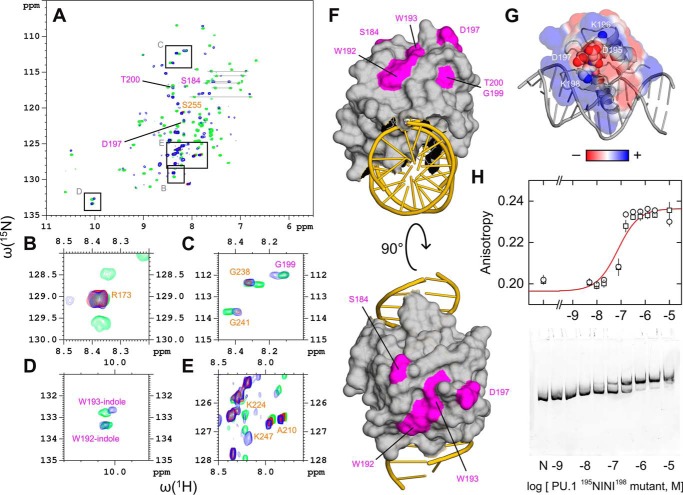
Mapping the dimerization interface of the site-specific 2:1 complex. A, overlay of 1H-15N HSQC spectra in the absence (green) or presence of 16-bp site-specific DNA at 0.5 (red) and 1.0 (blue) molar ratios. Peaks labeled in orange that showed strong overlap among all three states (blue/red/green) were taken to represent residues not involved in site-specific dimerization. Peaks labeled in purple that overlapped only in the unbound and 1:1-bound states (blue/green) were taken to represent residues involved in dimerization. Assigned resonances were as reported for residues 167–260 by Jia et al. (27). Boxes indicate regions that are magnified in B–E. F, mapping of the (purple) residues implicated in PU.1 dimerization to the 1:1 co-crystal structure (PDB code 1PUE). G, continuum electrostatic surface potential of PU.1 in the co-crystal structure. The residues 195DKDK198 are shown as spheres. H, DNA-binding profiles of a 195NINI198 mutant of PU.1ΔN167 by fluorescence polarization (20 bp) and gel mobility shift (209 bp) under the same experimental conditions as in Fig. 2. Symbols represent replicate experiments; the curve represents a 1:1 fit to the data. Error bars, S.E.
Figure 6.
Figure 6.
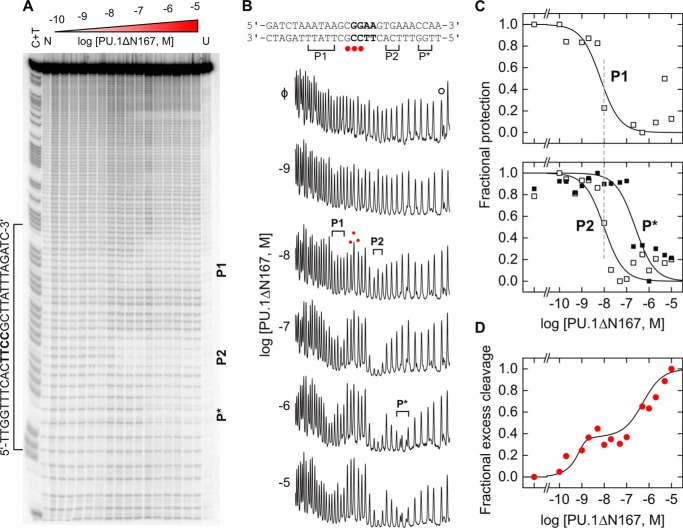
Expansion of the DNA contact interface in the 2:1 PU.1/DNA complex. A singly end-radiolabeled DNA fragment was titrated at equilibrium with PU.1ΔN167 and digested with OH under single-hit conditions. A C + T reaction was included to index the digested DNA following denaturing electrophoresis. A, image of the sequencing gel. N and U denote DNA digested without protein and undigested DNA, respectively. A second footprint was observed at a cryptic binding site (5′-ATGGGAATTC-3′) encoded by pUC19 vector further downstream from the cloned high-affinity site. The lower affinity of this site (48) meant that it did not generate the sequential 2:1 complex beyond the 1:1 footprint at the maximum PU.1 concentration used. B, traces of the indicated lanes. Brackets and red dots denote protected and hypersensitive positions at the indicated and higher protein concentrations, respectively, relative to a distal control peak marked with a hollow dot (○). C, titration of the summed integrated intensities of the protected bases marked P1 and P2 (white squares) associated with the 1:1 complex and P* (black squares) produced by the 2:1 complex in B, normalized to the control peak intensity and scaled to (0, 1). Curves represent empirical fits to the Hill equation. D, titration of the summed integrated intensities of the hypersensitive peaks (red circles), scaled to (0, 1) but normalized to the intensity at the highest PU.1ΔN167 concentration tested. The curve represents a fit by a sequential 2:1 binding model.
Scheme 1
Scheme 1
Scheme 2
Scheme 2

References

    1. Iwasaki H., Somoza C., Shigematsu H., Duprez E. A., Iwasaki-Arai J., Mizuno S., Arinobu Y., Geary K., Zhang P., Dayaram T., Fenyus M. L., Elf S., Chan S., Kastner P., Huettner C. S., et al. (2005) Distinctive and indispensable roles of PU.1 in maintenance of hematopoietic stem cells and their differentiation. Blood 106, 1590–1600 - PMC - PubMed
    1. Mak K. S., Funnell A. P., Pearson R. C., and Crossley M. (2011) PU.1 and haematopoietic cell fate: dosage matters. Int. J. Cell Biol. 2011, 808524. - PMC - PubMed
    1. Dozmorov M. G., Wren J. D., and Alarcón-Riquelme M. E. (2014) Epigenomic elements enriched in the promoters of autoimmunity susceptibility genes. Epigenetics 9, 276–285 - PMC - PubMed
    1. Rosenbauer F., Wagner K., Kutok J. L., Iwasaki H., Le Beau M. M., Okuno Y., Akashi K., Fiering S., and Tenen D. G. (2004) Acute myeloid leukemia induced by graded reduction of a lineage-specific transcription factor, PU.1. Nat. Genet. 36, 624–630 - PubMed
    1. Tatetsu H., Ueno S., Hata H., Yamada Y., Takeya M., Mitsuya H., Tenen D. G., and Okuno Y. (2007) Down-regulation of PU.1 by methylation of distal regulatory elements and the promoter is required for myeloma cell growth. Cancer Res. 67, 5328–5336 - PubMed

Publication types

MeSH terms

Associated data

LinkOut - more resources