


Antioxidant Activity of Quercetin and Its Glucosides from Propolis: A Theoretical Study
- PMID: 28790397
- PMCID: PMC5548903
- DOI: 10.1038/s41598-017-08024-8
Antioxidant Activity of Quercetin and Its Glucosides from Propolis: A Theoretical Study
Abstract
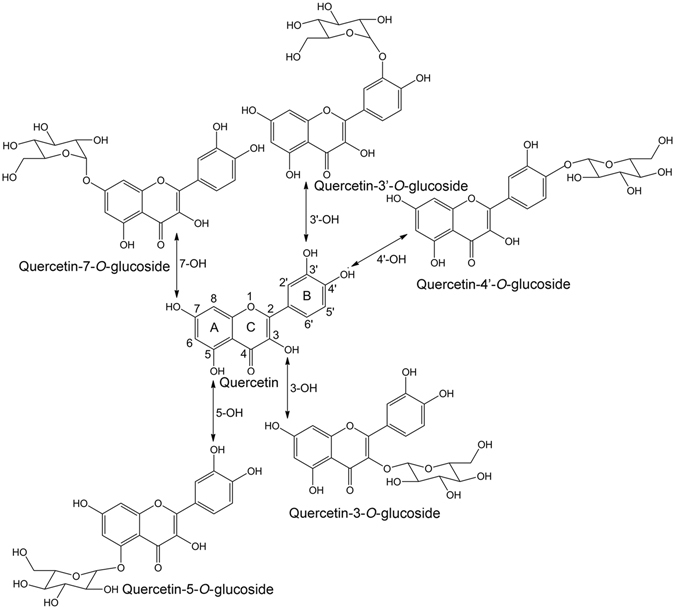
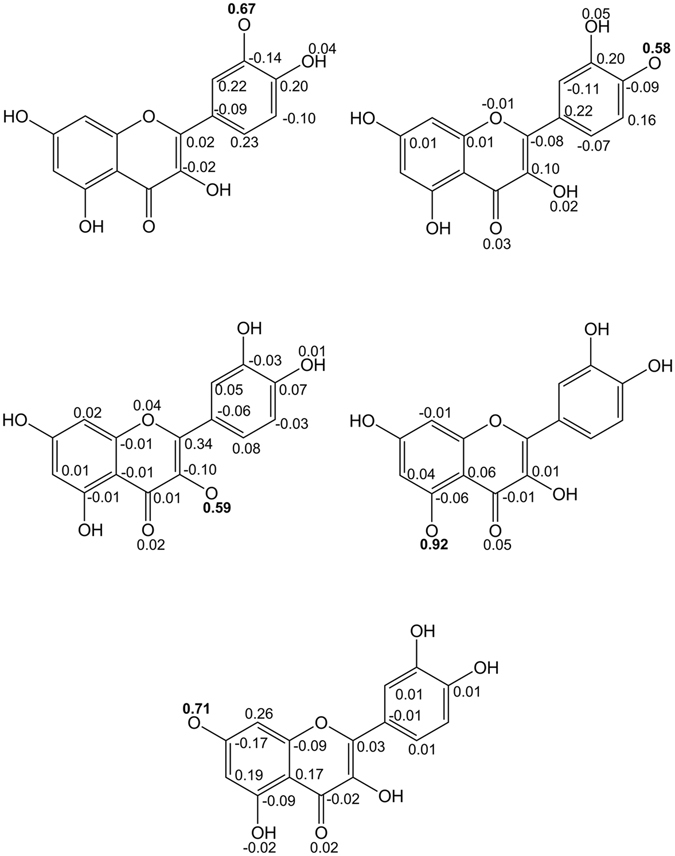
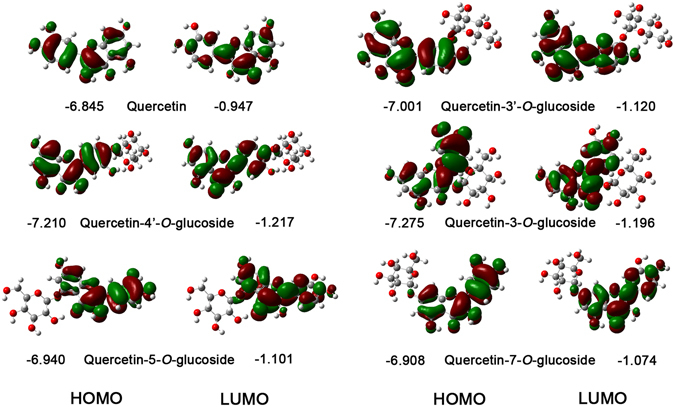
Among the multiple components of propolis, flavonoids contribute greatly to the antioxidant activities of propolis. Flavonoids mainly exist in the form of sugar-conjugated derivatives. Quercetin glycosides represent the predominant flavonoid fraction in propolis. In this work, density functional theory (DFT) calculations were applied to analyze the antioxidative properties of quercetin and its glucosides in the gas and in the liquid phase (ethanol, water). Three main antioxidant mechanisms, hydrogen atom transfer (HAT), single electron transfer followed by proton transfer (SET-PT) and sequential proton loss electron transfer (SPLET) were used to analyze the antioxidative capacity of the investigated compounds. Solvent effects dominantly affect SET-PT and SPLET. Thus, the thermodynamically preferred mechanism can be altered. HAT and SPLET are the thermodynamically dominant mechanisms in gas and solvent phases, respectively. Therefore, in the gas phase, the sequence of the antioxidative capacity is similar with the bond dissociation enthalpy values: quercetin > quercetin-5-O-glucoside > quercetin-7-O-glucoside > quercetin-3-O-glucoside > quercetin-3'-O-glucoside > quercetin-4'-O-glucoside. While, in the solvent phases, the sequence is similar with the proton affinity values: quercetin-4'-O-glucoside > quercetin-5-O-glucoside > quercetin > quercetin-3-O-glucoside > quercetin-7-O-glucoside > quercetin-3'-O-glucoside. OH groups in B-ring and C-ring contribute mainly to the antioxidative activities of quercetin and glucosides compared with A-ring.
Conflict of interest statement
The authors declare that they have no competing interests.
Figures
References
-
- Nagai T, Sakai M, Inoue R, Inoue H, Suzuki N. Antioxidative activities of some commercially honeys, royal jelly, and propolis. Food Chem. 2001;75:237–240. doi: 10.1016/S0308-8146(01)00193-5. - DOI
-
- Diplock AT, Rice-Evans CA, Burdon RH. Is there a significant role for lipid peroxidation in the causation of malignancy and for antioxidants in cancer prevention. Cancer Res. 1994;54:1952–1956. - PubMed
-
- Bankova VS, de Castro SL, Marcucci MC. Propolis: Recent advances in chemistry and plant origin. Apidologie. 2000;31:3–15. doi: 10.1051/apido:2000102. - DOI
Publication types
MeSH terms
Substances
LinkOut - more resources
Full Text Sources
Other Literature Sources
Medical
