. 2017 Aug 8;7(1):7484.
doi: 10.1038/s41598-017-07774-9.

The manipulation of gene expression and the biosynthesis of Vitamin C, E and folate in light-and dark-germination of sweet corn seeds

Affiliations

The manipulation of gene expression and the biosynthesis of Vitamin C, E and folate in light-and dark-germination of sweet corn seeds

Fengyuan Liu et al. Sci Rep. .

Abstract

This study investigates the potential interrelationship between gene expression and biosynthesis of vitamin C, E and folate in sweet corn sprouts. Germination of sweet corn kernels was conducted in light and dark environments to determine if this relationship was regulated by photo-illumination. Results indicated that light and dark environments affected the DHAR, TMT and GTPCH expression and that these genes were the predominant genes of vitamin C, E and folate biosynthesis pathways respectively during the germination. Levels of vitamin C and folate increased during the germination of sweet corn seeds while vitamin E had a declining manner. Sweet corn sprouts had higher vitamin C and E levels as well as relevant gene expression levels in light environment while illumination had little influence on the folate contents and the gene expression levels during the germination. These results indicate that there might be a collaborative relationship between vitamin C and folate regulation during sweet corn seed germination, while an inhibitive regulation might exist between vitamin C and E.


Conflict of interest statement

The authors declare that they have no competing interests.

Figures
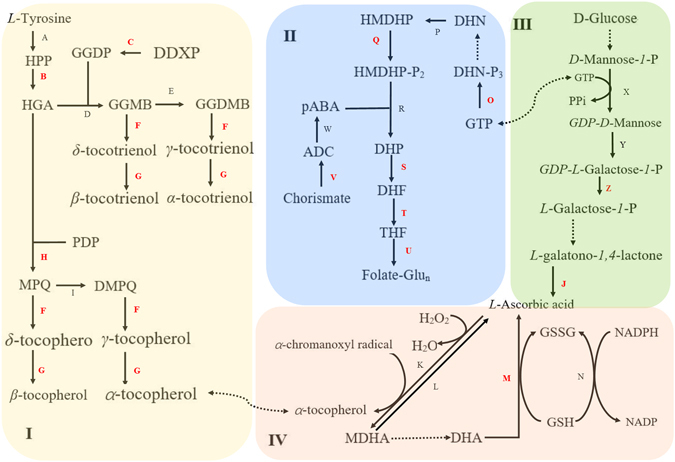
Figure 1
Figure 1
Pathways investigated in this study. (I) Vitamin E biosynthesis pathway. (II) Folate biosynthesis pathway. (III) Vitamin C biosynthesis pathway. (IV) Ascorbic acid-Glutathione-Tocopherol cycle. Letters indicates the catalyzing enzymes in the individual reactions and red letters refers to those enzymes studied in this paper: A, tyrosine aminotransferase; B, HPPD, 4-hydoxyphenyl-pruvate dioxygenase; C, DXPR, 1-deoxy-D-xylulose-5-phosphate reductase; D, HGGT, homogentisate geranylgeranyl transferase; E, I, MPBQ-MT, 2-methyl-6-phytyl-1,4-benzoquinol methyltransferase; F, TC, tocopherol/tocotrienol cyclase; G, TMT, tocopherol/tocotrienol methyltransferase; H, HPT, homogentisic acid phytyltransferase; J, GLDH, L-galactono-1,4-lactone dehydrogenase; K, APX, ascorbate peroxidase; L, MDHAR, monodehydroascorbate reductase; M, DHAR, dehydroascorbate reductase; N, GR, glutathione reductase; O, GTPCH, GTP cyclohydrolase; P, DHN aldolase; Q, HPPK, 6-hydroxymethyldihydropterin pyrophosphokinase; R, DHPS, dihydropteroate synthase; S, DHFS, dihydrofolate synthase; T, DHFR, dihydrofolate reductase; U, FPGS, folylpolyglutamate synthase; V, ADCS, aminodeoxychorismate synthase; W, aminodeoxychorismate lyase; X, GMP, GDP-mannose pyrophosphorylase; Y, GME, GDP-mannose-3,5-epimerase; Z, VTC2, GDP-L-galactose phosphorylase. Abbreviations: HPP, 4-hydoxyphenyl-pyruvate; HGA, homogentisic acid; GGDP, geranylgeranyl diphosphate; DDXP, 1-deoxy-D-xylulose-5-p; GGMB, 6-geranylgeranyl-2-methylbenzene-1,4-diol; GGDMB, geranylgeranyl-2,3-dimethylbenzene-1,4-diol; PDP, phytyldiphosphate; MPQ, 1-methyl-6-phytyl-1,4-benzoquinol; DMPQ, 2,3-dimenthyl-5-phytyl-1,4-benzoquinol; MDHA, monodehydroascorbate; DHA, dehydroascorbate; GSH, glutathione; GSSG, oxidized glutathione; NADP, nicotinamide adenine dinucleotide phosphate; NADPH, nicotinamide adenine dinucleotide phosphate; GTP, guanosine triphosphate; DHN-P, dihydroneopterin phosphate; DHN, dihydroneopterin; HMDHP, 6-hydroxymethyldihydropterin; HMDHP-P2, 6-hydroxymethyldihydropterin diphosphate; DHP, dihydropteroate; DHF, dihydrofolate; THF, tetrahydrofolate; ADC, aminodeoxychorismate; pABA, p-aminobenzoate.
Figure 2
Figure 2
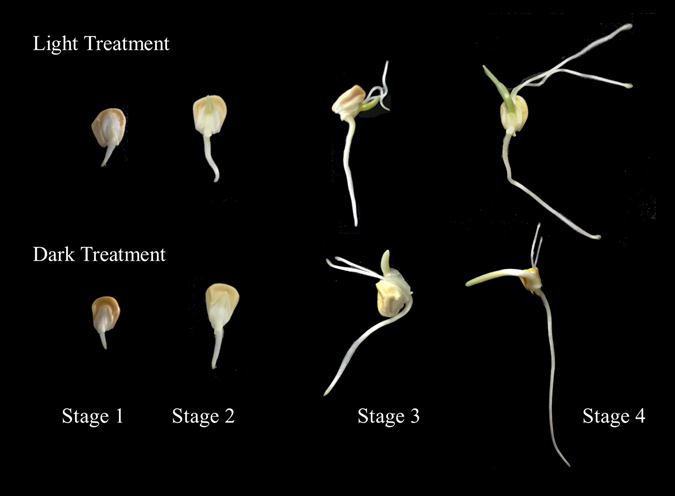
Sweet corn sprouts at different germination stages. Stage 1 representing initial radical emergence (typically after 48 hours); stage 2 representing chitting of the corn (typically after 72 hours); stage 3 representing emergence of the shoot and development of the root (typically after 96 hours); stage 4 representing shoot and root elongation with the appearance of euphylla (typically after 130 hours).
Figure 3
Figure 3
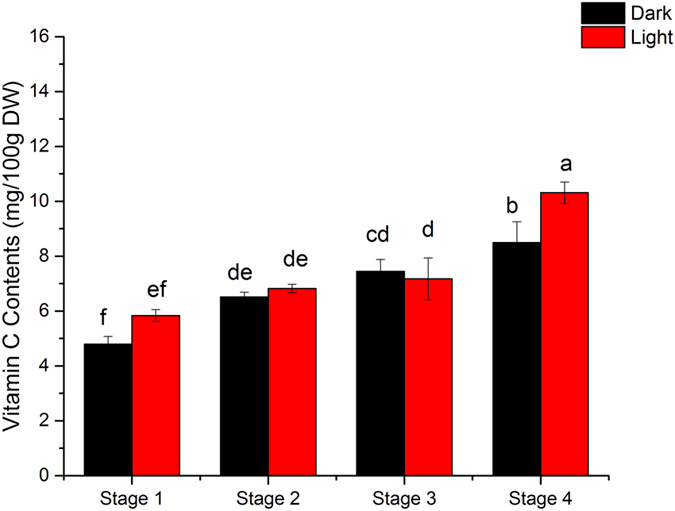
Changes of vitamin C during sweet corn seed germination; Bars with different letter indicates significant difference (p < 0.05) exists within groups.
Figure 4
Figure 4
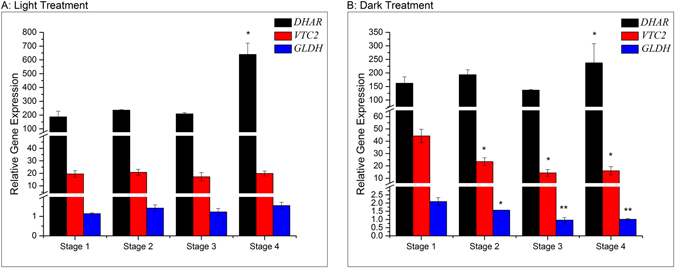
Changes of relative expression level of relevant genes in Vitamin C biosynthetic pathway during sweet corn seed germination; Bars with * and ** indicates significant difference at p < 0.05 and p < 0.01 respectively compared to stage 1. (a) Light treatment; (b) dark treatment.
Figure 5
Figure 5
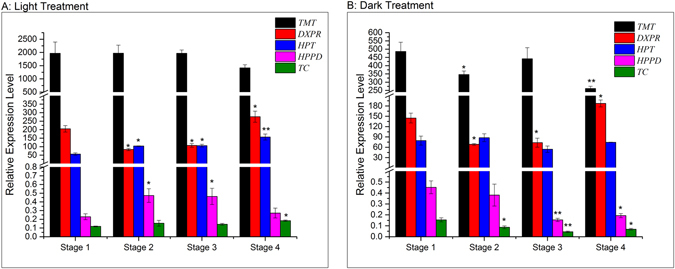
Changes of relative expression level of relevant genes in Vitamin E biosynthetic pathway during sweet corn seed germination; Bars with * and ** indicates significant difference at p < 0.05 and p < 0.01 respectively compared to stage 1. (a) Light treatment; (b) dark treatment.
Figure 6
Figure 6
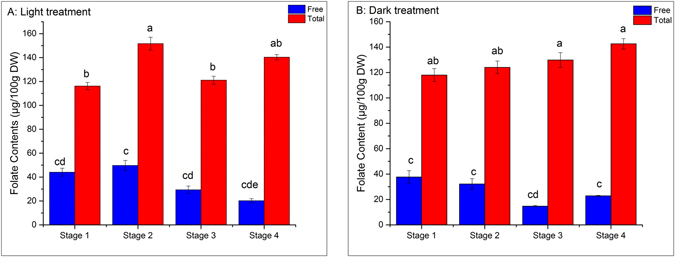
Changes of Folates during sweet corn seed germination; Bars with different letter indicates significant difference (p < 0.05) exists within groups. (a) Light treatment; (b) dark treatment. Free means readily extracted folate, which is obtained by free-enzyme extraction after autoclaving.
Figure 7
Figure 7
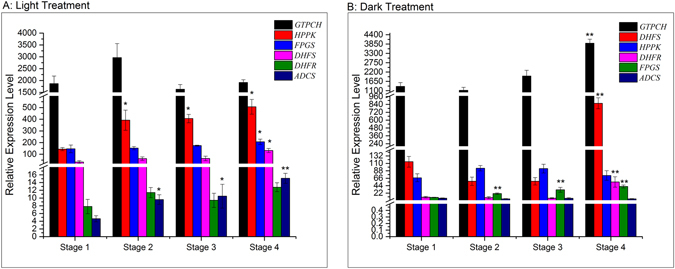
Changes of relative expression level of relevant genes in folate biosynthetic pathway during sweet corn seed germination; Bars with * and ** indicates significant difference at p < 0.05 and p < 0.01 respectively compared to stage 1. (a) Light treatment; (b) dark treatment.

References

    1. Simons M, Bertr Hirel. Nitrogen-use efficiency in maize (Zea mays L.): from ‘omics’ studies to metabolic modelling. Journal of Experimental Botany. 2014;65:5657–5671. doi: 10.1093/jxb/eru227. - DOI - PubMed
    1. Kusano M, Fukushima A. Current challenges and future potential of tomato breeding using omics approaches. Breeding Science. 2013;63:31–41. doi: 10.1270/jsbbs.63.31. - DOI - PMC - PubMed
    1. Colmsee C, et al. OPTIMAS-DW: a comprehensive transcriptomics, metabolomics, ionomics, proteomics and phenomics data resource for maize. BMC Plant Biology. 2012;12:1–10. doi: 10.1186/1471-2229-12-245. - DOI - PMC - PubMed
    1. Smirnoff N, Wheeler GL. Ascorbic acid in plants: biosynthesis and function. Critical Reviews in Plant Sciences. 2000;35:291–314. - PubMed
    1. Dellapenna D, Pogson BJ. Vitamin synthesis in plants: Tocopherols and Carotenoids. Annual Review of Plant Biology. 2006;57:711–738. doi: 10.1146/annurev.arplant.56.032604.144301. - DOI - PubMed

Publication types

MeSH terms