. 2017 Jul-Aug;51(4):359-367.
doi: 10.4103/ortho.IJOrtho_280_17.

The History of Biomechanics in Total Hip Arthroplasty

Affiliations

The History of Biomechanics in Total Hip Arthroplasty

Jan Van Houcke et al. Indian J Orthop. 2017 Jul-Aug.

Erratum in

Abstract

Biomechanics of the hip joint describes how the complex combination of osseous, ligamentous, and muscular structures transfers the weight of the body from the axial skeleton into the appendicular skeleton of the lower limbs. Throughout history, several biomechanical studies based on theoretical mathematics, in vitro, in vivo as well as in silico models have been successfully performed. The insights gained from these studies have improved our understanding of the development of mechanical hip pathologies such as osteoarthritis, hip fractures, and developmental dysplasia of the hip. The main treatment of end-stage degeneration of the hip is total hip arthroplasty (THA). The increasing number of patients undergoing this surgical procedure, as well as their demand for more than just pain relief and leading an active lifestyle, has challenged surgeons and implant manufacturers to deliver higher function as well as longevity with the prosthesis. The science of biomechanics has played and will continue to play a crucial and integral role in achieving these goals. The aim of this article, therefore, is to present to the readers the key concepts in biomechanics of the hip and their application to THA.

Keywords: Arthroplasty; Total hip arthroplasty; biomechanics; cemented THA; hip; low friction arthroplasty; metal on poly; metal-on-metal; osteoarthritis; replacement; uncemented THA.


Conflict of interest statement

There are no conflicts of interest.

Figures
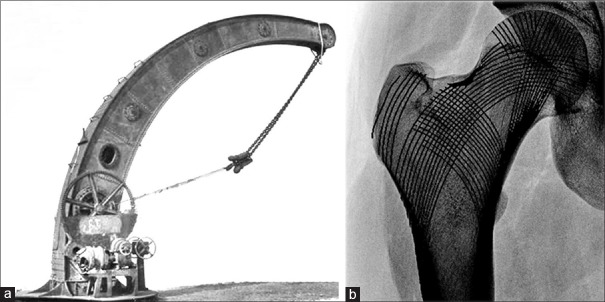
Figure 1
Figure 1
(a) Fairbairn steam crane (b) inner trabecular architecture in the proximal femur
Figure 2
Figure 2
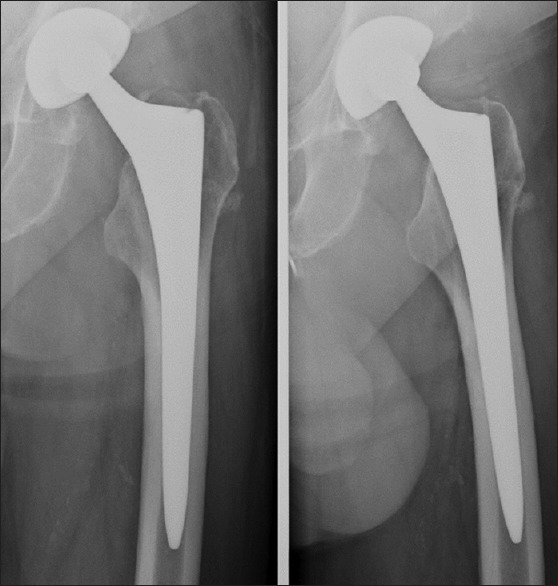
Stress shielding in a left uncemented femoral implant. Note the distal cortical thickening around the canal filling stem and resorption in the metaphyseal Gruen zones 1 and 7
Figure 3
Figure 3
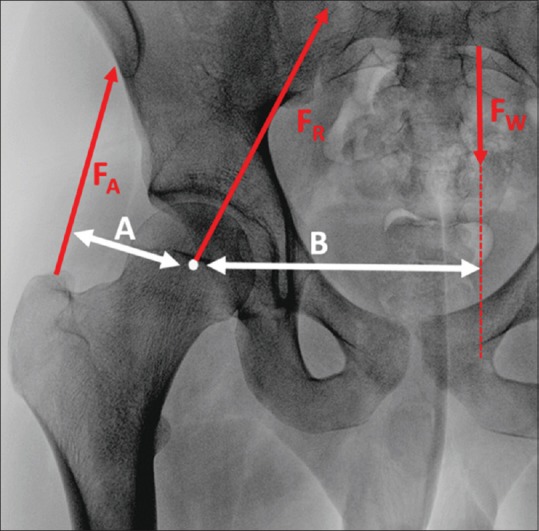
The static biomechanical model of unipodal stance during gait. The body weight vector (Fw), running perpendicular to the ground and originating from the center of mass, is counter balanced by the abductor force (FA). The magnitude of the bodyweight equals the bodyweight minus that of the weightbearing leg. The abductor force pulls along the trajectory of the gluteus medius/minimus muscle fibers. The bodyweight lever arm (B) is the perpendicular distance between the center of hip rotation and the bodyweight vector. As the center of mass moves laterally and the bodyweight increases, the abductor force will need to increase. The abductor lever arm (A) is the perpendicular distance between the center of hip rotation and the abductor force vector. If the abductor lever arm morphologically increases, the abductor force needed to counterbalance a given load decreases
Figure 4
Figure 4
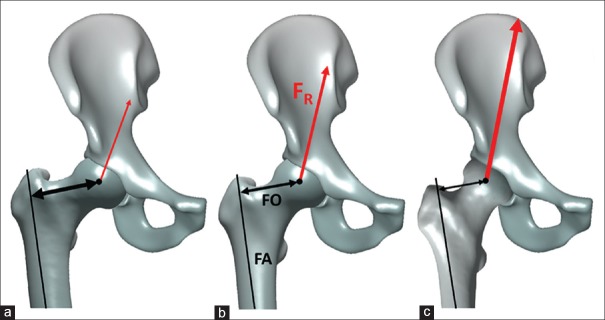
Impact of neck-shaft angle on the femoral offset and hip joint reaction force. An increased neck-shaft angle results in a decrease in femoral offset and increase in hip joint reaction force. (a) Varus hip configuration of 115°, (b) mean Caucasian hip configuration with neck-shaft angle of 130°, (c) valgus hip configuration of 142°. FA: long axis of the femur, FO: femoral offset, FR: hip joint reaction force
Figure 5
Figure 5
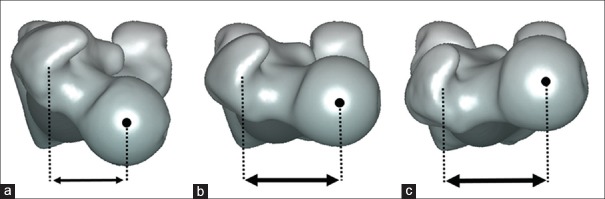
Impact of femoral version on the “functional” femoral offset. As the femoral anteversion increases, the femoral offset decreases resulting in higher hip joint reaction forces. (a) 35° of femoral anteversion, (b) 10° of physiological anteversion, (c) 10° of retroversion
Figure 6
Figure 6
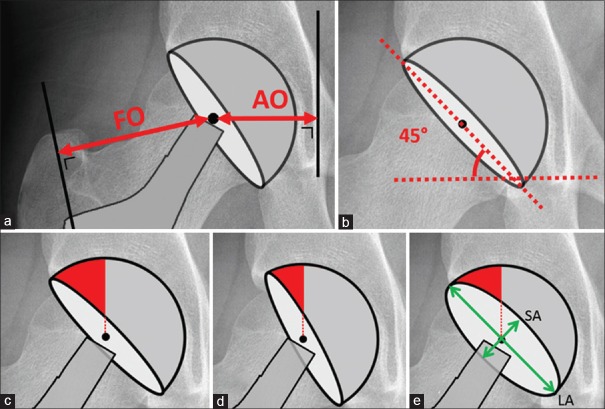
(a) Measurement of the AO and FO. (b) Cup abduction angle measured as the angle between the inter teardrop line and the major axis of the cup projection. (c) Anterosuperior weightbearing area in a cup with 45° of abduction and 15° anteversion, (d) reduced anterosuperior weightbearing area when cup is placed in 60° of abduction, (e) reduced anterosuperior weightbearing area with increased cup anteversion compared to image (c) of the same figure, green arrows representing SA and LA of the cup. Anteversion angle = asin (SA/LA) *180/pi. AO: Acetabular offset, FO: Femoral offset, SA: Short axis, LA: Long axis

References

    1. Murphy LB, Helmick CG, Schwartz TA, Renner JB, Tudor G, Koch GG, et al. One in four people may develop symptomatic hip osteoarthritis in his or her lifetime. Osteoarthritis Cartilage. 2010;18:1372–9. - PMC - PubMed
    1. Learmonth ID, Young C, Rorabeck C. The operation of the century: Total hip replacement. Lancet. 2007;370:1508–19. - PubMed
    1. Wiles P. The surgery of the osteoarthritic hip. Br J Surg. 1958;45:488–97. - PubMed
    1. McKee GK, Watson-Farrar J. Replacement of arthritic hips by the McKee-Farrar prosthesis. J Bone Joint Surg Br. 1966;48:245–59. - PubMed
    1. 13th Annual Report: National Joint Registry for England, Wales, Northern Ireland and the Isle of Man. National Joint Registry. 2016

LinkOut - more resources