


The status of immunosuppression in patients with stage IIIB or IV non-small-cell lung cancer correlates with the clinical characteristics and response to chemotherapy
- PMID: 28790848
- PMCID: PMC5530847
- DOI: 10.2147/OTT.S136259
The status of immunosuppression in patients with stage IIIB or IV non-small-cell lung cancer correlates with the clinical characteristics and response to chemotherapy
Abstract
Background: Indoleamine 2,3-dioxygenase (IDO) catalyzes the rate-limiting step of tryptophan (Trp) degradation via the kynurenine (Kyn) pathway, which inhibits the proliferation of T cells and induces the apoptosis of T cells, leading to immune tolerance. Therefore, IDO has been considered as the most important mechanism for tumor cells to escape from immune response. Previous studies suggested that IDO might be involved in the progression of tumor and resistance to chemotherapy. Several preclinical and clinical studies have proven that IDO inhibitors can regulate IDO-mediated tumor immune escape and potentiate the effect of chemotherapy. Thus, the present study investigated the correlation between the clinical parameters, responses to chemotherapy, and IDO activity to provide a theoretical basis for the clinical application of IDO inhibitors to improve the suppression status and poor prognosis in cancer patients.
Methods: The serum concentrations of Trp and Kyn were measured by high-performance liquid chromatography in 252 patients with stage IIIB or IV non-small-cell lung cancer, and 55 healthy controls. The IDO activity was determined by calculating the serum Kyn-to-Trp (Kyn/Trp) ratio.
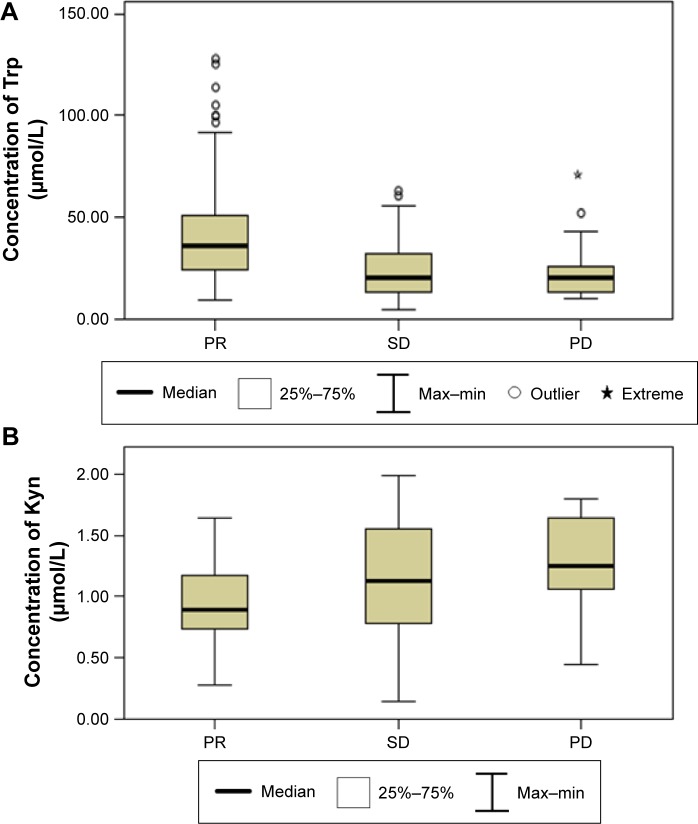
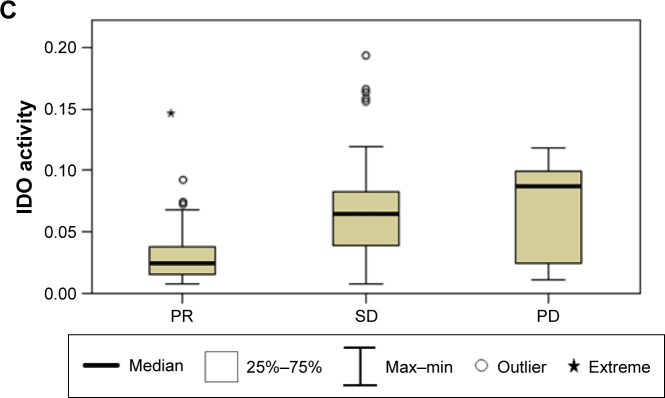
Results: The IDO activity was significantly higher in the lung cancer patients than in the controls (median 0.0389 interquartile range [0.0178-0.0741] vs 0.0111 [0.0091-0.0133], respectively; P<0.0001). In addition, patients with adenocarcinoma had higher IDO activity than patients with nonadenocarcinoma (0.0449 [0.0189-0.0779] vs 0.0245 [0.0155-0.0563], respectively; P=0.006). Furthermore, patients with stage IIIB disease had higher IDO activity than patients with stage IV disease (0.0225 [0.0158-0.0595] vs 0.0445 [0.0190-0.0757], respectively; P=0.012). The most meaningful discovery was that there was a significant difference between the partial response (PR) patients and the stable disease (SD) and progressive disease (PD) patients (0.0240 [0.0155-0.0381] vs 0.0652 [0.0390-0.0831] vs 0.0868 [0.0209-0.0993], respectively, P<0.0001).
Conclusion: IDO activity was increased in lung cancer patients. Higher IDO activity correlated with histological types and disease stages of lung cancer patients, induced the cancer cells' resistance to chemotherapy, and decreased the efficacy of chemotherapy.
Keywords: advanced non-small-cell lung cancer; chemotherapy response; immune escape; indoleamine 2,3-dioxygenase; tumor immunotherapy.
Conflict of interest statement
Disclosure The authors report no conflicts of interest in this work.
Figures
References
-
- Siegel RL, Miller KD, Jemal A. Cancer statistics. CA Cancer J Clin. 2016;66(1):7–30. - PubMed
-
- Govindan R, Page N, Morgensztern D, et al. Changing epidemiology of small-cell lung cancer in the United States over the last 30 years: analysis of the surveillance, epidemiologic, and end results database. J Clin Oncol. 2006;24(28):4539–4544. - PubMed
-
- Auperin A, Le Pechoux C, Rolland E, et al. Meta-analysis of concomitant versus sequential radiochemotherapy in locally advanced non-small-cell lung cancer. J Clin Oncol. 2010;28(13):2181–2190. - PubMed
-
- Besse B, Adjei A, Baas P, et al. 2nd ESMO Consensus Conference on Lung Cancer: non-small-cell lung cancer first-line/second and further lines of treatment in advanced disease. Ann Oncol. 2014;25(8):1475–1484. - PubMed
LinkOut - more resources
Full Text Sources
Other Literature Sources
Research Materials
