


Exercise Preserves Lean Mass and Performance during Severe Energy Deficit: The Role of Exercise Volume and Dietary Protein Content
- PMID: 28790922
- PMCID: PMC5522839
- DOI: 10.3389/fphys.2017.00483
Exercise Preserves Lean Mass and Performance during Severe Energy Deficit: The Role of Exercise Volume and Dietary Protein Content
Abstract
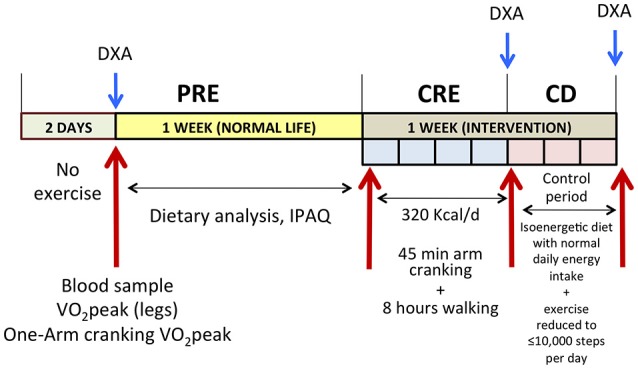
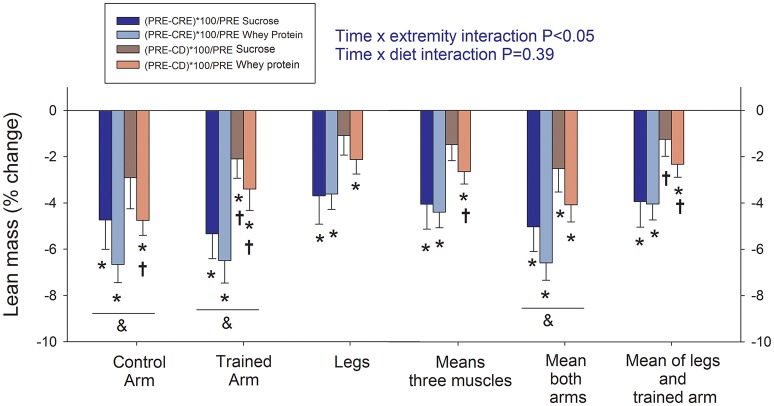
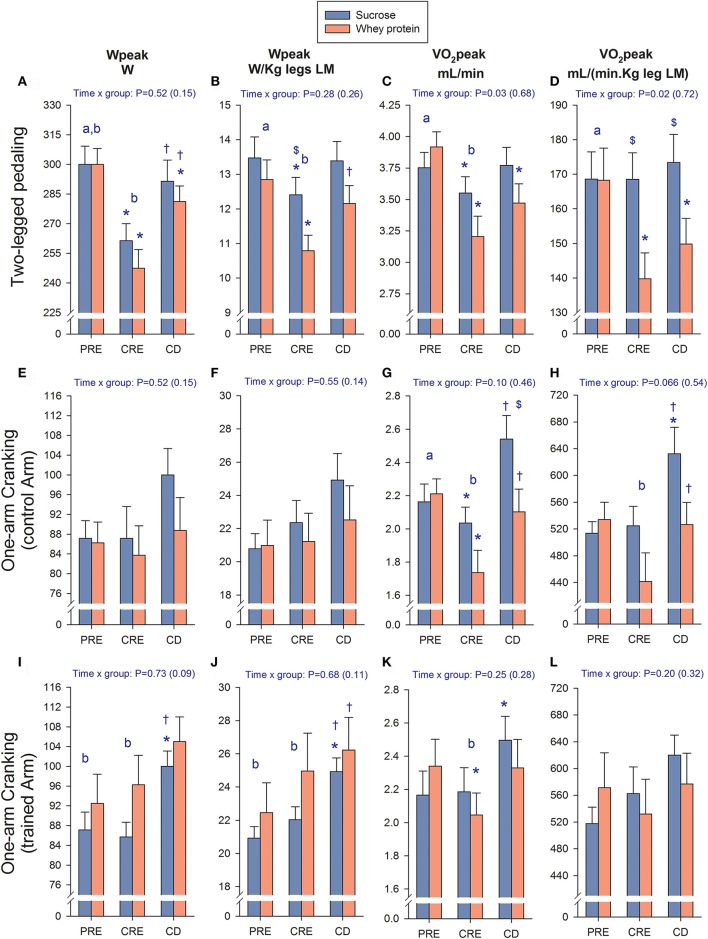
The loss of fat-free mass (FFM) caused by very-low-calorie diets (VLCD) can be attenuated by exercise. The aim of this study was to determine the role played by exercise and dietary protein content in preserving the lean mass and performance of exercised and non-exercised muscles, during a short period of extreme energy deficit (~23 MJ deficit/day). Fifteen overweight men underwent three consecutive experimental phases: baseline assessment (PRE), followed by 4 days of caloric restriction and exercise (CRE) and then 3 days on a control diet combined with reduced exercise (CD). During CRE, the participants ingested a VLCD and performed 45 min of one-arm cranking followed by 8 h walking each day. The VLCD consisted of 0.8 g/kg body weight/day of either whey protein (PRO, n = 8) or sucrose (SU, n = 7). FFM was reduced after CRE (P < 0.001), with the legs and the exercised arm losing proportionally less FFM than the control arm [57% (P < 0.05) and 29% (P = 0.05), respectively]. Performance during leg pedaling, as reflected by the peak oxygen uptake and power output (Wpeak), was reduced after CRE by 15 and 12%, respectively (P < 0.05), and recovered only partially after CD. The deterioration of cycling performance was more pronounced in the whey protein than sucrose group (P < 0.05). Wpeak during arm cranking was unchanged in the control arm, but improved in the contralateral arm by arm cranking. There was a linear relationship between the reduction in whole-body FFM between PRE and CRE and the changes in the cortisol/free testosterone ratio (C/FT), serum isoleucine, leucine, tryptophan, valine, BCAA, and EAA (r = -0.54 to -0.71, respectively, P < 0.05). C/FT tended to be higher in the PRO than the SU group following CRE (P = 0.06). In conclusion, concomitant low-intensity exercise such as walking or arm cranking even during an extreme energy deficit results in remarkable preservation of lean mass. The intake of proteins alone may be associated with greater cortisol/free testosterone ratio and is not better than the ingestion of only carbohydrates for preserving FFM and muscle performance in interventions of short duration.
Keywords: VLCD; exercise; obesity; sucrose; very-low-calorie diet; whey protein.
Figures
References
-
- Afolabi P. R., Jahoor F., Jackson A. A., Stubbs J., Johnstone A. M., Faber P., et al. (2007). The effect of total starvation and very low energy diet in lean men on kinetics of whole body protein and five hepatic secretory proteins. Am. J. Physiol. Endocrinol. Metab. 293, E1580–E1589. 10.1152/ajpendo.00169.2007 - DOI - PubMed
-
- Allerton D. M., Campbell M. D., Gonzalez J. T., Rumbold P. L., West D. J., Stevenson E. J. (2016). Co-ingestion of whey protein with a carbohydrate-rich breakfast does not affect glycemia, insulinemia or subjective appetite following a subsequent meal in healthy males. Nutrients 8:116. 10.3390/nu8030116 - DOI - PMC - PubMed
-
- Aloia J. F., Vaswani A., Ma R., Flaster E. (1995). To what extent is bone mass determined by fat-free or fat mass? Am. J. Clin. Nutr. 61, 1110–1114. - PubMed
LinkOut - more resources
Full Text Sources
Other Literature Sources
Medical
