. 2017 Jul 25:8:523.
doi: 10.3389/fphys.2017.00523. eCollection 2017.

Moderate Exercise Allows for shorter Recovery Time in Critical Limb Ischemia

Affiliations

Moderate Exercise Allows for shorter Recovery Time in Critical Limb Ischemia

Anne Lejay et al. Front Physiol. .

Abstract

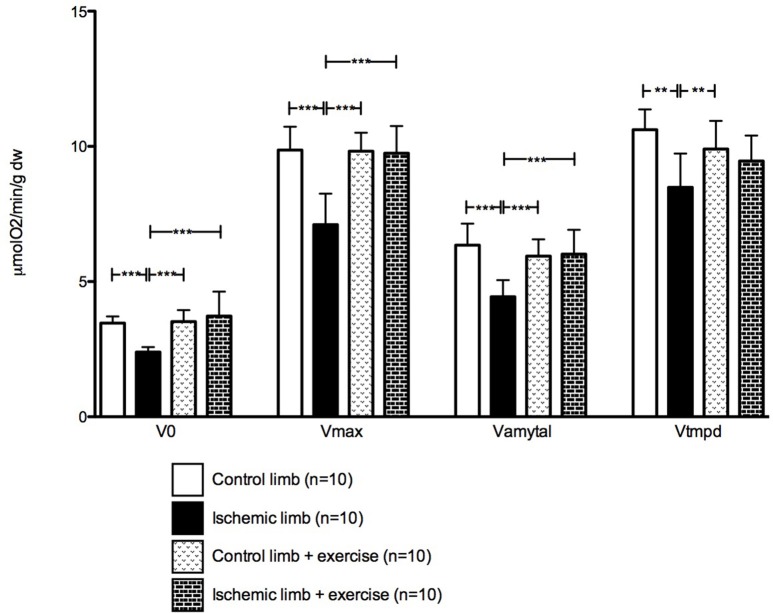
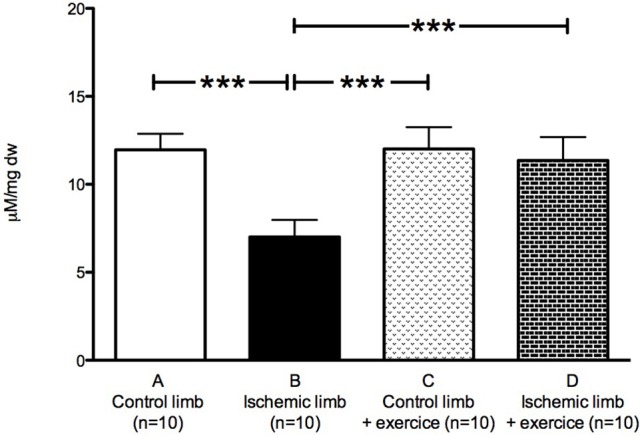
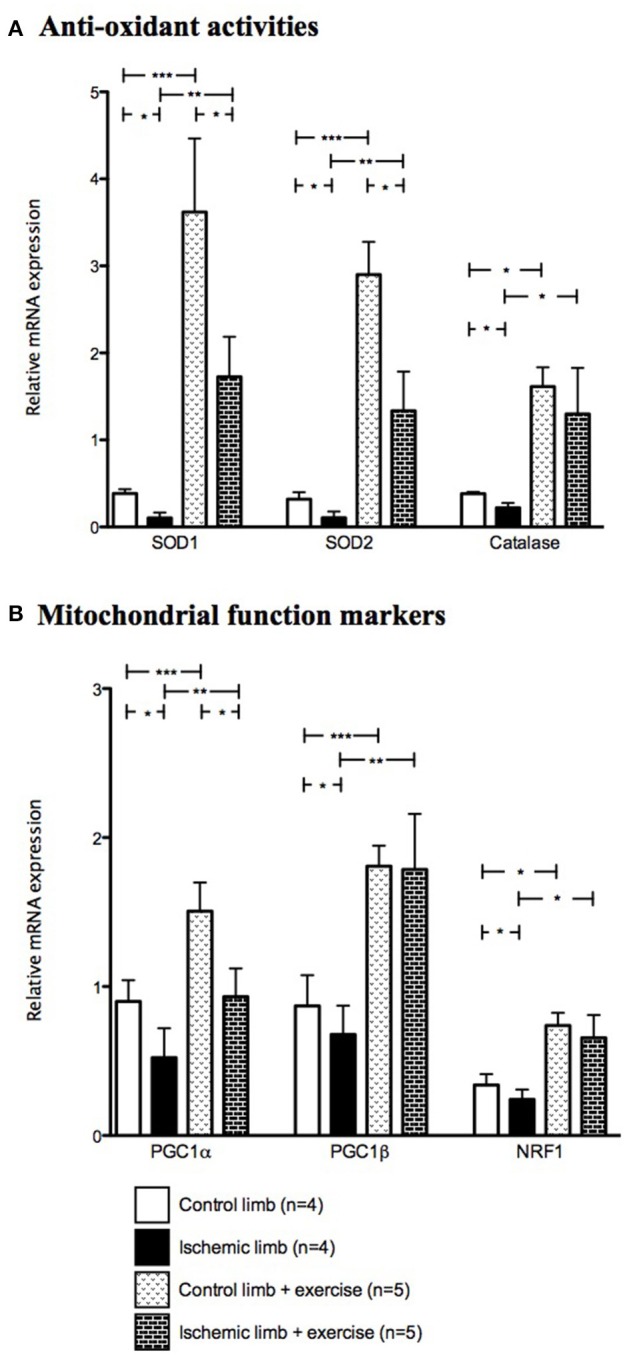
Whether and how moderate exercise might allow for accelerated limb recovery in chronic critical limb ischemia (CLI) remains to be determined. Chronic CLI was surgically induced in mice, and the effect of moderate exercise (training five times per week over a 3-week period) was investigated. Tissue damages and functional scores were assessed on the 4th, 6th, 10th, 20th, and 30th day after surgery. Mice were sacrificed 48 h after the last exercise session in order to assess muscle structure, mitochondrial respiration, calcium retention capacity, oxidative stress and transcript levels of genes encoding proteins controlling mitochondrial functions (PGC1α, PGC1β, NRF1) and anti-oxidant defenses markers (SOD1, SOD2, catalase). CLI resulted in tissue damages and impaired functional scores. Mitochondrial respiration and calcium retention capacity were decreased in the ischemic limb of the non-exercised group (Vmax = 7.11 ± 1.14 vs. 9.86 ± 0.86 mmol 02/min/g dw, p < 0.001; CRC = 7.01 ± 0.97 vs. 11.96 ± 0.92 microM/mg dw, p < 0.001, respectively). Moderate exercise reduced tissue damages, improved functional scores, and restored mitochondrial respiration and calcium retention capacity in the ischemic limb (Vmax = 9.75 ± 1.00 vs. 9.82 ± 0.68 mmol 02/min/g dw; CRC = 11.36 ± 1.33 vs. 12.01 ± 1.24 microM/mg dw, respectively). Exercise also enhanced the transcript levels of PGC1α, PGC1β, NRF1, as well as SOD1, SOD2, and catalase. Moderate exercise restores mitochondrial respiration and calcium retention capacity, and it has beneficial functional effects in chronic CLI, likely by stimulating reactive oxygen species-induced biogenesis and anti-oxidant defenses. These data support further development of exercise therapy even in advanced peripheral arterial disease.

Keywords: exercise; ischemia; mitochondria; muscle; oxidative stress; peripheral arterial disease; sarcopenia.


Figures

Figure 1
Figure 1
Exercise improved tissue damage and functional scores in the exercised group compared to the non-exercised group. Tissue damage (A) and functional (B) scores were evaluated in non-exercised (n = 10) and exercised (n = 10) groups. Results are expressed as means and standard deviations at days 0, 4, 6, 10, 20, and 30. *p < 0.05; **p < 0.01.
Figure 2
Figure 2
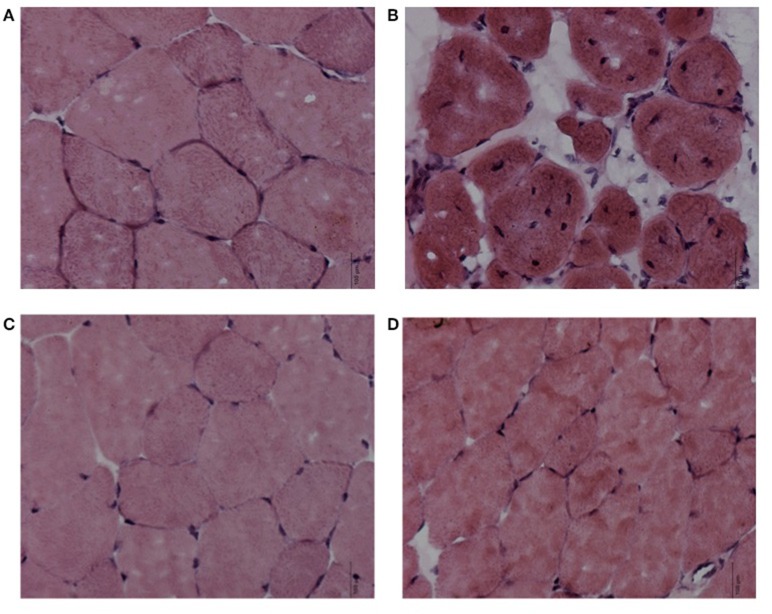
Exercise allowed the recovery of the myopathic feature. Tibialis muscles specimens were examined under bright-field microscopy after hematoxylin-eosin stain (x40). Hematoxylin eosin showed myopathic features of ischemic muscles in the non-exercised group (A Control limb, B Ischemic limb), exercise does not (C Control limb + exercise, D Ischemic limb + exercise).
Figure 3
Figure 3
Mitochondrial respiration is restored in ischemic limbs after exercise. V0 = Basal mitochondrial oxidative capacity; Vmax = Maximal mitochondrial oxidative capacity; Vamytal = Complexes II, III, and IV activity; Vtmpd = Complexes IV activity. Mean ± SD at Day 30 in the non-exercised group (n = 10) and in the exercised group (n = 10). **p < 0.01; ***p < 0.001.
Figure 4
Figure 4
Calcium retention capacity is restored in ischemic limbs after exercise. Mean ± SD at Day 30 in the non-exercised group (n = 10) and in the exercised group (n = 10). ***p < 0.001.
Figure 5
Figure 5
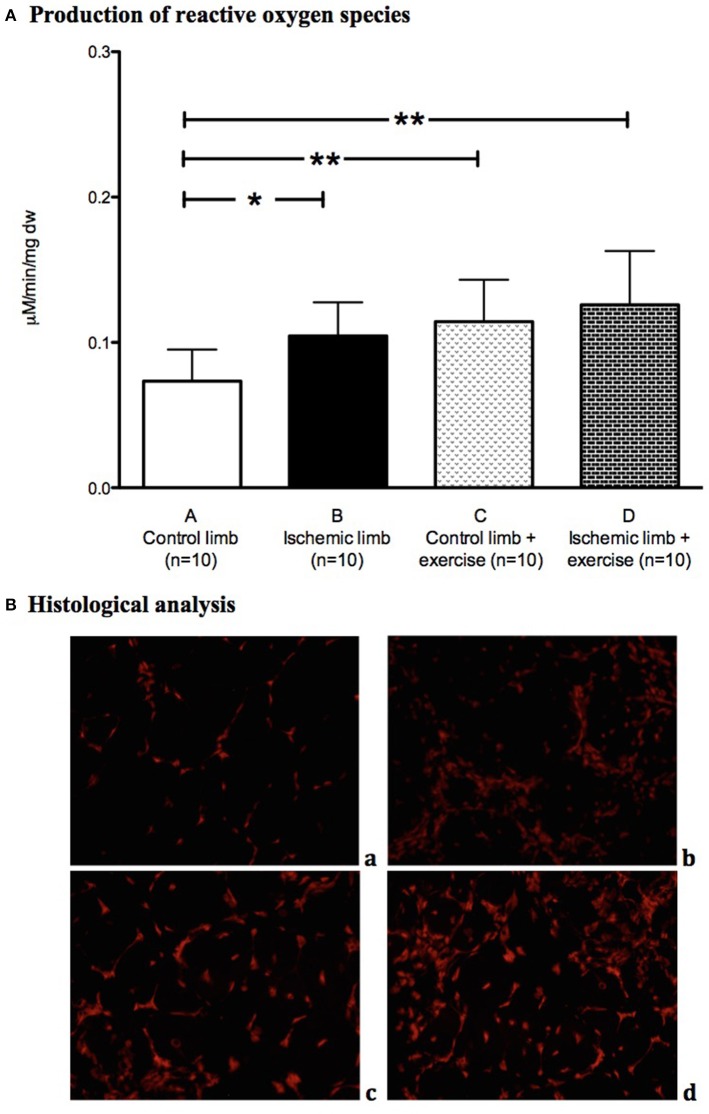
Oxidative stress is increased by critical limb ischemia and exercise. Production of free radicals (A) was increased in ischemic muscles (n = 10) compared to control muscles (n = 10) in the non-exercised group. DHE staining (B) showed higher fluorescence in ischemic muscles compared to control muscles (a, Control limb; b, Ischemic limb) in the non-exercised group. Production of free radicals was increased in the exercised group compared to the non-exercised group (A). Exercice showed higher fluorescence (B) in control and ischemic limbs (c, Control limb + exercise; d, Ischemic limb + exercise). *p < 0.05; **p < 0.01.
Figure 6
Figure 6
Relative mRNA expression of anti-oxidant and mitochondrial function markers are increased after exercise. Mean ± SD at Day 30 in the non-exercised group (n = 4) and in the exercised group (n = 5). *p < 0.05; **p < 0.01; ***p < 0.001. (SOD, superoxide dismutase; PGC, proliferator activated receptor gamma coactivator; NRF, nuclear respiratory factor).

References

    1. Abe T., Loenneke J. P., Fahs C. A., Rossow L. M., Thiebaud R. S., Bemben M. G. (2012). Exercise intensity and muscle hypertrophy in blood-flow restricted limbs and non-restricted muscles: a brief review. Clin. Physiol. Funct. Imaging 32, 247–252. 10.1111/j.1475-097X.2012.01126.x - DOI - PubMed
    1. Baum O., Torchetti E., Malik C., Hoier B., Walker M., Walker P. J., et al. (2016). Capillary ultrastructure and mitochondrial density in skeletal muscle in relation to reduced exercise. Am. J. Physiol. Regul. Integr. Comp. Physiol. 310, 943–952. 10.1152/ajpregu.00480.2015 - DOI - PubMed
    1. Bouitbir J., Charles A. L., Echaniz-Laguna A., Kindo M., Daussin F., Auwerx J., et al. (2012). Opposite effects of statins on mitochondria of cardiac and skeletal muscles: a ‘mitohormesis’ mechanism involving reactive oxygen species and PGC-1. Eur. Heart J. 33, 1397–1407. 10.1093/eurheartj/ehr224 - DOI - PMC - PubMed
    1. Boveris A., Navarro A. (2008). Systemic and mitochondrial adaptive responses to moderate exercise in rodents. Free Radic. Biol. Med. 44, 224–229. 10.1016/j.freeradbiomed.2007.08.015 - DOI - PubMed
    1. Charles A. L., Guilbert A. S., Bouitbir J., Goette-Di Marco P., Enache I., Zoll J., et al. (2011). Effect of postconditioning on mitochondrial dysfunction in experimental aortic cross-clamping. Br. J. Surg. 98, 511–516. 10.1002/bjs.7384 - DOI - PubMed