


The Role of Sulfide Oxidation Impairment in the Pathogenesis of Primary CoQ Deficiency
- PMID: 28790927
- PMCID: PMC5525000
- DOI: 10.3389/fphys.2017.00525
The Role of Sulfide Oxidation Impairment in the Pathogenesis of Primary CoQ Deficiency
Abstract
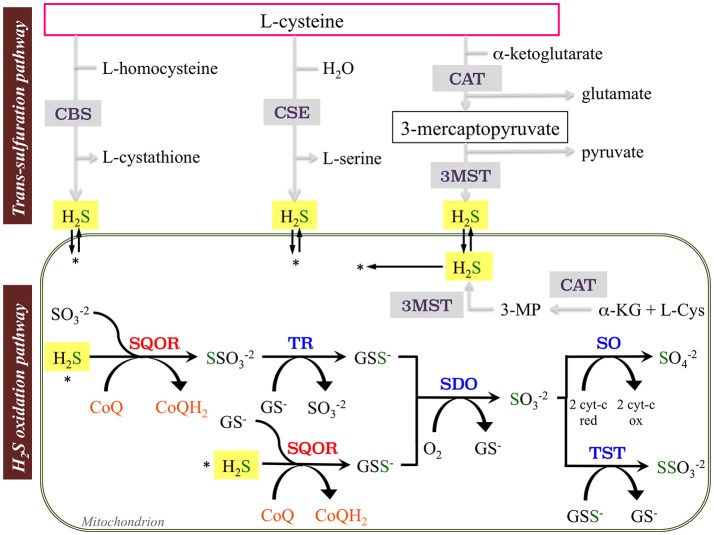
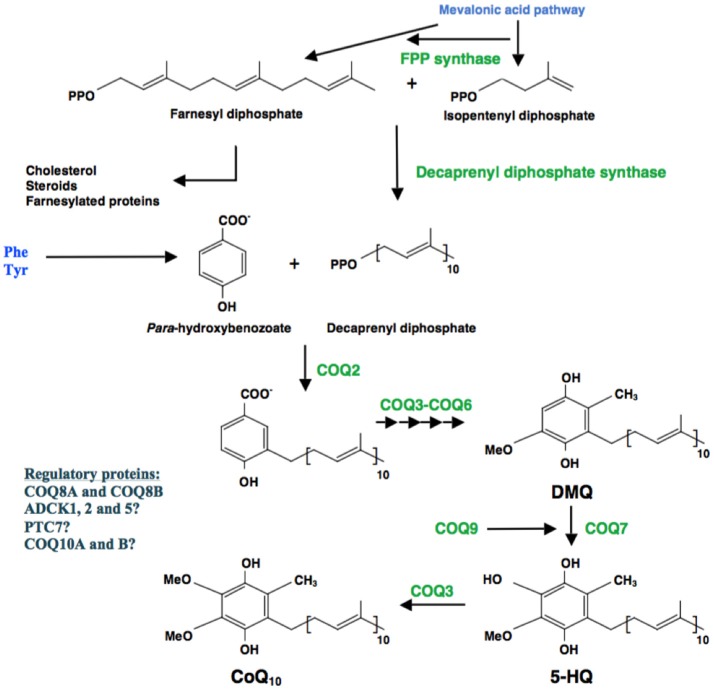
Coenzyme Q (CoQ) is a lipid present in all cell membranes. One of the multiple metabolic functions of CoQ is to transport electrons in the reaction catalyzed by sulfide:quinone oxidoreductase (SQOR), the first enzyme of the oxidation pathway of sulfides (hydrogen sulfide, H2S). Early evidence of a defect in the metabolism of H2S in primary CoQ deficiency came from yeast studies in Schizosaccharomyces pombe strains defective for dps1 and ppt1 (homologs of PDSS1 and COQ2, respectively), which have H2S accumulation. Our recent studies in human skin fibroblasts and in murine models of primary CoQ deficiency show that, also in mammals, decreased CoQ levels cause impairment of H2S oxidation. Patient fibroblasts carrying different mutations in genes encoding proteins involved in CoQ biosynthesis show reduced SQOR activity and protein levels proportional to the levels of CoQ. In Pdss2kd/kd mice, kidney, the only organ clinically affected, shows reduced SQOR levels and downstream enzymes, accumulation of H2S, and glutathione depletion. Pdss2kd/kd mice have also low levels of thiosulfate in plasma and urine, and increased C4-C6 acylcarnitines in blood, due to inhibition of short-chain acyl-CoA dehydrogenase. Also in Coq9R239X mice, the symptomatic organ, cerebrum, shows accumulation of H2S, reduced SQOR, increase in thiosulfate sulfurtransferase and sulfite oxidase, and reduction in the levels of glutathione and glutathione enzymes, leading to alteration of the biosynthetic pathways of glutamate, serotonin, and catecholamines. Coq9R239X mice have also reduced blood pressure, possible consequence of H2S-induced vasorelaxation. Since liver is not clinically affected in Pdss2 and Coq9 mutant mice, the effects of the impairment of H2S oxidation in this organ were not investigated, despite its critical role in metabolism. In conclusion, in vitro and in vivo studies of CoQ deficient models provide evidence of tissue-specific H2S oxidation impairment, an additional pathomechanism that should be considered in the understanding and treatment of primary CoQ deficiency.
Keywords: CoQ; H2S; SQOR; coenzyme Q; sulfide:quinone oxidoreductase; sulfides.
Figures
References
Publication types
Grants and funding
LinkOut - more resources
Full Text Sources
Other Literature Sources
Miscellaneous
