Review
. 2017 Jul 24:8:354.
doi: 10.3389/fneur.2017.00354. eCollection 2017.

Rethinking Neuroprotection in Severe Traumatic Brain Injury: Toward Bedside Neuroprotection

Affiliations
Review

Rethinking Neuroprotection in Severe Traumatic Brain Injury: Toward Bedside Neuroprotection

Tommaso Zoerle et al. Front Neurol. .

Abstract

Neuroprotection after traumatic brain injury (TBI) is an important goal pursued strenuously in the last 30 years. The acute cerebral injury triggers a cascade of biochemical events that may worsen the integrity, function, and connectivity of the brain cells and decrease the chance of functional recovery. A number of molecules acting against this deleterious cascade have been tested in the experimental setting, often with preliminary encouraging results. Unfortunately, clinical trials using those candidate neuroprotectants molecules have consistently produced disappointing results, highlighting the necessity of improving the research standards. Despite repeated failures in pharmacological neuroprotection, TBI treatment in neurointensive care units has achieved outcome improvement. It is likely that intensive treatment has contributed to this progress offering a different kind of neuroprotection, based on a careful prevention and limitations of intracranial and systemic threats. The natural course of acute brain damage, in fact, is often complicated by additional adverse events, like the development of intracranial hypertension, brain hypoxia, or hypoperfusion. All these events may lead to additional brain damage and worsen outcome. An approach designed for early identification and prompt correction of insults may, therefore, limit brain damage and improve results.

Keywords: animal models; intensive care unit; multimodal monitoring; neuroprotection; traumatic brain injury.


Figures
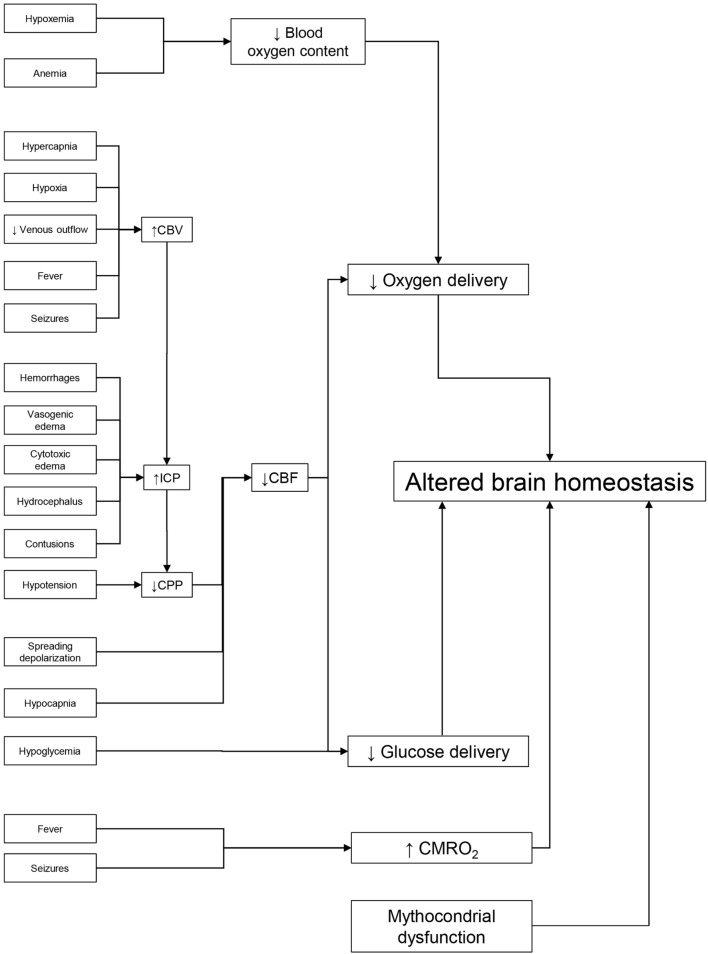
Figure 1
Figure 1
Dealing with potential brain insults at the bedside. Preservation of brain homeostasis requires careful detection of multiple threats, listed on the left side of the figure. Reduced delivery of metabolic substrate and/or increased cerebral metabolic rate of oxygen (CMRO2) are the common pathophysiological mechanisms that may alter brain homeostasis. The key elements in oxygen delivery are blood oxygen content and cerebral blood flow (CBF). The first may be limited by hypoxia (secondary to respiratory failure) or by low hemoglobin. Continuous monitoring of CBF in the ICU is difficult but it can be estimated from cerebral perfusion pressure (CPP). Arterial hypotension and/or elevated intracranial pressure (ICP) [secondary to increased cerebral blood volume (CBV), hematomas, contusion, hydrocephalus, and edema] can reduce CBF. Cerebral vasoconstriction secondary to hypocapnia and spreading depolarization can also limit CBF. Glucose delivery is guaranteed by CBF and blood glucose levels. Factors limiting CBF and hypoglycemia (common during intensive insulin therapy) can reduce its supply. Seizures and fever are common causes of high CMRO2 in the acute phase of traumatic brain injury. By leading to cerebral vasodilatation, they can raise CBV and ICP, lower CPP, and limit CBF and substrate delivery. Unfortunately, preserving the delivery of oxygen and glucose may not be enough to maintain cerebral homeostasis if their utilization is impaired by mitochondrial dysfunction.

References

    1. Bleck TP. Historical aspects of critical care and the nervous system. Crit Care Clin (2009) 25:153–64. 10.1016/j.ccc.2008.12.004 - DOI - PubMed
    1. Stein SC, Georgoff P, Meghan S, Mizra K, Sonnad SS. 150 years of treating severe traumatic brain injury: a systematic review of progress in mortality. J Neurotrauma (2010) 27:1343–53. 10.1089/neu.2009.1206 - DOI - PubMed
    1. Majdan M, Plancikova D, Brazinova A, Rusnak M, Nieboer D, Feigin V, et al. Epidemiology of traumatic brain injuries in Europe: a cross-sectional analysis. Lancet Public Health (2016) 1:e76–83. 10.1016/S2468-2667(16)30017-2 - DOI - PubMed
    1. Stocchetti N, Zanier ER. Chronic impact of traumatic brain injury on outcome and quality of life: a narrative review. Crit Care (2016) 20:148. 10.1186/s13054-016-1318-1 - DOI - PMC - PubMed
    1. Roozenbeek B, Maas AI, Menon DK. Changing patterns in the epidemiology of traumatic brain injury. Nat Rev Neurol (2013) 9:231–6. 10.1038/nrneurol.2013.22 - DOI - PubMed
