. 2016 Feb 1;7(2):910-915.
doi: 10.1039/c5sc03526k. Epub 2015 Oct 14.

Imposing control on self-assembly: rational design and synthesis of a mixed-metal, mixed-ligand coordination cage containing four types of component

Affiliations

Imposing control on self-assembly: rational design and synthesis of a mixed-metal, mixed-ligand coordination cage containing four types of component

Alexander J Metherell et al. Chem Sci. .

Abstract

Retrosynthetic analysis of a [M16L24]32+ coordination cage shows how it can be assembled rationally, in a stepwise manner, using a combination of kinetically inert and kinetically labile components. Combination of the components of fac-[Ru(Lph)3](PF6)2, Cd(BF4)2 and Lnaph in the necessary 4 : 12 : 12 stoichiometry afforded crystals of [Ru4Cd12(Lph)12(Lnaph)12]X32 (X = a mono-anion) in which the location of the two types of metal ion [Ru(ii) or Cd(ii)] at specific vertices in the metal-ion array, and the two types of bridging ligand (Lph and Lnaph) along specific edges, is completely controlled by the synthetic strategy. The incorporation of four different types of component at pre-determined positions in a coordination cage superstructure represents a substantial advance in imposing control on the self-assembly of complex metallosupramolecular entities.


Figures
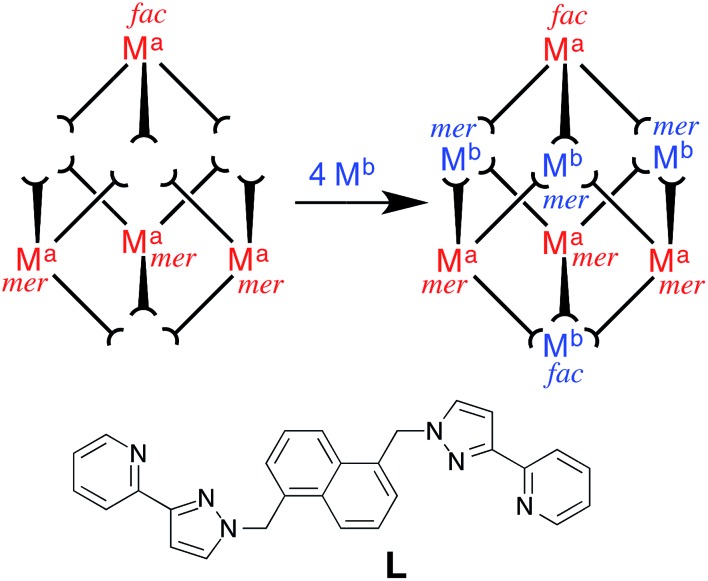
Fig. 1
Fig. 1. Example of stepwise preparation of heterometallic cages from a mixture of kinetically inert units [(Ma)L3]2+ and additional labile ions (Mb)2+ in a 4 : 4 stoichiometry (from ref. 4).
Fig. 2
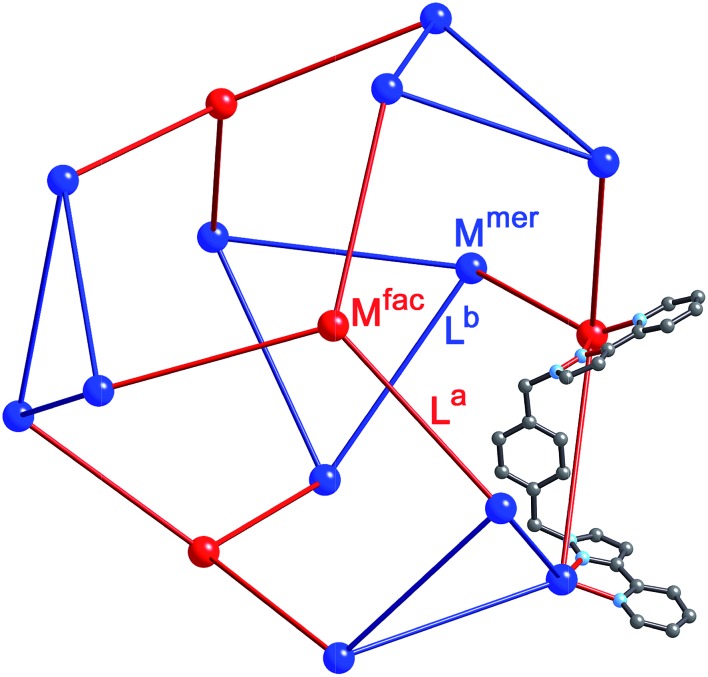
Fig. 2. Representation of the core structure of [Cd16(Lph)24](ClO4)32 (ref. 5) with one bridging ligand included. All metal sites are Cd(ii) but the two different types of geometric isomer are colour-coded: fac tris-chelate metals are in red (Mfac, see main text) and mer tris-chelate metals are in blue (Mmer). Likewise the two ligand environments are La in red, and Lb in blue (see main text).
Fig. 3
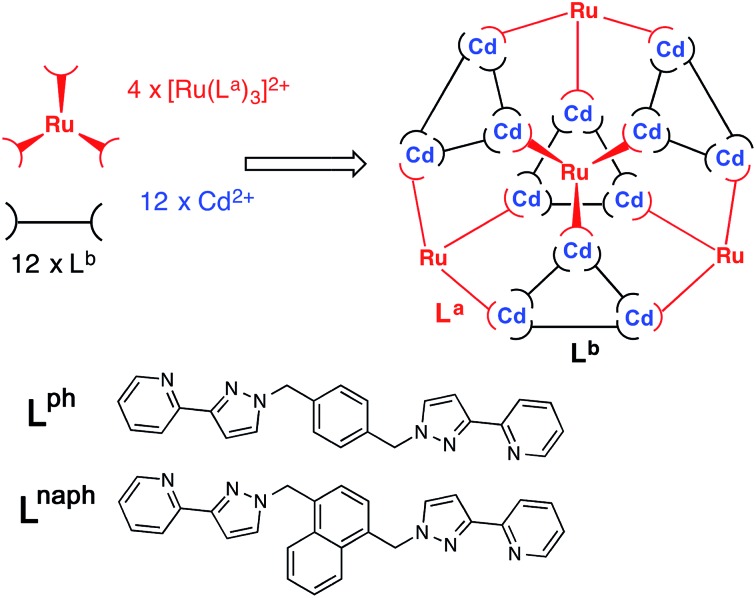
Fig. 3. Sketch of the stepwise synthetic strategy used in this work to prepare the heterometallic, mixed-ligand cage: viz. combination of pre-formed fac-[Ru(La)3]2+ (red), additional labile Cd2+ ions (blue), and free ligand (Lb, black) in a 4 : 12 : 12 ratio to give hexadecanuclear [Ru4Cd12(La)12(Lb)]32+ with La = Lph and Lb = Lnaph.
Fig. 4
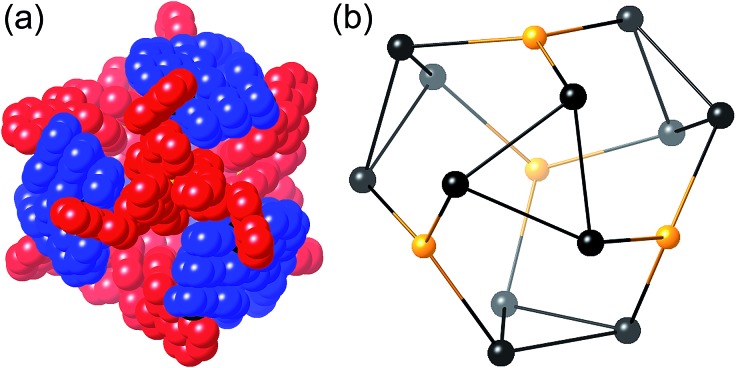
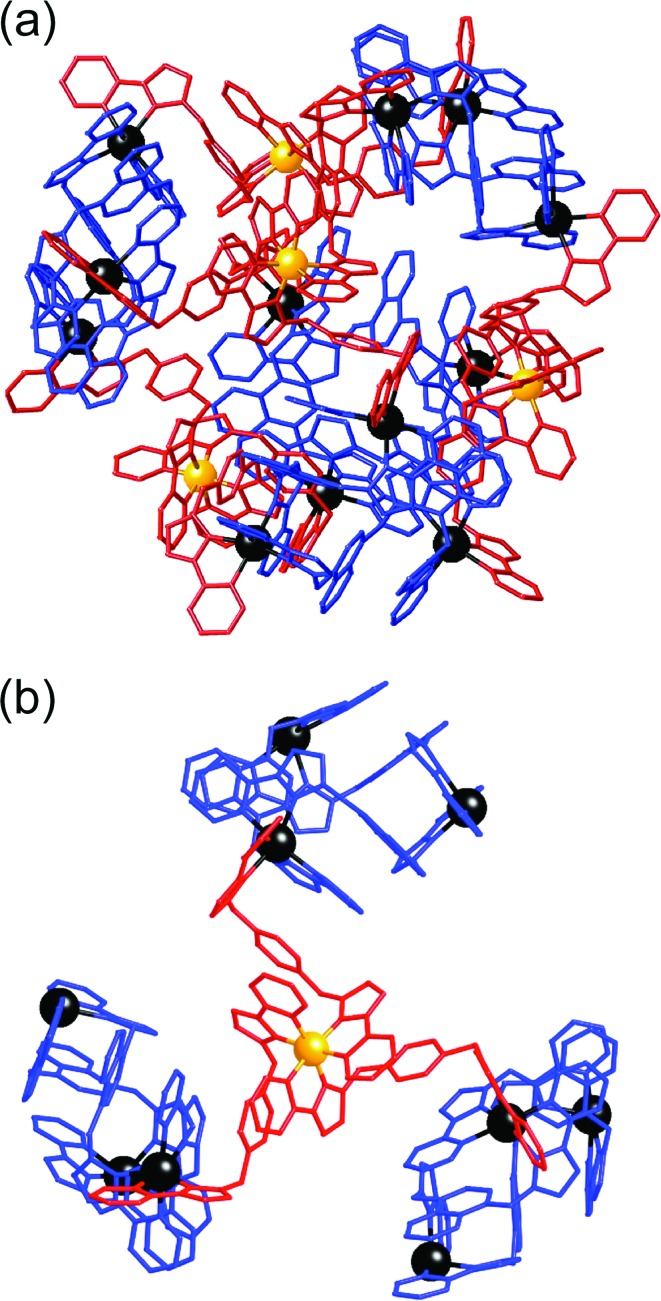
Fig. 4. Two views of the crystal structure of [Ru4Cd12(Lph)12(Lnaph)12](PF6)7(BF4)25. (a) The entire complex cation in spacefilling view (Lnaph shown in blue, Lph shown in red); (b) arrangement of metal ions in the Ru4Cd12 core (Ru – yellow, Cd – black).
Fig. 5
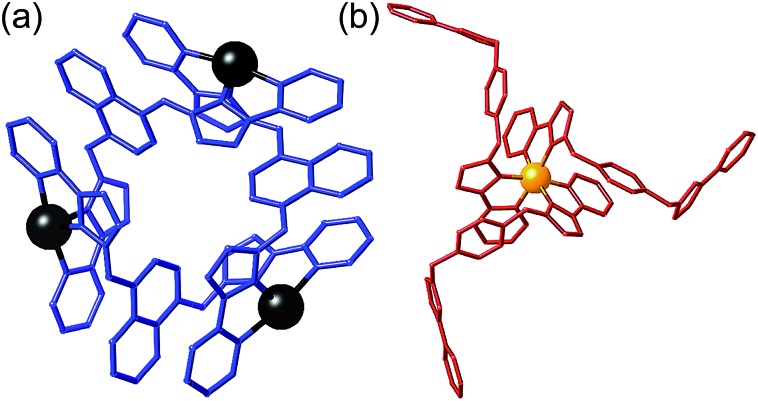
Fig. 5. Fragments from the crystal structure of [Ru4Cd12(Lph)12(Lnaph)12] (PF6)7(BF4)25 (same colouring scheme as Fig. 4). (a) A [Cd3(Lnaph)3]6+ triangular cyclic helicate unit; (b) a fac-[Ru(Lph)3]2+ unit.
Fig. 6
Fig. 6. Left: View of the complete complex cation of [Ru4Cd12(Lph)12(Lnaph)12](PF6)7(BF4)25, (same colouring scheme as Fig. 4). Right: Partial view of the complex, emphasising how each fac-[Ru(Lph)3]2+ vertex is connected to three [Cd3(Lnaph)3]6+ units.
Fig. 7
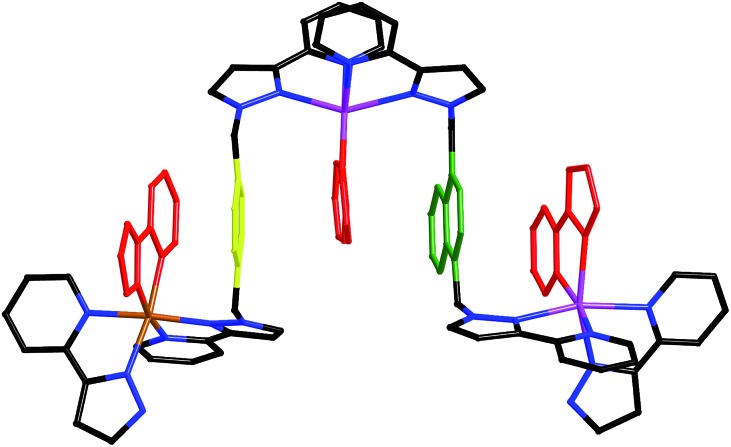
Fig. 7. Five-layer aromatic stack in the structure of [Ru4Cd12(Lph)12(Lnaph)12](PF6)7(BF4)25 with electron-rich phenyl and naphthyl rings in yellow and green, respectively, and electron deficient pyrazolyl–pyridine units in red. Cd – purple; Ru – orange.
Fig. 8
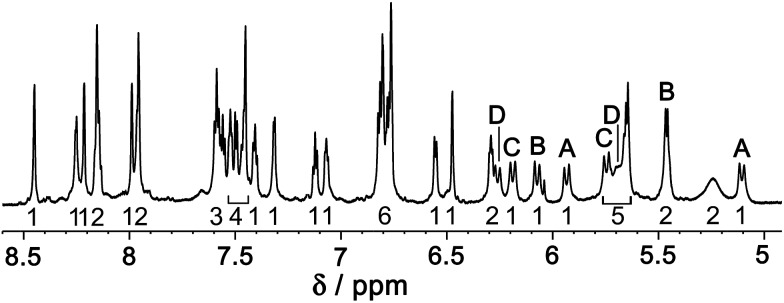
Fig. 8. 1H NMR spectrum (CD3NO2, 800 MHz) of redissolved crystals of [Ru4Cd12(Lph)12(Lnaph)12](PF6)7(BF4)25. Integers under the signals are integral values (total 42). Labels (A–D) refer to the four pairs of doublets from diastereotopic methylene groups, identified from a COSY spectrum, which confirm the presence of two independent ligand environments with no internal symmetry and equal numbers of each type (see main text).
Fig. 9
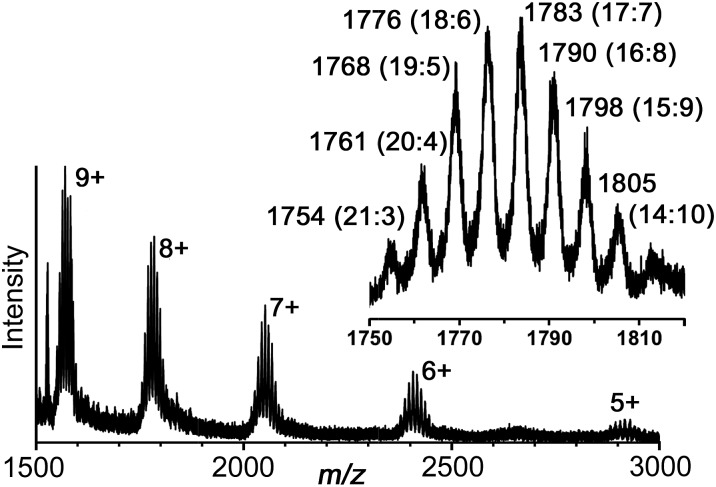
Fig. 9. Partial electrospray mass spectrum of redissolved crystals of [Ru4Cd12(Lph)12(Lnaph)12](PF6)7(BF4)25 showing the sequence of signals associated with progressive loss of anions. For each charge, the presence of multiple closely-spaced signals is associated with different combinations of [BF4] and [PF6] anions. The inset shows the expansion of the set of signals around m/z 1780 for the 8+ ions: the number of [BF4] and [PF6] anions for each is shown in parentheses. Thus, the signal at m/z 1768 corresponds to {[Ru4Cd12(Lph)12(Lnaph)12](BF4)19(PF6)5}8+, etc. For high-resolution expansions, see ESI.

References

    1. Fiedler D., Leung D. H., Bergman R. G., Raymond K. N. Acc. Chem. Res. 2005;38:349. - PubMed
    2. Fujita M., Tominaga M., Hori A., Therrien B. Acc. Chem. Res. 2005;38:369. - PubMed
    3. Ward M. D. Chem. Commun. 2009:4487. - PubMed
    4. Perry J. J., Perman J. A., Zaworotko M. J. Chem. Soc. Rev. 2009;38:1400. - PubMed
    5. Amouri H., Desmarets C., Moussa J. Chem. Rev. 2012;112:2015. - PubMed
    6. Williams A. F. Coord. Chem. Rev. 2011;255:2104.
    7. Laughrey Z., Gibb B. Chem. Soc. Rev. 2011;40:363. - PubMed
    8. Jin P., Dalgarno S. J., Atwood J. L. Coord. Chem. Rev. 2012;254:1760.
    9. Chakrabarty R. J., Mukherjee P. S., Stang P. J. Chem. Rev. 2011;111:6810. - PMC - PubMed
    10. Inokuma Y., Kawano M., Fujita M. Nat. Chem. 2011;3:349. - PubMed
    11. Pluth M. D., Bergman R. G., Raymond K. N. Acc. Chem. Res. 2009;42:1650. - PubMed
    12. Smulders M. M. J., Riddell I. A., Browne C., Nitschke J. R. Chem. Soc. Rev. 2013;42:1728. - PubMed
    13. Nakamura T., Ube H., Shionoya M. Chem. Lett. 2014;42:328.
    14. Li H., Yao Z.-J., Liu D., Jin G.-X. Coord. Chem. Rev. 2015;293–294:139.
    15. Chen L., Chen Q., Wu M., Jiang F., Hong M. Acc. Chem. Res. 2015;48:201. - PubMed
    1. Harris K., Fujita D., Fujita M. Chem. Commun. 2013;49:6703. - PubMed
    1. Ousaka N., Grunder S., Castilla A. M., Whalley A. C., Stoddart J. F., Nitschke J. R. J. Am. Chem. Soc. 2012;134:15528. - PubMed
    1. Metherell A. J., Ward M. D. Chem. Commun. 2014;50:6330. - PubMed
    2. Wragg A. B., Metherell A. J., Cullen W., Ward M. D. Dalton Trans. 2015;44:17939. - PubMed
    1. Argent S. P., Adams H., Riis-Johannessen T., Jeffery J. C., Harding L. P., Ward M. D. J. Am. Chem. Soc. 2006;128:72. - PubMed
    2. Stephenson A., Argent S. P., Riis-Johannessen T., Tidmarsh I. S., Ward M. D. J. Am. Chem. Soc. 2011;133:858. - PubMed