Review
. 2017 Jul 24:5:162.
doi: 10.3389/fped.2017.00162. eCollection 2017.

Oxidative Stress and Bronchial Asthma in Children-Causes or Consequences?

Affiliations
Review

Oxidative Stress and Bronchial Asthma in Children-Causes or Consequences?

Milos Jesenak et al. Front Pediatr. .

Abstract

Bronchial asthma is one of the most common chronic inflammatory diseases of the airways. In the pathogenesis of this disease, the interplay among the genes, intrinsic, and extrinsic factors are crucial. Various combinations of the involved factors determine and modify the final clinical phenotype/endotype of asthma. Oxidative stress results from an imbalance between the production of reactive oxygen species and reactive nitrogen species and the capacity of antioxidant defense mechanisms. It was shown that oxidative damage of biomolecules is strongly involved in the asthmatic inflammation. It is evident that asthma is accompanied by oxidative stress in the airways and in the systemic circulation. The oxidative stress is more pronounced during the acute exacerbation or allergen challenge. On the other hand, the genetic variations in the genes for anti-oxidative and pro-oxidative enzymes are variably associated with various asthmatic subtypes. Whether oxidative stress is the consequence of, or the cause for, chronic changes in asthmatic airways is still being discussed. Contribution of oxidative stress to asthma pathology remains at least partially controversial, since antioxidant interventions have proven rather unsuccessful. According to current knowledge, the relationship between oxidative stress and asthmatic inflammation is bidirectional, and genetic predisposition could modify the balance between these two positions-oxidative stress as a cause for or consequence of asthmatic inflammation.

Keywords: bronchial asthma; childhood; chronic inflammation; oxidative damage of biomolecules; oxidative stress.


Figures
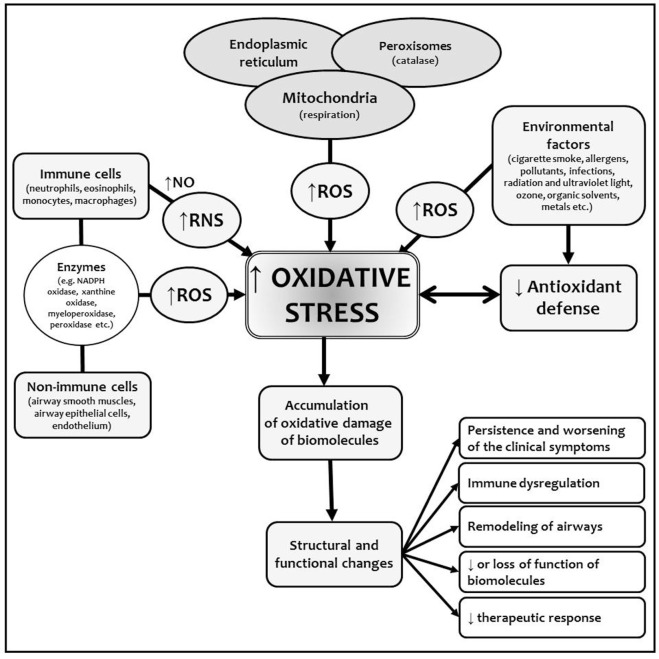
Figure 1
Figure 1
Origin of ROS and RNS and oxidative stress in bronchial asthma (BA). Chronic inflammation in BA is characterized by the overproduction of ROS/RNS as a consequence of increased activation of immune and non-immune cells in cellular inflammatory infiltrate. Various exogenous factors promote and amplify the inflammation and also increased the formation of reactive species via many mechanisms (e.g., induction of mitochondrial dysfunction, DNA repair mechanisms damage). Chronic inflammation decreases the capacity of endogenous antioxidant defense mechanisms, which are not able to compensate overproduction of ROS/RNS. This leads to the accumulation of the changes in biomolecules with structural and functional consequences. Abbreviations: NO, nitric oxide; RNS, reactive nitrogen species; ROS, reactive oxygen species.
Figure 2
Figure 2
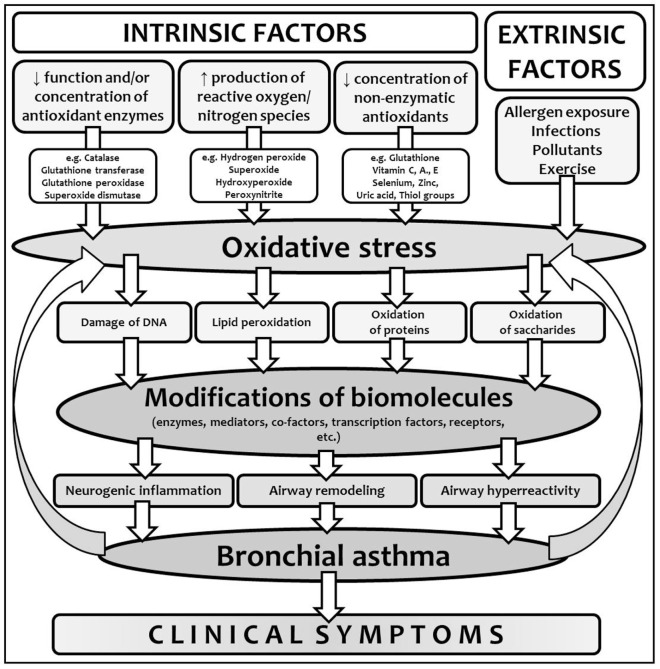
Oxidative stress in the context of bronchial asthma development. Interplay between intrinsic and extrinsic factors leads to the production of reactive oxygen species (ROS) and in certain conditions, due to the imbalance between the production of ROS and antioxidant defense, oxidative stress and modification of biomolecules develops. Due to the modifications of various biomolecules with different functions, particular components of chronic inflammation lead to asthma development and clinical symptoms onset. Moreover, non-controlled or partially controlled and regulated inflammation is another important source of ROS, which closes the vicious circle.

References

    1. Anandan C, Nurmatov U, van Schayck OC, Sheikh A. Is the prevalence of asthma declining? Systematic review of epidemiological studies. Allergy (2010) 65:152–67. 10.1111/j.1398-9995.2009.02244.x - DOI - PubMed
    1. James A, Hedlin G. Biomarkers for phenotyping and monitoring of asthma in children. Curr Treat Options Allergy (2016) 3:439–52. 10.1007/s40521-016-0106-0 - DOI - PMC - PubMed
    1. Nosal S, Durdik P, Sutovska M, Franova S, Nosal V, Koppl J, et al. Changes of airway obstruction parameters in healthy children caused by mother’s smoking during pregnancy. J Physiol Pharmacol (2008) 59:523–9. - PubMed
    1. Stein RT, Martinez FD. Asthma phenotypes in childhood: lessons from an epidemiological approach. Paediatr Respir Rev (2004) 5:155–61. 10.1016/j.prrv.2004.01.007 - DOI - PubMed
    1. Lötvall J, Akdis CA, Bacharier LB, Bjermer L, Casale TB, Custovic A, et al. Asthma endotypes: a new approach to classification of disease entities within asthma syndrome. J Allergy Clin Immunol (2011) 127:355–60. 10.1016/j.jaci.2010.11.037 - DOI - PubMed