


The medial habenula and interpeduncular nucleus circuitry is critical in addiction, anxiety, and mood regulation
- PMID: 28791703
- PMCID: PMC6740332
- DOI: 10.1111/jnc.14008
The medial habenula and interpeduncular nucleus circuitry is critical in addiction, anxiety, and mood regulation
Abstract
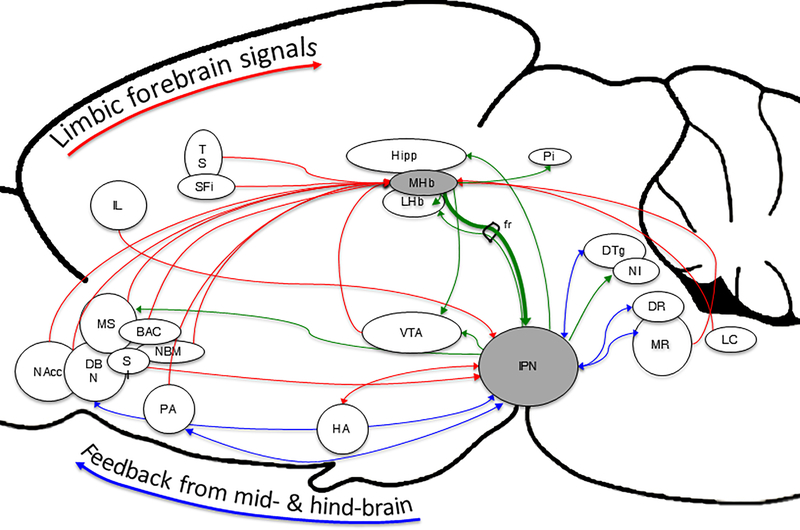
Abstinence from chronic use of addictive drugs triggers an aversive withdrawal syndrome that compels relapse and deters abstinence. Many features of this syndrome are common across multiple drugs, involving both affective and physical symptoms. Some of the network signaling underlying withdrawal symptoms overlaps with activity that is associated with aversive mood states, including anxiety and depression. Given these shared features, it is not surprising that a particular circuit, the dorsal diencephalic conduction system, and the medial habenula (MHb) and interpeduncular nucleus (IPN), in particular, have been identified as critical to the emergence of aversive states that arise both as a result and, independently, of drug addiction. As the features of this circuit continue to be characterized, the MHb-IPN axis is emerging as a viable target for therapeutics to aid in the treatment of addiction to multiple drugs of abuse as well as mood-associated disorders. This is an article for the special issue XVth International Symposium on Cholinergic Mechanisms.
Keywords: alcohol; epithalamus; interpeduncular nucleus; mood; stress; withdrawal.
© 2017 International Society for Neurochemistry.
Conflict of interest statement
Conflict of interests
All authors declare that they do not have any conflicts of interest to report.
Figures
References
-
- Agetsuma M, Aizawa H, Aoki T et al. (2010) The habenula is crucial for experience-dependent modification of fear responses in zebrafish. Nature neuroscience, 13, 1354–1356. - PubMed
-
- Ahumada-Galleguillos P, Lemus CG, Diaz E, Osorio-Reich M, Hartel S and Concha ML (2016) Directional asymmetry in the volume of the human habenula. Brain structure & function. - PubMed
-
- Aizawa H, Kobayashi M, Tanaka S, Fukai T and Okamoto H (2012) Molecular characterization of the subnuclei in rat habenula. The Journal of comparative neurology, 520, 4051–4066. - PubMed
-
- Association AP (2013) Diagnostic and statistical manual of mental disorders. American Psychiatric Publishing, Arlington, VA.
Publication types
MeSH terms
Substances
Grants and funding
LinkOut - more resources
Full Text Sources
Other Literature Sources
Medical
Research Materials
