


Retention in Care Services Reported by HIV Care Providers in the United States, 2013 to 2014
- PMID: 28791914
- PMCID: PMC5575976
- DOI: 10.1177/2325957417724204
Retention in Care Services Reported by HIV Care Providers in the United States, 2013 to 2014
Abstract
Objectives: Evidence-based guidelines recommend that HIV care providers offer retention-in-care services, but data are needed to assess service provision.
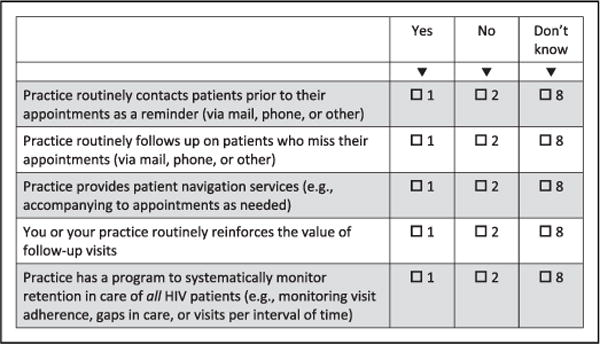
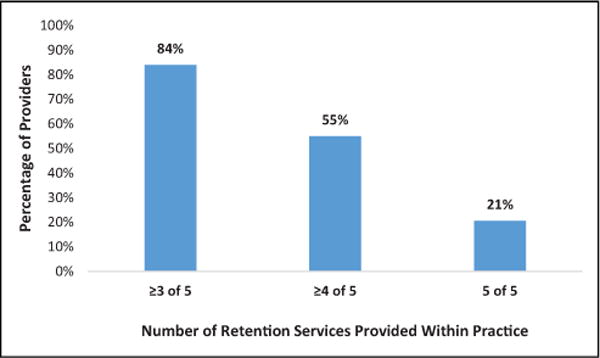
Methods: We surveyed a probability sample of 1234 HIV care providers to estimate the percentage of providers whose practices offered 5 recommended retention services and describe providers' perceptions of barriers to care among patients.
Results: An estimated 21% of providers' practices offered all 5 retention services. Providers at smaller (<50 versus >400 patients), private, and non-Ryan White HIV/AIDS Program (RWHAP)-funded practices, and practices without on-site case management were significantly less likely to provide patient navigation services or do systematic monitoring of retention. Providers' most commonly perceived barriers to care among patients were mental health (40%), substance abuse (36%), and transportation (34%) issues.
Conclusion: Deficiencies in the provision of key retention services are substantial. New strategies may be needed to increase the delivery of recommended retention services, especially among private, non-RWHAP-funded, and smaller facilities.
Keywords: HIV; HIV care providers; Medical Monitoring Project; delivery of health care; retention in care.
Conflict of interest statement
The author(s) declared no potential conflicts of interest with respect to the research, authorship, and/or publication of this article.
Figures
References
-
- White House Office of National AIDS Policy. National HIV/AIDS strategy for the United States: updated to 2020. 2015 https://www.aids.gov/federal-resources/national-hiv-aids-strategy/nhas-u.... Accessed July 27, 2017.
-
- Centers for Disease Control and Prevention. Monitoring selected national HIV prevention and care objectives by using HIV surveillance data—United States and 6 dependent areas—2013. HIV Surveill Suppl Rep. 2015;20(2):70.
-
- Wiewel EW, Braunstein SL, Xia Q, Shepard CW, Torian LV. Monitoring outcomes for newly diagnosed and prevalent HIV cases using a care continuum created with New York city surveillance data. J Acquir Immune Defic Syndr. 2015;68(2):217–226. - PubMed
MeSH terms
Grants and funding
LinkOut - more resources
Full Text Sources
Other Literature Sources
Medical
