


Hospital Drains as Reservoirs of Pseudomonas aeruginosa: Multiple-Locus Variable-Number of Tandem Repeats Analysis Genotypes Recovered from Faucets, Sink Surfaces and Patients
- PMID: 28792484
- PMCID: PMC5617993
- DOI: 10.3390/pathogens6030036
Hospital Drains as Reservoirs of Pseudomonas aeruginosa: Multiple-Locus Variable-Number of Tandem Repeats Analysis Genotypes Recovered from Faucets, Sink Surfaces and Patients
Abstract
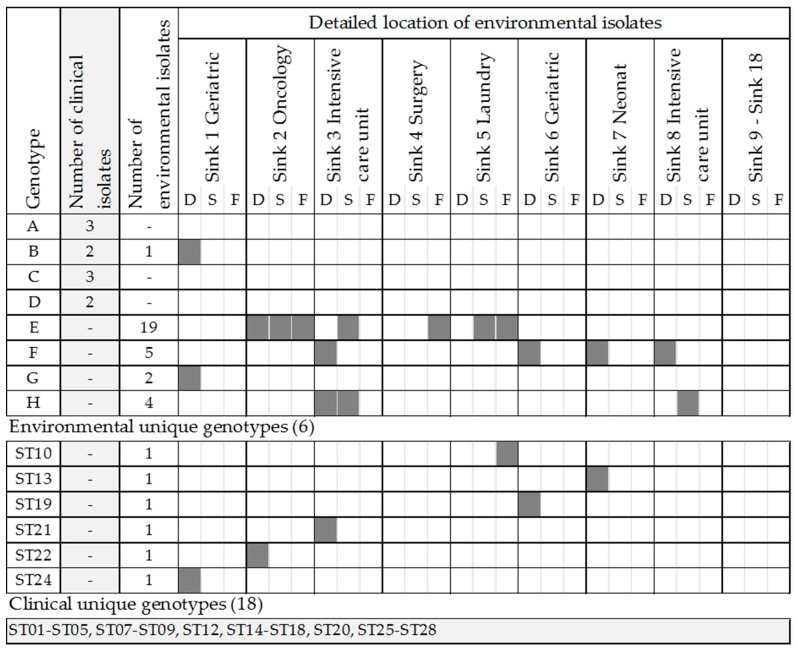
Identifying environmental sources of Pseudomonas aeruginosa (Pa) related to hospital-acquired infections represents a key challenge for public health. Biofilms in water systems offer protection and favorable growth conditions, and are prime reservoirs of microorganisms. A comparative genotyping survey assessing the relationship between Pa strains recovered in hospital sink biofilm and isolated in clinical specimens was conducted. Environmental strains from drain, faucet and sink-surface biofilm were recovered by a culture method after an incubation time ranging from 48 to 240 h. The genotyping of 38 environmental and 32 clinical isolates was performed using a multiple-locus variable-number of tandem repeats analysis (MLVA). More than one-third of Pa isolates were only cultivable following ≥48 h of incubation, and were predominantly from faucet and sink-surface biofilms. In total, 41/70 strains were grouped within eight genotypes (A to H). Genotype B grouped a clinical and an environmental strain isolated in the same ward, 5 months apart, suggesting this genotype could thrive in both contexts. Genotype E grouped environmental isolates that were highly prevalent throughout the hospital and that required a longer incubation time. The results from the multi-hospital follow-up study support the drain as an important reservoir of Pa dissemination to faucets, sink surfaces and patients. Optimizing the recovery of environmental strains will strengthen epidemiological investigations, facilitate pathway identification, and assist in identifying and controlling the reservoirs potentially associated to hospital-acquired infections.
Keywords: MLVA; Pseudomonas aeruginosa; environmental reservoir; genotyping; heathcare-acquired infections; sink environment.
Conflict of interest statement
The authors declare no conflict of interest.
Figures
References
-
- World Heatlh Organization (WHO) Report on the Burden of Endemic Health Care-Associated Infection Worldwide: A Systematic Review of the Litterature. World Heatlh Organization; Geneva, Switzerland: 2011.
-
- Hidron A.I., Edwards J.R., Patel J., Horan T.C., Sievert D.M., Pollock D.A., Fridkin S.K. Nhsn annual update: Antimicrobial resistant pathogens associated with healthcare associated infections: Annual summary of data reported to the national healthcare safety network at the centers for disease control and prevention, 2006–2007. Infect. Control Hosp. Epidemiol. 2008;29:996–1011. doi: 10.1086/591861. - DOI - PubMed
-
- The RAISIN Working Group Surveillance and outbreak reports “raisin”—A national programme for early warning, investigation and surveillance of healthcare-associated infection in France. Eurosurveillance. 2009;14:429–433. - PubMed
-
- Zarb P., Coignard B., Griskeviciene J., Muller A., Vankerckhoven V., Weist K., Goossens M.M., Vaerenberg S., Hopkins S., Catry B., et al. The European centre for disease prevention and control (ECDC) pilot point prevalence survey of healthcare-associated infections and antimicrobial use. Eurosurveillance. 2012;17:4–19. - PubMed
-
- Ferroni A., Nguyen L., Pron B., Quesne G., Brusset M.-C., Berche P. Outbreak of nosocomial urinary tract infections due to Pseudomonas aeruginosa in a paediatric surgical unit associated with tap-water contamination. J. Hosp. Infect. 1998;39:301–307. doi: 10.1016/S0195-6701(98)90295-X. - DOI - PubMed
LinkOut - more resources
Full Text Sources
Other Literature Sources
