


Operational Details of the Five Domains Model and Its Key Applications to the Assessment and Management of Animal Welfare
- PMID: 28792485
- PMCID: PMC5575572
- DOI: 10.3390/ani7080060
Operational Details of the Five Domains Model and Its Key Applications to the Assessment and Management of Animal Welfare
Abstract
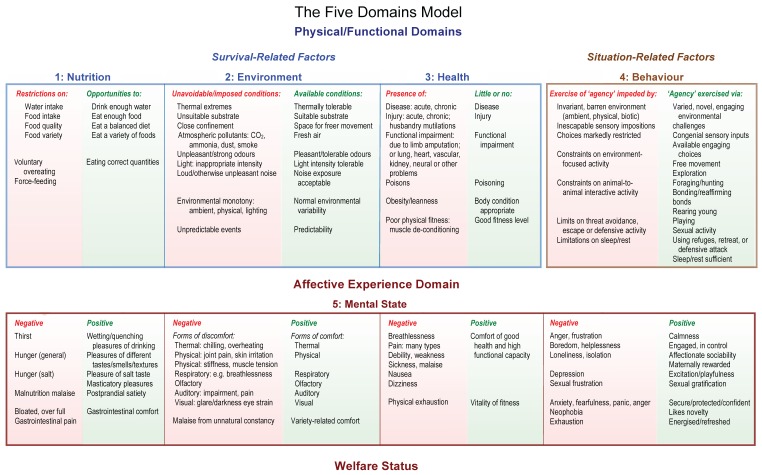
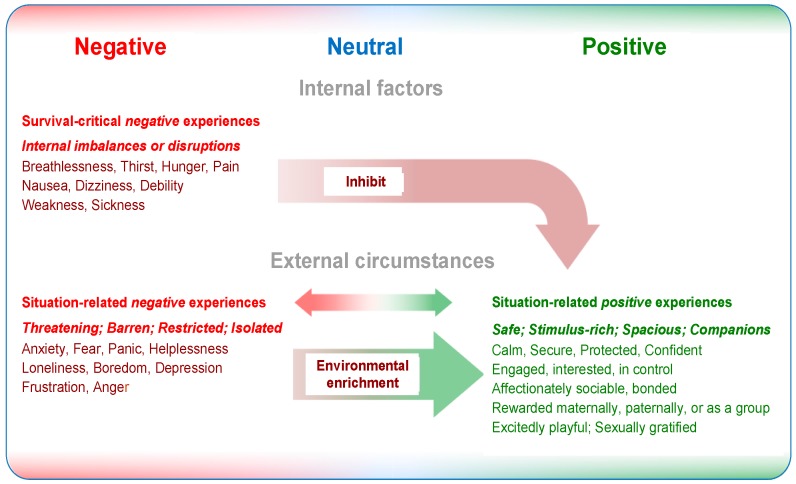
In accord with contemporary animal welfare science understanding, the Five Domains Model has a significant focus on subjective experiences, known as affects, which collectively contribute to an animal's overall welfare state. Operationally, the focus of the Model is on the presence or absence of various internal physical/functional states and external circumstances that give rise to welfare-relevant negative and/or positive mental experiences, i.e., affects. The internal states and external circumstances of animals are evaluated systematically by referring to each of the first four domains of the Model, designated "Nutrition", "Environment", "Health" and "Behaviour". Then affects, considered carefully and cautiously to be generated by factors in these domains, are accumulated into the fifth domain, designated "Mental State". The scientific foundations of this operational procedure, published in detail elsewhere, are described briefly here, and then seven key ways the Model may be applied to the assessment and management of animal welfare are considered. These applications have the following beneficial objectives-they (1) specify key general foci for animal welfare management; (2) highlight the foundations of specific welfare management objectives; (3) identify previously unrecognised features of poor and good welfare; (4) enable monitoring of responses to specific welfare-focused remedial interventions and/or maintenance activities; (5) facilitate qualitative grading of particular features of welfare compromise and/or enhancement; (6) enable both prospective and retrospective animal welfare assessments to be conducted; and, (7) provide adjunct information to support consideration of quality of life evaluations in the context of end-of-life decisions. However, also noted is the importance of not overstating what utilisation of the Model can achieve.
Keywords: affects; five domains model; model applications; situation-related factors; survival-critical factors; welfare assessment; welfare management.
Conflict of interest statement
The author declares no conflict of interest.
Figures
References
-
- Mellor D.J., Reid C.S.W. Improving the Well-Being of Animals in the Research Environment. Australian and New Zealand Council for the Care of Animals in Research and Teaching (ANZCCART); Glen Osmond, SA, Australia: 1994. Concepts of animal well-being and predicting the impact of procedures on experimental animals; pp. 3–18.
-
- Webster J. Animal Welfare: A Cool Eye Towards Eden. Blackwell Science; Oxford, UK: 1994. Assessment of animal welfare: The five freedoms; pp. 10–14.
-
- Webster J. Animal Welfare: Limping Towards Eden. Wiley-Blackwell; Chichester, UK: 2005.
-
- Webster J. Management and Welfare of Farm Animals. Wiley-Blackwell; Chichester, UK: 2011. UFAW Farm Handbook.
Publication types
LinkOut - more resources
Full Text Sources
Other Literature Sources
