. 2017 Aug 8;12(8):e0182395.
doi: 10.1371/journal.pone.0182395. eCollection 2017.

Cryptosporidium parvum vaccine candidates are incompletely modified with O-linked-N-acetylgalactosamine or contain N-terminal N-myristate and S-palmitate

Affiliations

Cryptosporidium parvum vaccine candidates are incompletely modified with O-linked-N-acetylgalactosamine or contain N-terminal N-myristate and S-palmitate

John R Haserick et al. PLoS One. .

Abstract

Cryptosporidium parvum (studied here) and Cryptosporidium hominis are important causes of diarrhea in infants and immunosuppressed persons. C. parvum vaccine candidates, which are on the surface of sporozoites, include glycoproteins with Ser- and Thr-rich domains (Gp15, Gp40, and Gp900) and a low complexity, acidic protein (Cp23). Here we used mass spectrometry to determine that O-linked GalNAc is present in dense arrays on a glycopeptide with consecutive Ser derived from Gp40 and on glycopeptides with consecutive Thr derived from Gp20, a novel C. parvum glycoprotein with a formula weight of ~20 kDa. In contrast, the occupied Ser or Thr residues in glycopeptides from Gp15 and Gp900 are isolated from one another. Gly at the N-terminus of Cp23 is N-myristoylated, while Cys, the second amino acid, is S-palmitoylated. In summary, C. parvum O-GalNAc transferases, which are homologs of host enzymes, densely modify arrays of Ser or Thr, as well as isolated Ser and Thr residues on C. parvum vaccine candidates. The N-terminus of an immunodominant antigen has lipid modifications similar to those of host cells and other apicomplexan parasites. Mass spectrometric demonstration here of glycopeptides with O-glycans complements previous identification C. parvum O-GalNAc transferases, lectin binding to vaccine candidates, and human and mouse antibodies binding to glycopeptides. The significance of these post-translational modifications is discussed with regards to the function of these proteins and the design of serological tests and vaccines.


Conflict of interest statement

Competing Interests: The authors have declared that no competing interests exist.

Figures

Fig 1
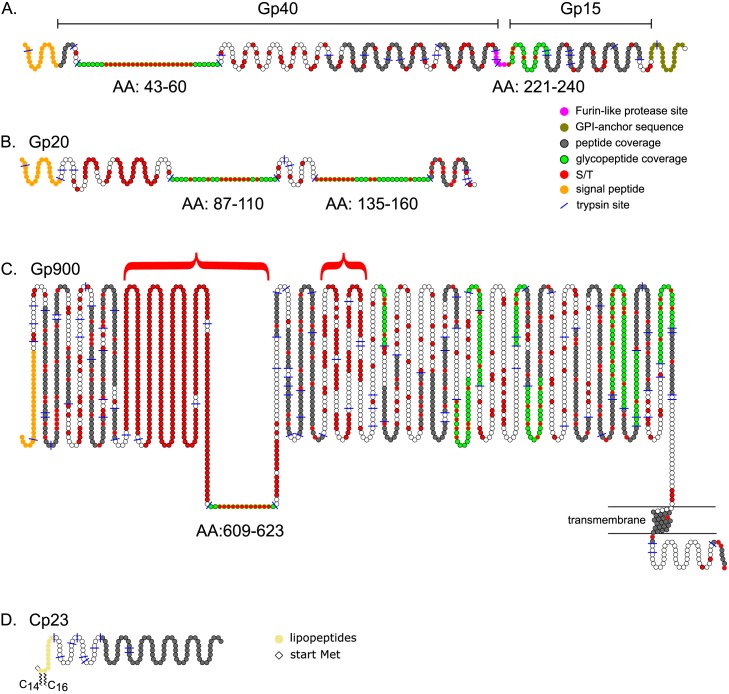
Fig 1. Schematics of Cryptosporidium glycoproteins characterized here by mass spectrometry.
(A) Gp40/Gp15 precursor is cleaved at a furin-like protease site (pink) into Gp40 and Gp15. Mass spectrometry showed Gp40 has a Thr-rich domain (AA-43 to 60) with numerous O-linked HexNAc modifications (marked in green, with Ser and Thr residues marked in red). Gp15 contains a single domain (AA-221 to 240) that is glycosylated. Other peptides identified with mass spectrometry are marked in grey. Predicted N-terminal signal peptide is marked in orange, while GPI-anchor signal is marked in olive. (B) A 20-kDa glycoprotein (Gp20) contains two Thr-rich domains (AA-87 to110 and AA-135 to 160), which contain numerous HexNAc modifications. (C) Gp900 contains two very large Thr-rich domains (red brackets), one of which contains a peptide with three HexNAc residues (AA-609 to 623). The transmembrane helix near the C-terminus is encompassed by two horizontal lines, representing a membrane. (D) The N-terminus of Cp23 is modified with N-myristate (C14) and S-palmitate (C16). The start Met is absent (diamond).
Fig 2
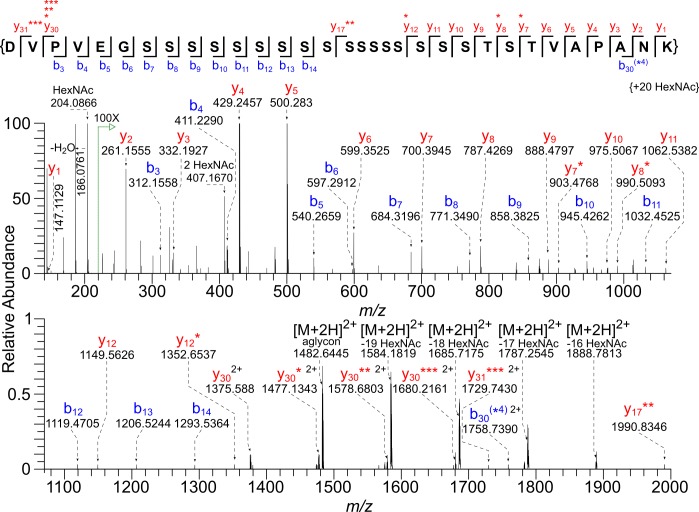
Fig 2. HCD MS/MS spectrum (@ 30 V) of a tryptic glycopeptide of Gp40 shows saturation of an array of Ser residues with O-HexNAc residues.
The monoisotopic mass of the precursor ion [M + 4H]4+ m/z 1757.2272 corresponds to the value calculated for the peptide (43)DVPVEGSSSSSSSSSSSSSSSSSTSTVAPANK(60) with the addition of 20 HexNAc residues (Δ 0.2 ppm). A very abundant HexNAc oxonium ion (m/z 204.0866) and a very low abundance peak (0.5%) corresponding to a HexNAc dimer (m/z 407.1670) are present. Asterisks mark the number of HexNAc residues present on b and y ions. Please see S1 Fig for a 45-V HCD MS/MS spectrum of the same Gp40 glycopeptide. The lists of the b and y ions assigned for MS/MS spectra shown in this figure and others can be found in S2 Excel File.
Fig 3
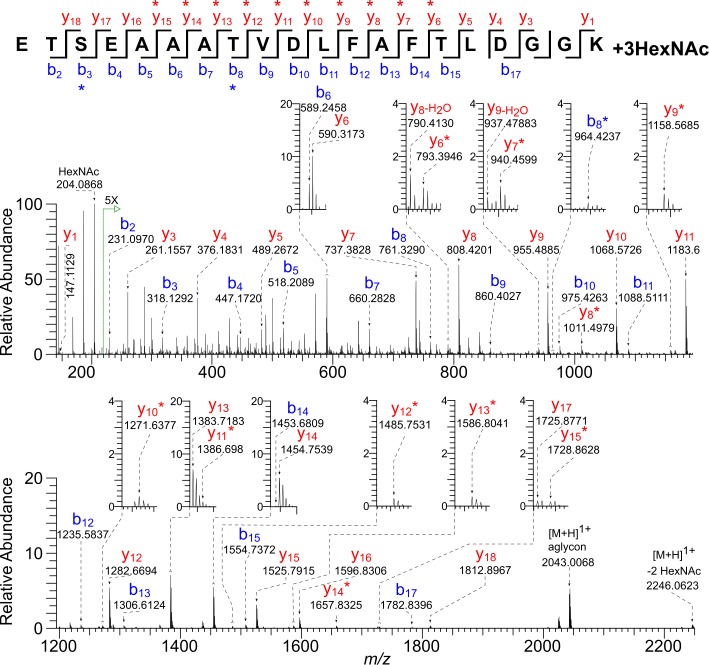
Fig 3. HCD MS/MS spectrum (@ 30 V) of a tryptic glycopeptide of Gp15 shows that three of four O-glycan sites contain the HexNAc modification.
The precursor ion [M + 2H]2+ m/z 1326.6164 of the most abundant Gp15 glycopeptide has a monoisotopic mass corresponding to that calculated for the peptide (221)ETSEAAATVDLFAFTLDGGK(240) with the addition of three HexNAc residues (Δ 0.3 ppm). There is a prominent HexNAc oxonium ion (m/z 204.0868) and full series of b and y ions, some of which contain a single HexNAc residue (*).
Fig 4
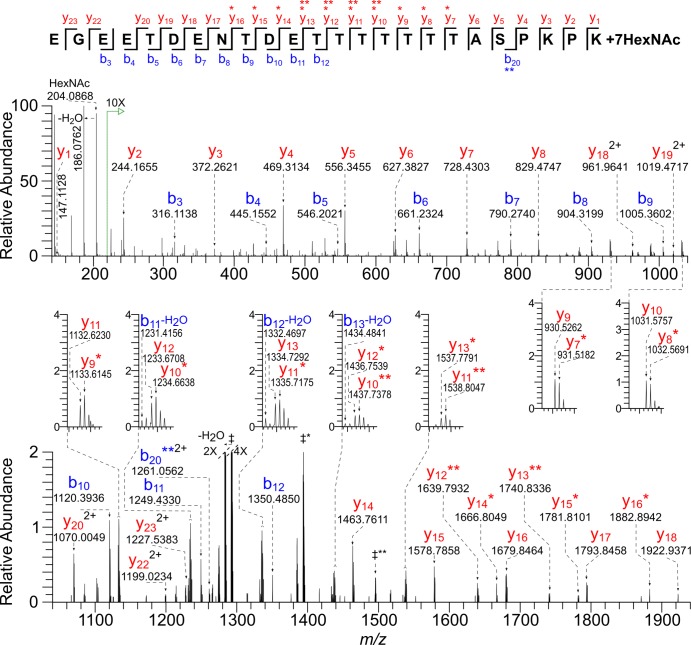
Fig 4. HCD MS/MS spectrum (@ 30V) of a tryptic glycopeptide of Gp20 shows near saturation of consecutive Thr residues with the O-HexNAc modification.
The precursor ion [M + 4H]4+ m/z 1001.9305 has a monoisotopic mass corresponding to that calculated for the peptide (87)EGEETDENTDETTTTTTTASPKPK(110) plus seven HexNAc residues (Δ 0.5 ppm). There is a prominent HexNAc oxonium ion (m/z 204.0868) and full series of b and y ions, some of which contain one (*) or two (**) HexNAc residues. All ions are singly charged, except where indicated. In addition, charge-reduced ions, all 2+, which correspond to species that have undergone consecutive losses of HexNAc residues, are labeled as follows: ‡** = [M + 2H]2+—HexNAc5 (m/z 1495.1470), ‡* = [M + 2H]2+—HexNAc6 (m/z 1393.6224), ‡ = [M + 2H]2+ aglycon peptide (m/z 1292.0851).
Fig 5
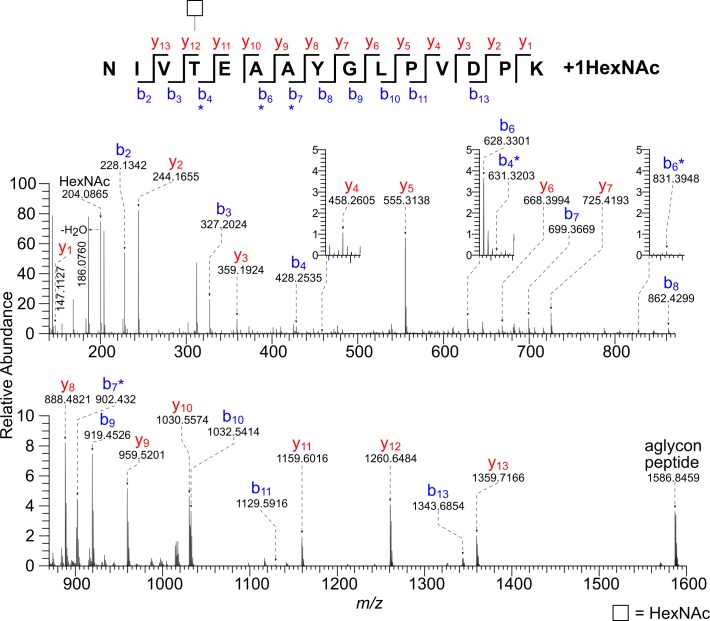
Fig 5. HCD MS/MS spectrum (@ 30V) of a tryptic glycopeptide of Gp900 shows a single O-HexNAc modification on a Thr residue.
The precursor ion [M + 4H]4+ m/z 895.4646 has a monoisotopic mass corresponding to that calculated for the peptide (1712)NIVTEAAYGLPVDPK(1726) plus a single HexNAc residue (Δ 0.1 ppm). There is a prominent HexNAc oxonium ion (m/z 204.0865) and full series of b and y ions, some of which contain a HexNAc residue (*). The b4*, b6*, and b7* ions show that Thr-1715 is modified.
Fig 6
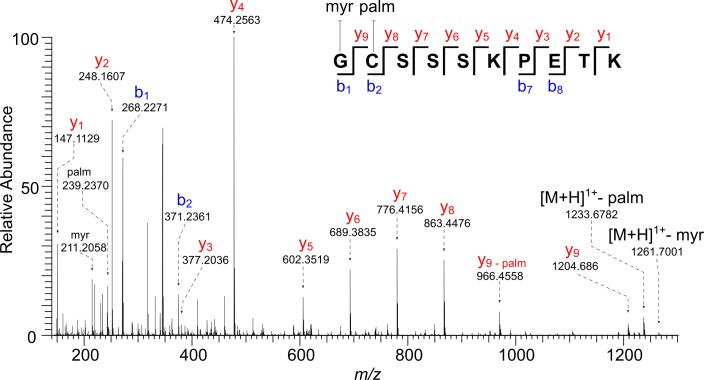
Fig 6. HCD MS/MS spectrum (@30 V) of an N-terminal peptide of Cp23 (minus Met-1) shows Gly-1 is modified with myristate and Cys-2 is modified with palmitate.
The precursor ion [M + 2H]2+ m/z 736.4573 has a monoisotopic mass corresponding to that calculated for the peptide (2)GCSSSKPETK(11) plus myristate and palmitate (Δ 1.1 ppm). Fragment ions could be assigned to myristate (m/z 211.2056) and palmitate (m/z 239.2370), as well as the charge-reduced [M + H]1+ molecular ions that have undergone loss of palmitate (m/z 1233.6782) or myristate (m/z 1261.7001). All the appropriate b/y ions contain the lipid modification, unless otherwise indicated.

References

    1. Checkley W, White AC Jr., Jaganath D, Arrowood MJ, Chalmers RM, Chen XM, et al. A review of the global burden, novel diagnostics, therapeutics, and vaccine targets for cryptosporidium. Lancet Infect Dis. 2015;15(1):85–94. doi: 10.1016/S1473-3099(14)70772-8 ; PubMed Central PMCID: PMCPMC4401121. - DOI - PMC - PubMed
    1. Esch KJ, Petersen CA. Transmission and epidemiology of zoonotic protozoal diseases of companion animals. Clin Microbiol Rev. 2013;26(1):58–85. doi: 10.1128/CMR.00067-12 ; PubMed Central PMCID: PMCPMC3553666. - DOI - PMC - PubMed
    1. Fayer R, Xiao L. Cryptosporidium and cryptosporidiosis: CRC press; 2007.
    1. Tzipori S, Widmer G. A hundred-year retrospective on cryptosporidiosis. Trends Parasitol. 2008;24(4):184–9. doi: 10.1016/j.pt.2008.01.002 ; PubMed Central PMCID: PMCPMC2716703. - DOI - PMC - PubMed
    1. Garcia LS, Bruckner DA, Brewer TC, Shimizu RY. Techniques for the recovery and identification of Cryptosporidium oocysts from stool specimens. J Clin Microbiol. 1983;18(1):185–90. ; PubMed Central PMCID: PMCPMC270765. - PMC - PubMed

MeSH terms