. 2017 Aug 9;11(8):e0005826.
doi: 10.1371/journal.pntd.0005826. eCollection 2017 Aug.

The microbiome in urogenital schistosomiasis and induced bladder pathologies

Affiliations

The microbiome in urogenital schistosomiasis and induced bladder pathologies

Adewale S Adebayo et al. PLoS Negl Trop Dis. .

Erratum in

Abstract

Background: Human schistosomiasis is a highly prevalent neglected tropical disease (NTD) caused by Schistosoma species. Research on the molecular mechanisms influencing the outcomes of bladder infection by Schistosoma haematobium is urgently needed to develop new diagnostics, therapeutics and infection prevention strategies. The objective of the research study was to determine the microbiome features and changes in urine during urogenital schistosomiasis and induced bladder pathologies.

Methodology: Seventy participants from Eggua, southwestern Nigeria provided morning urine samples and were screened for urogenital schistosomiasis infection and bladder pathologies in a cross-sectional study. Highthroughput NGS sequencing was carried out, targeting the 16S V3 region. Filtered reads were processed and analyzed in a bioinformatics pipeline.

Principal findings: The study participants (36 males and 34 females, between ages 15 and 65) were categorized into four groups according to status of schistosomiasis infection and bladder pathology. Data analytics of the next-generation sequencing reads revealed that Proteobacteria and Firmicutes dominated and had influence on microbiome structure of both non-infected persons and persons with urogenital schistosomiasis. Furthermore, gender and age influenced taxa abundance independent of infection or bladder pathology. Several taxa distinguished urogenital schistosomiasis induced bladder pathologies from urogenital schistosomiasis infection alone and from healthy persons, including known immune-stimulatory taxa such as Fusobacterium, Sphingobacterium and Enterococcus. Some of these significant taxa, especially Sphingobacterium were projected as markers of infection, while several genera including potentially beneficial taxa such as Trabulsiella and Weissella, were markers of the non-infected. Finally, expected changes in protein functional categories were observed to relate to cellular maintenance and lipid metabolism.

Conclusion: The urinary microbiome is a factor to be considered in developing biomarkers, diagnostic tools, and new treatment for urogenital schistosomiasis and induced bladder pathologies.


Conflict of interest statement

The authors have declared that no competing interests exist.

Figures
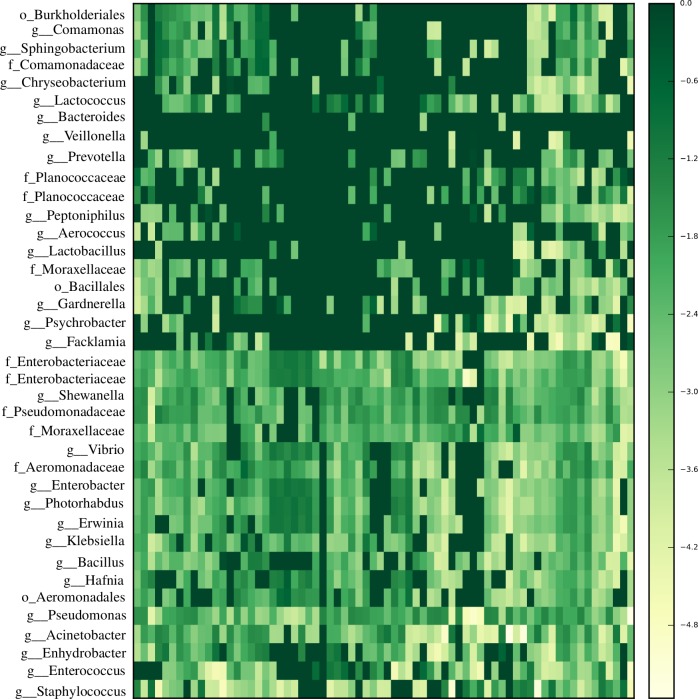
Fig 1
Fig 1. The most dominant genera and their respective families in the urinary tract microbiome of individuals in Eggua, southwest Nigeria.
Dark colors represent lower abundance, lighter colors represent higher abundance.
Fig 2
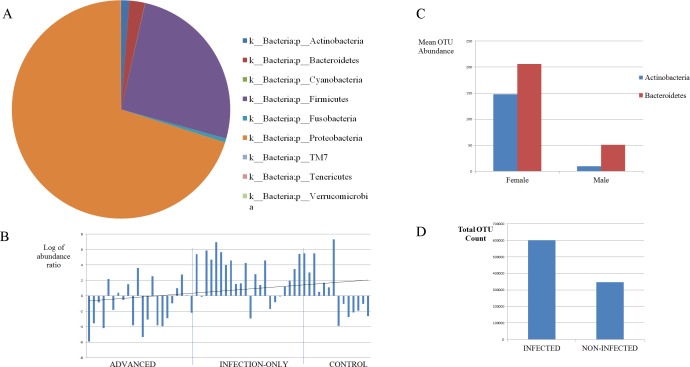
Fig 2
(A) Mean relative abundance of various phyla in the urine microbiome of a study population in Eggua, southwestern Nigeria. (B) Bar plot of the Firmicutes/Proteobacteria log abundance ratio in different states of urogenital schistosomiasis. The correlation was not significant (p = 0.08). (C)Abundance of phyla Actinobacteria and Bacteroidetes with regard to gender in the urine microbiome of a study population in Eggua, southwestern Nigeria (p<0.05). (D) Proportions of filtered OTU counts in urogenital schistosomiasis and controls(p = 2.06E-16).
Fig 3
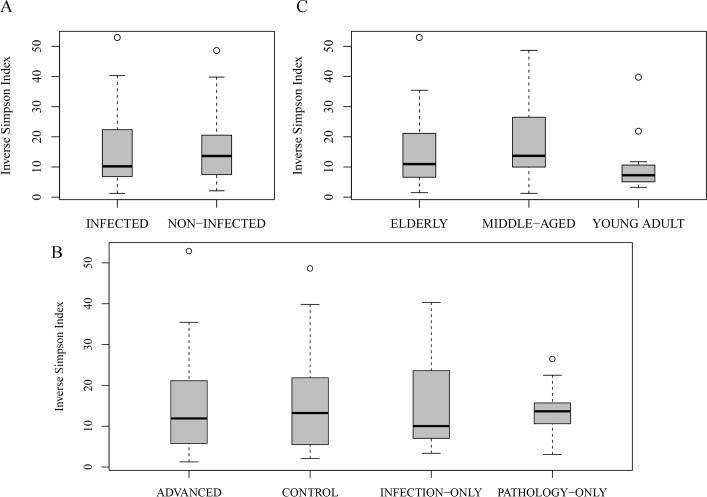
Fig 3
Comparison of microbiome diversity indices (A) between urogenital schistosomiasis infection and controls, (B) in different states of urogenital schistosomiasis and controls, and (C) among age groups. Dark band represent mean diversity index, circles represent outliers. The differences in diversity were not significant (p>0.05) except in C(p = 0.038).
Fig 4
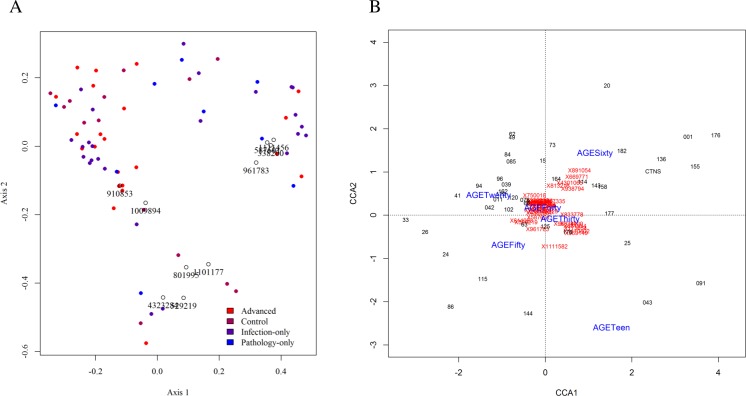
Fig 4
(A) Principal Coordinates biplot of beta diversity in different states of urogenital schistosomiasis and controls. Circle and small typeset represent Greengenes ID of dominant OTUs. These dominant OTUs were mainly assigned to Pseudomonas and Staphylococcus, but had little influence on disease status. (B) Partial canonical correspondence analysis of age groups without the influence of urogenital schistosomiasis infection. Blue fonts are age categories, red typeface are Greengenes ID of the most influential OTU. Clustering together indicates no special correlation with age group. OTUs that corresponded closely with participants aged sixty years were mainly assigned to Acinetobacter.
Fig 5
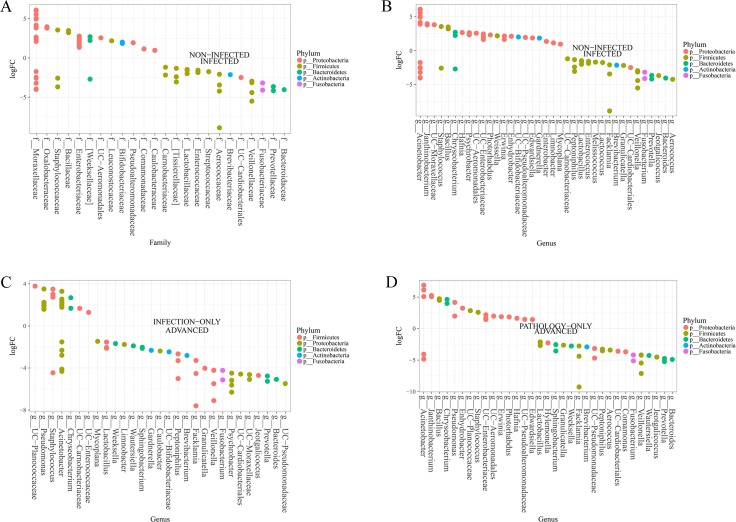
Fig 5. Specific urinary microbes are abundant in different states of urogenital schistosomiasis infection.
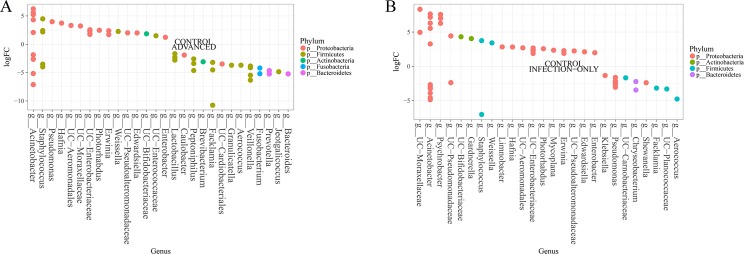
(A) Differentially abundant microbiome families in urogenital schistosomiasis (infected) and controls (non-infected), (B) Differentially abundant microbiome genera in urogenital schistosomiasis (infected) and controls (non-infected), (C) Differential microbiome genera between urogenital schistosomiasis (infection-only) and urogenital schistosomiasis induced bladder pathology (advanced), (D) Differentially abundant microbiome genera in non-infected bladder pathology (pathology-only) and urogenital schistosomiasis induced bladder pathology (advanced) (FDR<0.05). Differential abundance was measured with LogFC, the log2 of the number of times the OTUs belonging to a genus (or family) are more numerous in one group relative to the other. Circle on a vertical line represents a bacterial genus or family colored by their phylum and the genus or family is named at the end of the line. More than one circle on a vertical line represents species of the same genus. The genus is labeled on the x-axis. UC represents a genus whose identity could not be completely confirmed, but with known family or order. Abundant microbes in each of the two groups are presented on either side of the middle zero line.
Fig 6
Fig 6. Urogenital schistosomiasis and induced bladder pathology result in specific microbiome changes in the urinary tract.
Differentially abundant microbiome (A) between urogenital schistosomiasis induced bladder pathology (advanced) and healthy controls, and (B) between urogenital schistosomiasis (infection-only) and healthy controls (FDR<0.05). Differential abundance was measured with LogFC, the log2 of the number of times the OTUs belonging to a genus (or family) are more numerous in one group relative to the other. Circle on a vertical line represents a bacterial genus or family colored by their phylum and the genus or family is named at the end of the line. More than one circle on a vertical line represents species of the same genus. The genus is labeled on the x-axis. UC represents a genus whose identity could not be completely confirmed, but with known family or order. Abundant microbes in each of the two groups are presented on either side of the middle zero line.
Fig 7
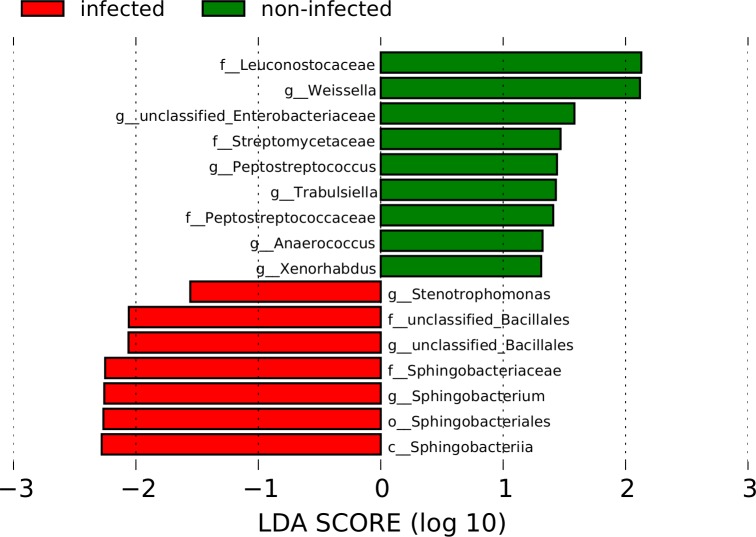
Fig 7. Predicted microbial biomarkers in urogenital schistosomiasis cases (infected) and controls (non-infected).
Fig 8
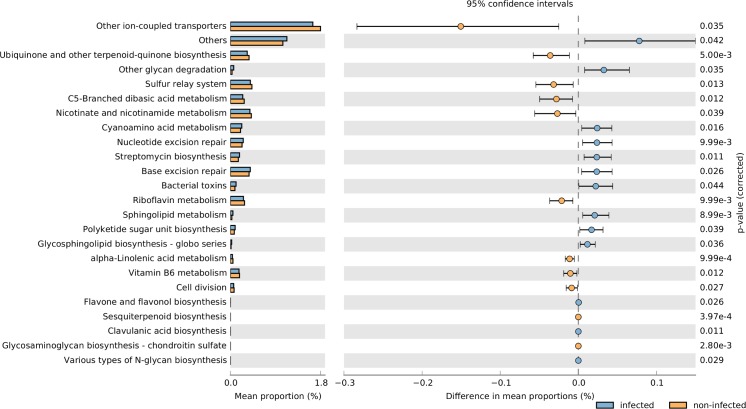
Fig 8. Predicted biochemical changes in the KEGG Ortholog database due to microbiome differences between urogenital schistosomiasis cases (infected) and controls (non-infected).

References

    1. Colley DG, Bustinduy AL, Secor WE, King CH. Human schistosomiasis. The Lancet 2014; 383: 2253–2264. - PMC - PubMed
    1. Rambau PF, Chalya PL, Jackson K. Schistosomiasis and urinary bladder cancer in North Western Tanzania: a retrospective review of 185 patients. Infectious Agents and Cancer 2013;8:19 doi: 10.1186/1750-9378-8-19 - DOI - PMC - PubMed
    1. Ray D, Nelson TA, Fu CL, Patel S, Gong DN, Odegaard JI, et al. Transcriptional profiling of the bladder in urogenital schistosomiasis reveals pathways of inflammatory fibrosis and urothelial compromise. PLoS Neglected Tropical Diseases 2012; 6: e1912 doi: 10.1371/journal.pntd.0001912 - DOI - PMC - PubMed
    1. World Health Organization (WHO). Schistosomiasis Fact sheet. 2014. Available from www.who.int/mediacentre/factsheets/fs115/en/
    1. Hotez PJ, Asojo OA, Adesina AM. Nigeria: ‘‘Ground Zero” for the High Prevalence Neglected Tropical Diseases. PLoS Neglected Tropical Diseases 2012; 6(7): e1600 doi: 10.1371/journal.pntd.0001600 - DOI - PMC - PubMed

MeSH terms