


Contrasting morphology with molecular data: an approach to revision of species complexes based on the example of European Phoxinus (Cyprinidae)
- PMID: 28793855
- PMCID: PMC5549366
- DOI: 10.1186/s12862-017-1032-x
Contrasting morphology with molecular data: an approach to revision of species complexes based on the example of European Phoxinus (Cyprinidae)
Erratum in
-
Corrigendum to «Contrasting morphology with molecular data: an approach to revision of species complexes based on the example of European (Cyprinidae)» by Palandačić et al. 2017.Biodivers Data J. 2017 Oct 24;(5):e21772. doi: 10.3897/BDJ.5.e21772. eCollection 2017. Biodivers Data J. 2017. PMID: 29104443 Free PMC article.
Abstract
Background: Molecular taxonomy studies and barcoding projects can provide rapid means of detecting cryptic diversity. Nevertheless, the use of molecular data for species delimitation should be undertaken with caution. Especially the single-gene approaches are linked with certain pitfalls for taxonomical inference. In the present study, recent and historical species descriptions based upon morphology were used as primary species hypotheses, which were then evaluated with molecular data (including in type and historical museum material) to form secondary species hypotheses. As an example of cryptic diversity and taxonomic controversy, the European Phoxinus phoxinus species complex was used.
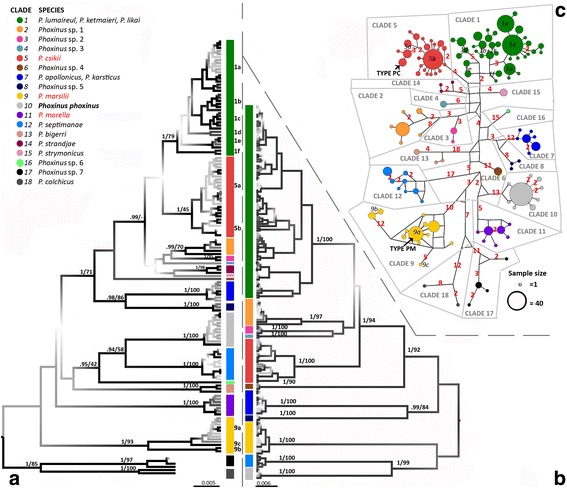
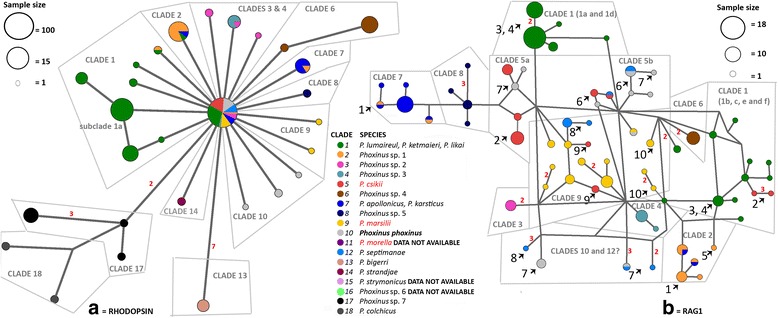
Results: The results of the revision showed that of the fourteen primary species hypotheses, three were rejected, namely P. ketmaieri, P. likai, and P. apollonicus. For three species (P. strandjae, P. strymonicus, P. morella), further investigation with increased data sampling was suggested, while two primary hypotheses, P. bigerri and P. colchicus, were supported as secondary species hypotheses. Finally, six of the primary species hypotheses (P. phoxinus, P. lumaireul, P. karsticus, P. septimanae, P. marsilii and P. csikii) were well supported by mitochondrial but only limitedly corroborated by nuclear data analysis.
Conclusion: The approach has proven useful for revision of species complexes, and the study can serve as an overview of the Phoxinus genus in Europe, as well as a solid basis for further work.
Keywords: Cryptic diversity; Molecular taxonomy; Phoxinus (Cyprinidae); Species delimitation.
Conflict of interest statement
Ethics approval and consent to participate
Not applicable.
Consent for publication
Not applicable.
Competing interests
The authors declare that they have no competing interest.
Publisher’s Note
Springer Nature remains neutral with regard to jurisdictional claims in published maps and institutional affiliations.
Figures

References
-
- Trontelj P, Fišer C. Perspectives: cryptic species diversity should not be trivialised. Syst Biodivers. 2009;7(1):1–3. doi: 10.1017/S1477200008002909. - DOI
-
- Feulner PGD, Kirschbaum F, Schugardt C, Ketmaier V, Tiedemann R. Electrophysiological and molecular genetic evidence for sympatrically occuring cryptic species in African weakly electric fishes (Teleostei: Mormyridae: Campylomormyrus) Mol Phylogen Evol. 2006;39(1):198–208. doi: 10.1016/j.ympev.2005.09.008. - DOI - PubMed
MeSH terms
Substances
LinkOut - more resources
Full Text Sources
Other Literature Sources
Research Materials
