


mtDNA structure: the women who formed the Brazilian Northeast
- PMID: 28793858
- PMCID: PMC5549335
- DOI: 10.1186/s12862-017-1027-7
mtDNA structure: the women who formed the Brazilian Northeast
Retraction in
-
Retraction Note: MtDNA structure: the women who formed the Brazilian Northeast.BMC Ecol Evol. 2025 Jul 28;25(1):73. doi: 10.1186/s12862-025-02427-2. BMC Ecol Evol. 2025. PMID: 40722134 Free PMC article. No abstract available.
Expression of concern in
-
Editorial Expression of Concern: mtDNA structure: the women who formed the Brazilian northeast.BMC Ecol Evol. 2025 Mar 21;25(1):26. doi: 10.1186/s12862-025-02366-y. BMC Ecol Evol. 2025. PMID: 40119262 Free PMC article. No abstract available.
Abstract
Background: The distribution of mitochondrial DNA (mtDNA) lineages in Brazil is heterogeneous due to different regional colonization dynamics. Northeastern Brazil, although being an important region in terms of human imigration and ethnic admixture, has little information regarding its population mtDNA composition. Here, we determine which mitochondrial lineages contributed to the formation of the Northeastern Brazilian population. Our sample consisted of 767 individuals distributed as follows i) 550 individuals from eight Northeastern states (Piauí, Ceará, Rio Grande do Norte, Paraíba, Pernambuco, Alagoas, Sergipe, and Bahia) which were sequenced for mtDNA hypervariable segments I, II, and III; ii) 217 individuals from Alagoas and Pernambuco (previously published data). Data analysis was performed through sequence alignment and Haplogrep 2.0 haplogroup assignment tools. Furthermore, maternal ancestry distribution was contextualized and, when possible, related to historical events to better understand the biological interactions and population dynamics that occurred in this region since the beginning of colonization.
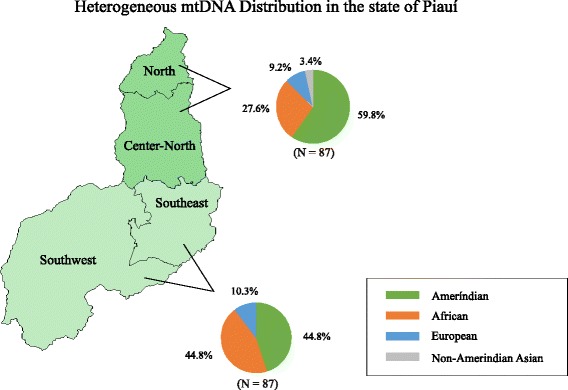
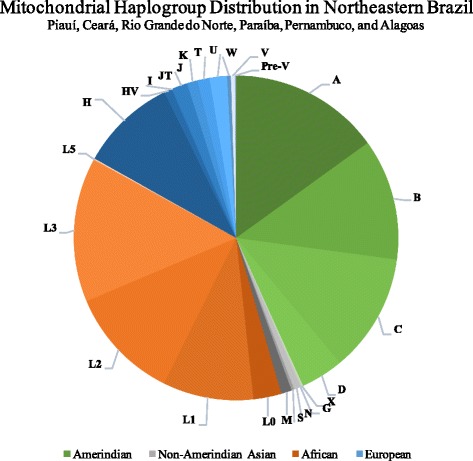
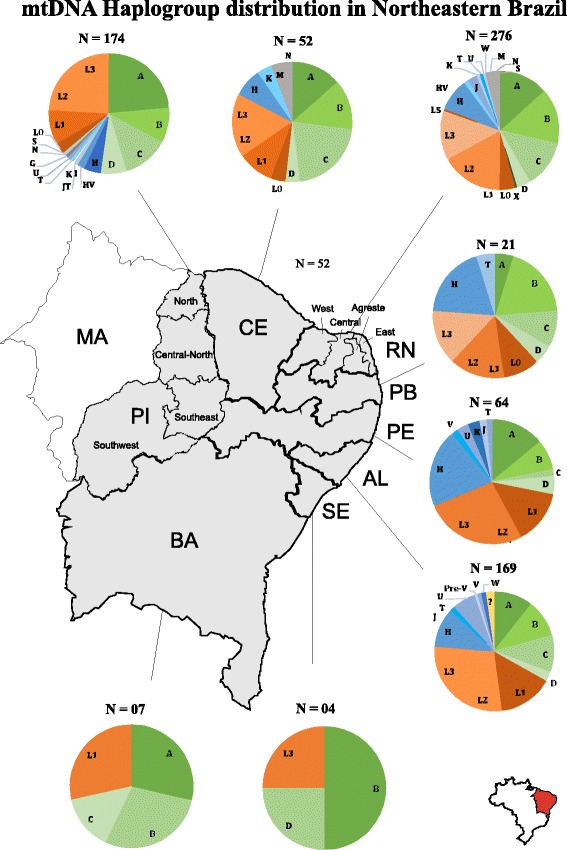
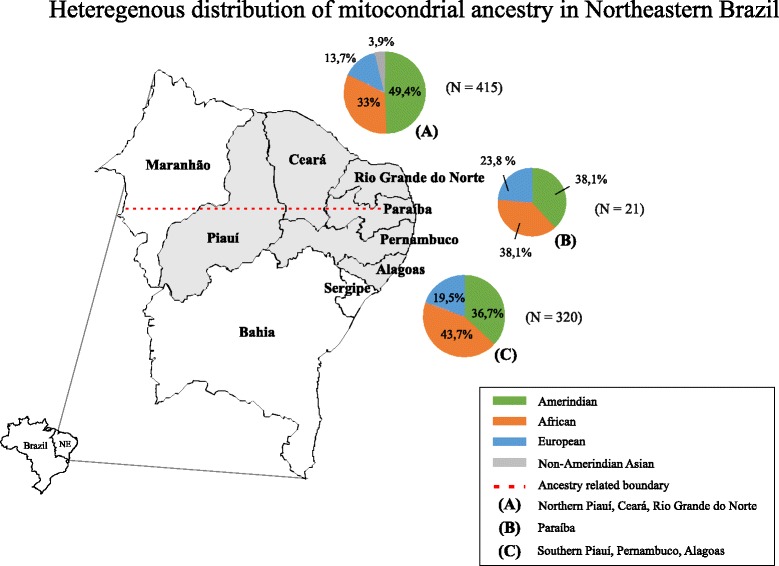
Results: Unexpectedly, Amerindian mitochondrial ancestry was the highest in the Northeastern region overall, followed by African, European and non-Amerindian Asian, unlike previous results for this region. Alagoas and Pernambuco states, however, showed a larger African mtDNA frequency. The Northeastern region showed an intraregional heterogeneous distribution regarding ancestral groups, in which states/mesoregions located to the north had a prevalent Amerindian ancestral frequency and those to the south had predominance of African ancestry. Moreover, results showed great diversity of European haplogroups and the presence of non-Amerindian Asian haplogroups.
Conclusions: Our findings are in disagreement with previous investigations that suggest African mitochondrial ancestry is the most prevalent in the Brazilian Northeast. The predominance of Amerindian lineages exemplifies the importance of indigenous women in the formation of the population, despite intense African slave entry and conflicts with European settlers. The variable distribution of ancestral groups observed in the Northeast is in accordance with historical records showing the similarities with colonization dynamics occurred in the Amazon region and the Brazilian Southeast. Moreover, the variety of European haplogroups suggests multiple origins of founding groups, specially those found in Western European populations.
Keywords: Asymmetric colonization; Genetic diversity; Migration pattern; Northeastern Brazil; Population admixture; mtDNA lineages.
Conflict of interest statement
Ethics approval and consent to participate
Ethical consent was obtained according to the Helsinki Declaration. Ethical approval was obtained from the Research Ethics Committee of the Federal University of Rio Grande do Norte, Federal University of Piauí, and Federal University of Ceará, under protocol numbers 27,493,614.0.0000.5293, 0443.0.045.000–11, and 702/04, respectively. Participants signed the Consent Form for participating in the research and analyses were performed preserving subjects anonymously throughout the study.
Consent for publication
Not applicable.
Competing interests
The authors declare that they have no competing interests.
Publisher’s Note
Springer Nature remains neutral with regard to jurisdictional claims in published maps and institutional affiliations.
Figures

References
-
- Greenberg JH, Turner CG, Zegura SL, Campbell L, Fox JA, Laughlin EJ, et al. The settlement of the Americas: a comparison of the linguistic, dental, and genetic evidence. Curr Anthropol. 1986; doi:10.1086/203472.
-
- Lobato-da-Silva DF, Ribeiro-dos-Santos AKC, SEB S. Diversidade genética de populações humanas na Amazônia. In: Guimarães Vieira IC, Cardoso da Silva JM, Oren DC, D’Ineao MA, editors. Diversidade Humana e Cultural na Amazônia. Belem: Museu Paraense Emilio Goeldi; 2001. pp. 167–193.
-
- Pedersen MW, Ruter A, Schweger C, Friebe H, Staff RA, Kjeldsen KK, et al. Postglacial viability and colonization in North America’s ice-free corridor. Nature. 2016; doi:10.1038/nature19085. - PubMed
Publication types
MeSH terms
Substances
LinkOut - more resources
Full Text Sources
Other Literature Sources
