


Examining the relationship between the food environment and adult diabetes prevalence by county economic and racial composition: an ecological study
- PMID: 28793887
- PMCID: PMC5551001
- DOI: 10.1186/s12889-017-4658-0
Examining the relationship between the food environment and adult diabetes prevalence by county economic and racial composition: an ecological study
Abstract
Background: Inequitable access to healthy food may contribute to health disparities. This study examines the relationship between the prevalence of adult diabetes and food access in the U.S. by county economic/racial composition.
Methods: An ecological study from 2012 was used to estimate the relationship between diabetes and retail food outlet access. County diabetes prevalence was measured based on individual responses to the Behavioral Risk Factor Surveillance Survey question, "Have you ever been told by a doctor that you have diabetes?" If the answer was "yes" individuals were classified as having diabetes. Retail food outlets included grocery stores, supercenters, farmer's markets, full-service restaurants, fast food restaurants and convenience stores. Counties were categorized as "high-poverty" or "low-poverty". Counties were categorized as low (< 4.6%), medium (4.6%-31.0%), and high (> 31.0%) percent minority residents. Multiple linear regression models estimated the association between retail food outlets and diabetes, controlling for confounders, and testing for interactions between retail food outlets and county racial composition. Regression models were conditioned on county economic composition. Data were analyzed in 2016.
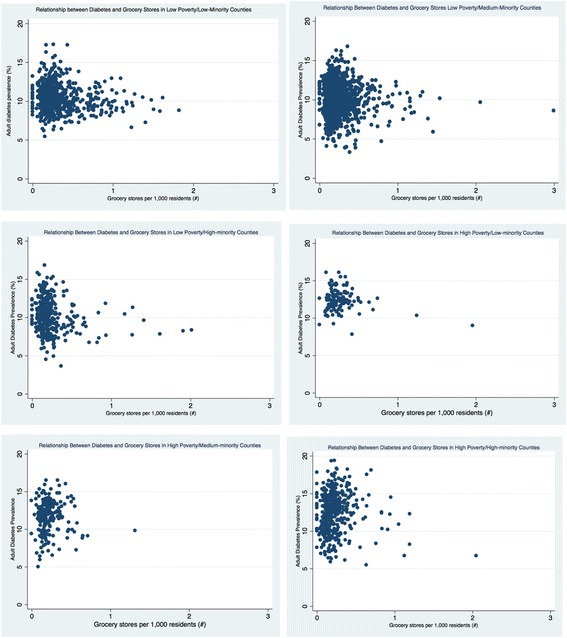
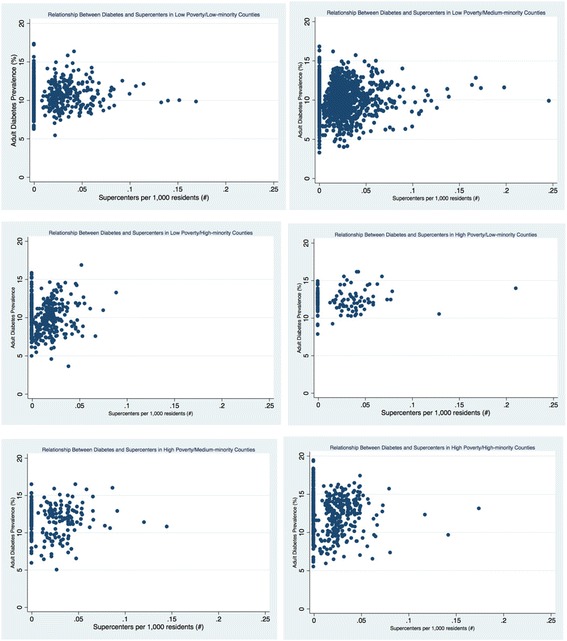
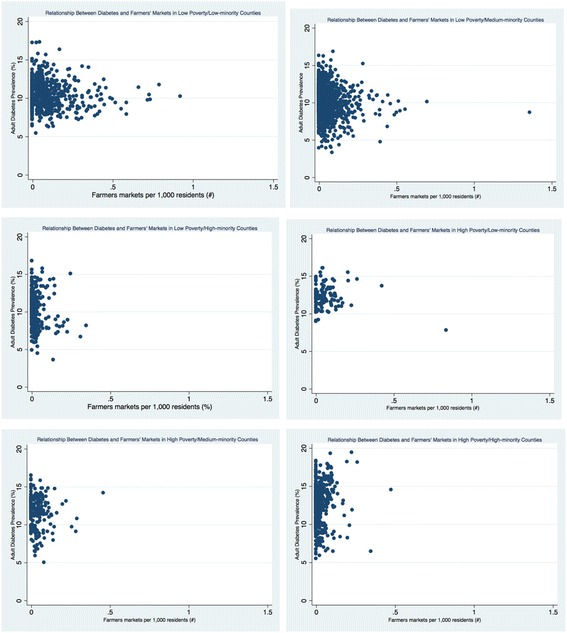
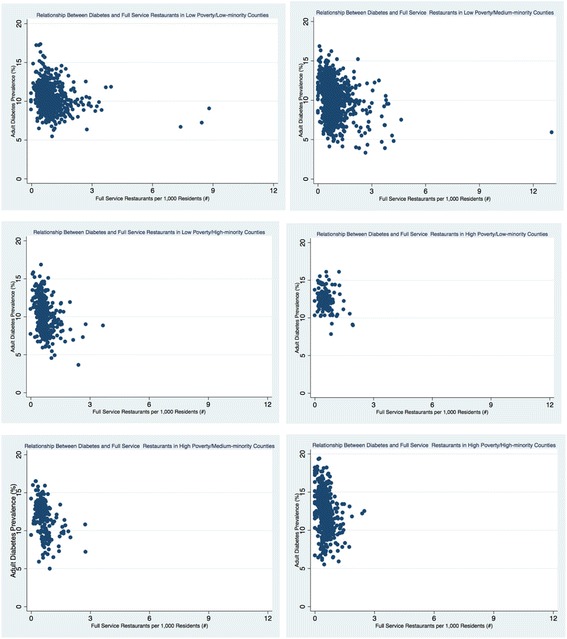
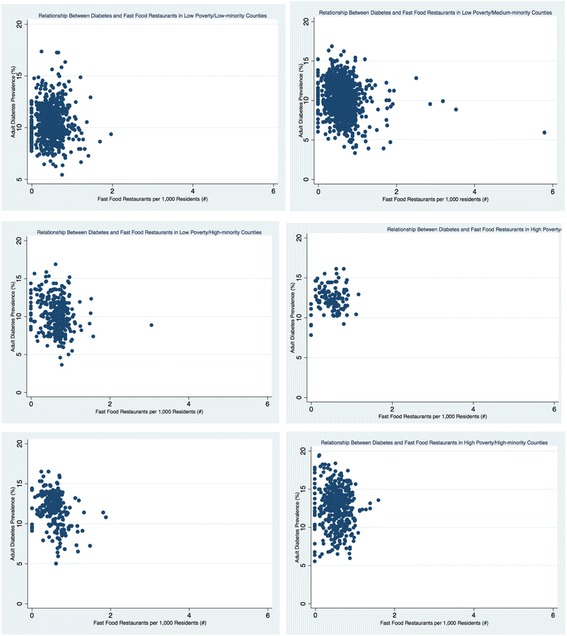
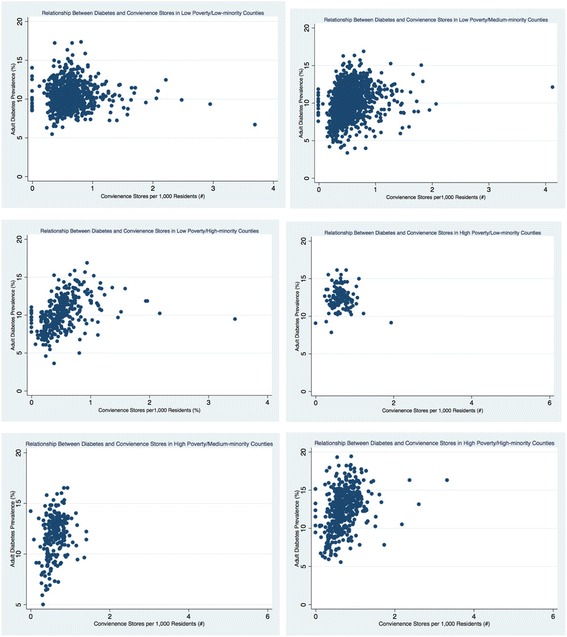
Results: Density of retail foods outlets varied greatly by county economic and racial composition; counties with medium-minority populations had the least access to grocery stores and the highest access to fast food restaurants and convenience stores. Low poverty/low-minority population counties had the greatest access to farmer's markets and grocery stores. For low poverty/low-minority counties, grocery stores were associated with decreased of diabetes prevalence. Supercenters were associated with an increase in diabetes prevalence for high-poverty/low-minority counties. Only low poverty/medium-minority counties had a statistically significant relationship between farmer's markets and diabetes prevalence. Fast food restaurants were found to be positively associated with diabetes prevalence in all counties except high poverty/medium-minority. However, only low poverty/low-minority counties had a statistically significant relationship. Across all models, access to full service restaurants were significantly associated with lower prevalence of diabetes. Generally, access to convenience stores were associated with increased diabetes prevalence, except for high poverty/low-minority counties.
Conclusions: The food environment is more strongly associated with diabetes prevalence for wealthier counties with a lower proportion of minority residents. This is important given efforts to increase food access in vulnerable communities. Availability of healthier food may not be enough to change health outcomes.
Keywords: Diabetes; Food access; Food environment; Health disparities.
Conflict of interest statement
Ethics approval and consent to participate
Institutional review board approval was not required for this study because the dataset is publicly available and does not reveal confidential information that can be identified to a particular individual.
Consent for publication
Not applicable.
Competing interests
The authors declare that they have no competing interests.
Publisher’s Note
Springer Nature remains neutral with regard to jurisdictional claims in published maps and institutional affiliations.
Figures
References
-
- Centers for Disease Control and Prevention website. (2015). Number (in millions) of civilian, noninstitutionalized adults with diagnosed diabetes, United States, 1980–2014. Retrieved from http://www.cdc.gov/diabetes/statistics/prev/national/figadults.htm. Accessed 21 Sept 2017.
-
- Whiteney E, Rolfes S. Understanding nutrition. 13. Belmont: Wadsworth Publishing; 2012.
-
- Centers for Disease Control and Prevention. (2014). National Diabetes Statistics Report: Estimates of Diabetes and Its Burden in the United States, 2014. Retrieved from https://www.cdc.gov/diabetes/data/statistics/2014statisticsreport.html. Accessed 21 Sept 2017.
-
- Sallis JF, Owen N, Fisher EB. Ecological models of heath behavior. In: Glanz K, Rimer BK, Viswanath K, editors. Health behavior and health education: theory, research, and practice. 4th. San Francisco: Jossey-Bass; 2008. pp. 465–486.
MeSH terms
LinkOut - more resources
Full Text Sources
Other Literature Sources
Medical
