


Latent class analysis derived subgroups of low back pain patients - do they have prognostic capacity?
- PMID: 28793903
- PMCID: PMC5551030
- DOI: 10.1186/s12891-017-1708-9
Latent class analysis derived subgroups of low back pain patients - do they have prognostic capacity?
Abstract
Background: Heterogeneity in patients with low back pain is well recognised and different approaches to subgrouping have been proposed. One statistical technique that is increasingly being used is Latent Class Analysis as it performs subgrouping based on pattern recognition with high accuracy. Previously, we developed two novel suggestions for subgrouping patients with low back pain based on Latent Class Analysis of patient baseline characteristics (patient history and physical examination), which resulted in 7 subgroups when using a single-stage analysis, and 9 subgroups when using a two-stage approach. However, their prognostic capacity was unexplored. This study (i) determined whether the subgrouping approaches were associated with the future outcomes of pain intensity, pain frequency and disability, (ii) assessed whether one of these two approaches was more strongly or more consistently associated with these outcomes, and (iii) assessed the performance of the novel subgroupings as compared to the following variables: two existing subgrouping tools (STarT Back Tool and Quebec Task Force classification), four baseline characteristics and a group of previously identified domain-specific patient categorisations (collectively, the 'comparator variables').
Methods: This was a longitudinal cohort study of 928 patients consulting for low back pain in primary care. The associations between each subgroup approach and outcomes at 2 weeks, 3 and 12 months, and with weekly SMS responses were tested in linear regression models, and their prognostic capacity (variance explained) was compared to that of the comparator variables listed above.
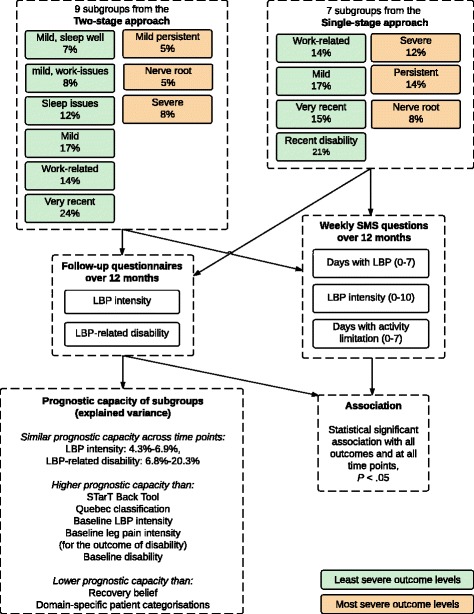
Results: The two previously identified subgroupings were similarly associated with all outcomes. The prognostic capacity of both subgroupings was better than that of the comparator variables, except for participants' recovery beliefs and the domain-specific categorisations, but was still limited. The explained variance ranged from 4.3%-6.9% for pain intensity and from 6.8%-20.3% for disability, and highest at the 2 weeks follow-up.
Conclusions: Latent Class-derived subgroups provided additional prognostic information when compared to a range of variables, but the improvements were not substantial enough to warrant further development into a new prognostic tool. Further research could investigate if these novel subgrouping approaches may help to improve existing tools that subgroup low back pain patients.
Keywords: Classification, prognosis; Low back pain; Prospective studies, Latent class analysis; Subgrouping.
Conflict of interest statement
Ethics approval and consent to participate
All participating patients gave written, informed consent. The Danish Data Protection Agency approved this study (ref. no. 2012–41-0762) and it did not need ethics approval under Danish law, as treatment was not affected by participation in the study.
Consent for publication
Not applicable
Competing interests
The authors have no financial or non-financial competing interests to declare. PK and AMN were partially, and AK was fully, financially supported by the Danish Foundation for Chiropractic Research and Post Graduate Education, Denmark. LH and AK are members of the Editorial Board of BMC Musculoskeletal Disorders.
Publisher’s Note
Springer Nature remains neutral with regard to jurisdictional claims in published maps and institutional affiliations.
Figures

References
-
- Global Burden of Disease Study C Global, regional, and national incidence, prevalence, and years lived with disability for 301 acute and chronic diseases and injuries in 188 countries, 1990-2013: a systematic analysis for the global burden of disease study 2013. Lancet. 2015;386(9995):743–800. doi: 10.1016/S0140-6736(15)60692-4. - DOI - PMC - PubMed
-
- Holmberg T, Poulsen MJ, Davidsen M. Muskel- og skeletlidelser i Danmark. Nøgletal 2015 [Musculoskeletal disorders in Denmark. Key figures 2015]. University of Southern Denmark: Statens Institut for Folkesundhed [National Institute of Public Health]; 2015.
-
- Flynn T, Fritz J, Whitman J, Wainner R, Magel J, Rendeiro D, et al. A clinical prediction rule for classifying patients with low back pain who demonstrate short-term improvement with spinal manipulation. Spine (Phila Pa 1976) 2002;27(24):2835–2843. doi: 10.1097/00007632-200212150-00021. - DOI - PubMed
Publication types
MeSH terms
LinkOut - more resources
Full Text Sources
Other Literature Sources
