


Corticotropin-Releasing Factor Receptor 1 Antagonism Is Ineffective for Women With Posttraumatic Stress Disorder
- PMID: 28793974
- PMCID: PMC5683912
- DOI: 10.1016/j.biopsych.2017.06.024
Corticotropin-Releasing Factor Receptor 1 Antagonism Is Ineffective for Women With Posttraumatic Stress Disorder
Abstract
Background: Medication and psychotherapy treatments for posttraumatic stress disorder (PTSD) provide insufficient benefit for many patients. Substantial preclinical and clinical data indicate abnormalities in the hypothalamic-pituitary-adrenal axis, including signaling by corticotropin-releasing factor, in the pathophysiology of PTSD.
Methods: We conducted a double-blind, placebo-controlled, randomized, fixed-dose clinical trial evaluating the efficacy of GSK561679, a corticotropin-releasing factor receptor 1 (CRF1 receptor) antagonist in adult women with PTSD. The trial randomized 128 participants, of whom 96 completed the 6-week treatment period.
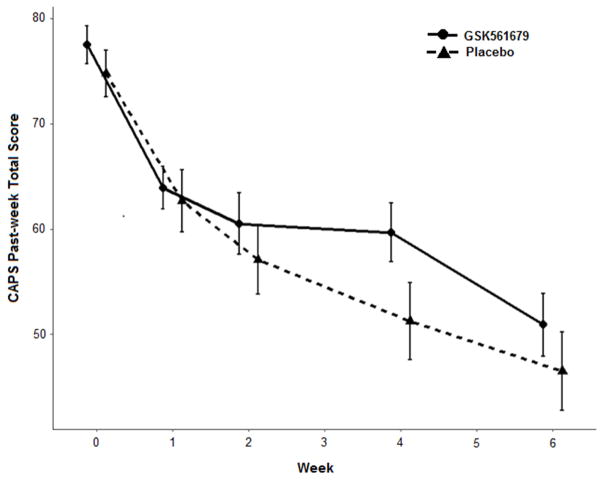
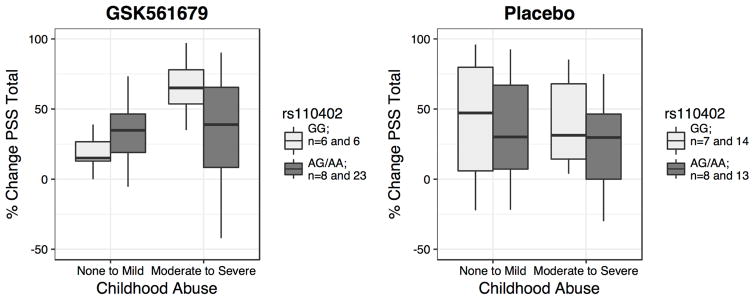
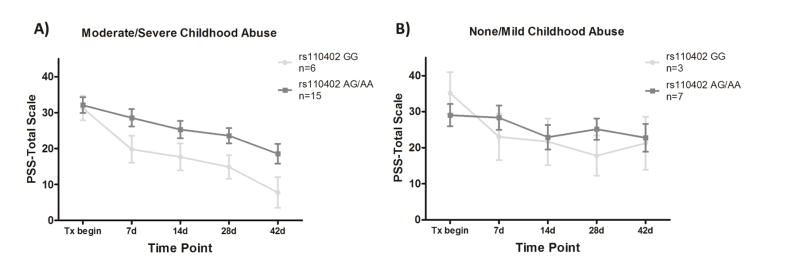
Results: In both the intent-to-treat and completer samples, GSK561679 failed to show superiority over placebo on the primary outcome of change in Clinician-Administered PTSD Scale total score. Adverse event frequencies did not significantly differ between GSK561679- and placebo-treated subjects. Exploration of the CRF1 receptor single nucleotide polymorphism rs110402 found that response to GSK561679 and placebo did not significantly differ by genotype alone. However, subjects who had experienced a moderate or severe history of childhood abuse and who were also GG homozygotes for rs110402 showed significant improvement after treatment with GSK561679 (n = 6) but not with placebo (n = 7) on the PTSD Symptom Scale-Self-Report.
Conclusions: The results of this trial, the first evaluating a CRF1 receptor antagonist for the treatment of PTSD, combined with other negative trials of CRF1 receptor antagonists for major depressive disorder, generalized anxiety disorder, and social anxiety disorder, suggest that CRF1 receptor antagonists lack efficacy as monotherapy agents for these conditions.
Keywords: Adrenocorticotropic hormone; Child abuse; Clinical trial; Dexamethasone; Pharmacogenetics.
Copyright © 2017 Society of Biological Psychiatry. Published by Elsevier Inc. All rights reserved.
Figures
Comment in
-
Corticotropin-Releasing Factor Type 1 Receptor Antagonists for Stress-Related Disorders: Time to Call It Quits?Biol Psychiatry. 2017 Dec 15;82(12):858-860. doi: 10.1016/j.biopsych.2017.10.012. Biol Psychiatry. 2017. PMID: 29129198 No abstract available.
References
-
- Rodriguez P, Holowka DW, Marx BP. Assessment of posttraumatic stress disorder-related functional impairment: A review. J Rehabil Res Dev. 2012;49:649–666. - PubMed
-
- Strawn JR, Geracioti TD., Jr Noradrenergic dysfunction and the psychopharmacology of posttraumatic stress disorder. Depress Anxiety. 2008;25:260–271. - PubMed
-
- Yehuda R. Status of glucocorticoid alterations in post-traumatic stress disorder. Ann N Y Acad Sci. 2009;1179:56–69. - PubMed
-
- Raskind MA, Millard SP, Petrie EC, Peterson K, Williams T, Hoff DJ, et al. Biol Psychiatry. 2016;80:736–742. - PubMed
Publication types
MeSH terms
Substances
Grants and funding
LinkOut - more resources
Full Text Sources
Other Literature Sources
Medical
