


Sex-specific stroke incidence over time in the Greater Cincinnati/Northern Kentucky Stroke Study
- PMID: 28794254
- PMCID: PMC5589794
- DOI: 10.1212/WNL.0000000000004325
Sex-specific stroke incidence over time in the Greater Cincinnati/Northern Kentucky Stroke Study
Abstract
Objective: Recent data suggest stroke incidence is decreasing over time, but it is unknown whether incidence is decreasing in women and men to the same extent.
Methods: Within our population of 1.3 million, all incident strokes among residents ≥20 years old were ascertained at all hospitals during July 1993-June 1994 and calendar years 1999, 2005, and 2010. A sampling scheme was used to ascertain out-of-hospital cases. Sex-specific incidence rates per 100,000 among black and white participants, age- and race-adjusted, were standardized to the 2000 US Census population. Trends over time by sex were compared; a Bonferroni correction was applied for multiple comparisons.
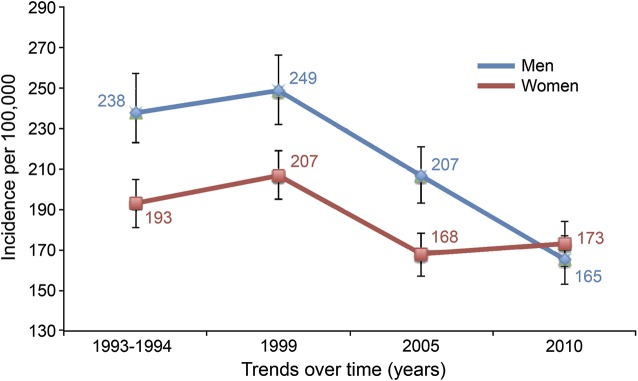
Results: Over the 4 study periods, there were 7,710 incident strokes; 57.2% (n = 4,412) were women. Women were older than men (mean ± SE 72.4 ± 0.34 vs 68.2 ± 0.32, p < 0.001). Incidence of all strokes decreased over time in men (263 [confidence interval 246-281] to 192 [179-205], p < 0.001) but not in women (217 [205-230] to 198 [187-210], p = 0.15). Similar sex differences were seen for ischemic stroke (men, 238 [223-257] to 165 [153-177], p < 0.01; women, 193 [181-205] to 173 [162-184], p = 0.09). Incidence of all strokes and of ischemic strokes was similar between women and men in 2010. Incidence of intracerebral hemorrhage and subarachnoid hemorrhage were stable over time in both sexes.
Conclusions: Decreases in stroke incidence over time are driven by a decrease in ischemic stroke in men. Contrary to previous study periods, stroke incidence rates were similar by sex in 2010. Future research is needed to understand why the decrease in ischemic stroke incidence is more pronounced in men.
© 2017 American Academy of Neurology.
Figures
Comment in
-
Trends in stroke incidence in the United States: Will women overtake men?Neurology. 2017 Sep 5;89(10):982-983. doi: 10.1212/WNL.0000000000004342. Epub 2017 Aug 9. Neurology. 2017. PMID: 28794256 No abstract available.
-
Reader response: Sex-specific stroke incidence over time in the Greater Cincinnati/Northern Kentucky Stroke Study.Neurology. 2018 Mar 27;90(13):625. doi: 10.1212/WNL.0000000000005200. Neurology. 2018. PMID: 29581329 No abstract available.
-
Reader response: Sex-specific stroke incidence over time in the Greater Cincinnati/Northern Kentucky Stroke Study.Neurology. 2018 Mar 27;90(13):626. doi: 10.1212/WNL.0000000000005198. Neurology. 2018. PMID: 29581330 No abstract available.
-
Author response: Sex-specific stroke incidence over time in the Greater Cincinnati/Northern Kentucky Stroke Study.Neurology. 2018 Mar 27;90(13):626. doi: 10.1212/WNL.0000000000005204. Neurology. 2018. PMID: 29581331 No abstract available.
References
-
- Di Carlo A, Lamassa M, Baldereschi M, et al. Sex differences in the clinical presentation, resource use, and 3-month outcome of acute stroke in Europe: data from a multicenter multinational hospital-based registry. Stroke 2003;34:1114–1119. - PubMed
-
- Gall SL, Tran PL, Martin K, Blizzard L, Srikanth V. Sex differences in long-term outcomes after stroke: functional outcomes, handicap, and quality of life. Stroke 2012;43:1982–1987. - PubMed
-
- Gargano JW, Reeves MJ. Sex differences in stroke recovery and stroke-specific quality of life: results from a statewide stroke registry. Stroke 2007;38:2541–2548. - PubMed
-
- Carandang R, Seshadri S, Beiser A, et al. Trends in incidence, lifetime risk, severity, and 30-day mortality of stroke over the past 50 years. JAMA 2006;296:2939–2946. - PubMed
MeSH terms
Grants and funding
LinkOut - more resources
Full Text Sources
Other Literature Sources
Medical
