. 2017 Aug 9;7(1):7648.
doi: 10.1038/s41598-017-08138-z.

A transcriptome atlas of rabbit revealed by PacBio single-molecule long-read sequencing

Affiliations

A transcriptome atlas of rabbit revealed by PacBio single-molecule long-read sequencing

Shi-Yi Chen et al. Sci Rep. .

Abstract

It is widely acknowledged that transcriptional diversity largely contributes to biological regulation in eukaryotes. Since the advent of second-generation sequencing technologies, a large number of RNA sequencing studies have considerably improved our understanding of transcriptome complexity. However, it still remains a huge challenge for obtaining full-length transcripts because of difficulties in the short read-based assembly. In the present study we employ PacBio single-molecule long-read sequencing technology for whole-transcriptome profiling in rabbit (Oryctolagus cuniculus). We totally obtain 36,186 high-confidence transcripts from 14,474 genic loci, among which more than 23% of genic loci and 66% of isoforms have not been annotated yet within the current reference genome. Furthermore, about 17% of transcripts are computationally revealed to be non-coding RNAs. Up to 24,797 alternative splicing (AS) and 11,184 alternative polyadenylation (APA) events are detected within this de novo constructed transcriptome, respectively. The results provide a comprehensive set of reference transcripts and hence contribute to the improved annotation of rabbit genome.


Conflict of interest statement

The authors declare that they have no competing interests.

Figures
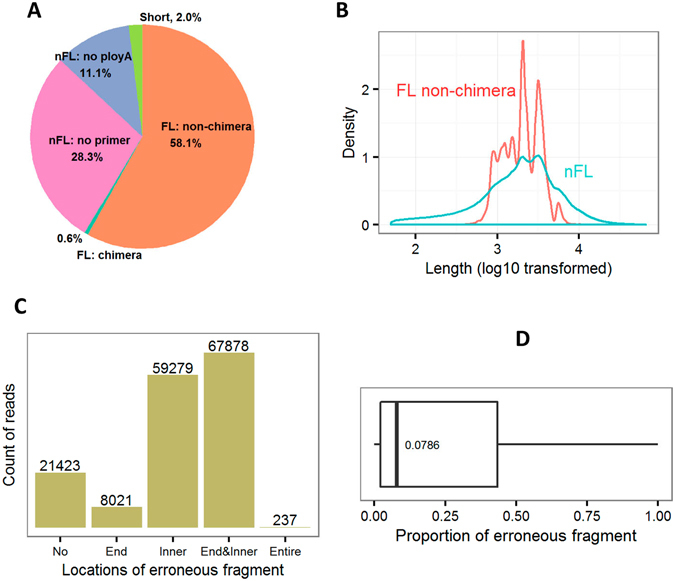
Figure 1
Figure 1
Classification of ROIs and error correction. All ROIs were first classified (A) and produced FL and nFL isoform sequences with differential patterns of length distribution (B). After the error correction by Illumina short reads, ROIs were categorized according to the occurred locations of erroneous fragments (C), including the absence (No), terminal ends (End), inner positions (Inner) and the entire sequences (Entire). Finally, we investigated the length proportion of erroneous fragment relative to raw ROIs (D).
Figure 2
Figure 2
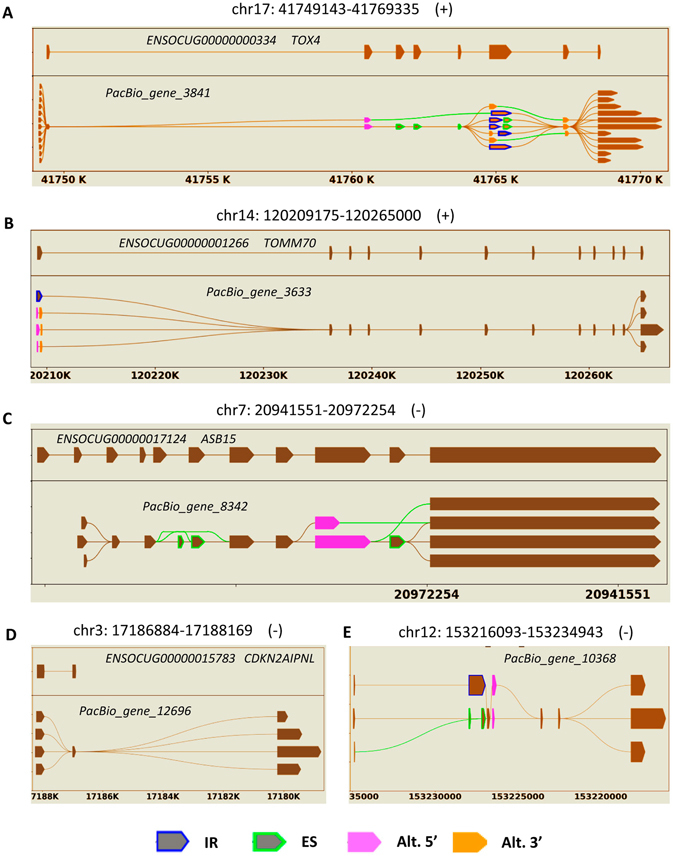
Schematic illustration of alternative isoforms within the PacBio transcriptome. The reference gene models in Ensembl are accordingly placed on upper side and labelled by chromosomal locations, gene ID and name. AS events could be found extensively (A) or exclusively detected within terminal exons (B). The events of ES and Alt. 5′ are specially shown with the shrunk length of introns (C). The newly revealed exon (D) and gene (E) in reference to Ensembl gene models are also demonstrated.
Figure 3
Figure 3
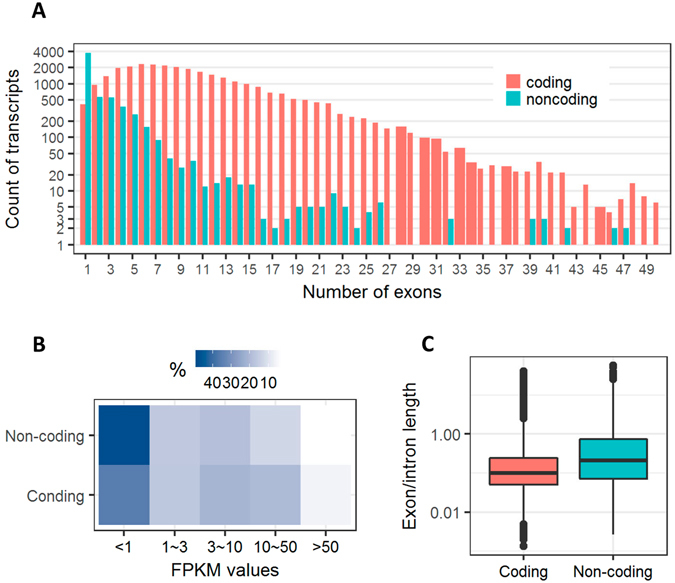
Comparisons between protein-coding and non-coding transcripts for the number of exons (A), expression levels (B) and length ratio of exon to intron (C). FPKM, fragments per transcript kilobase per million fragments mapped.
Figure 4
Figure 4
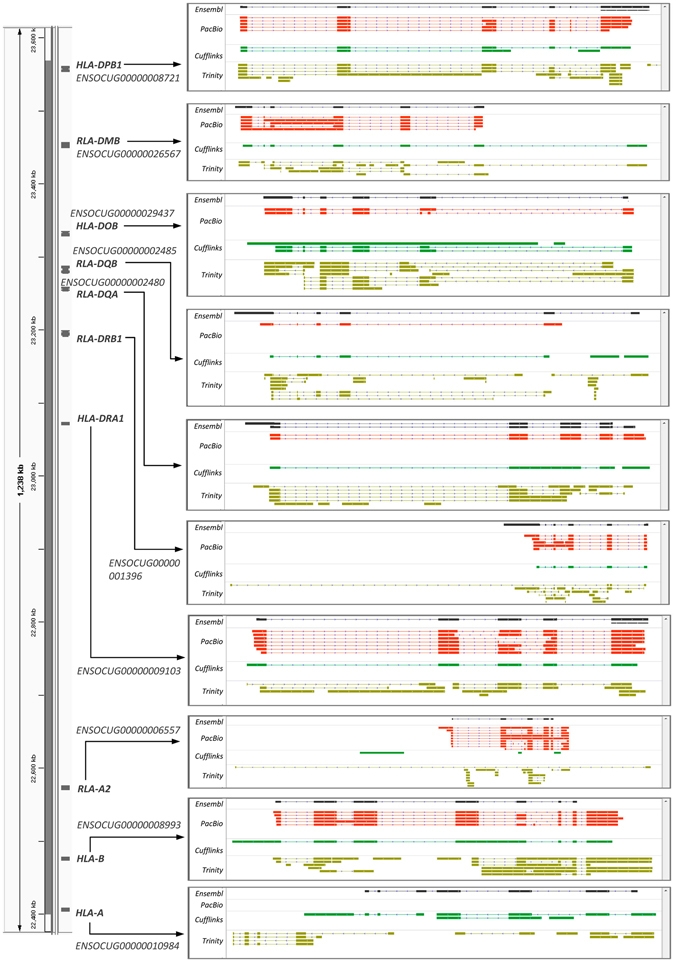
Recovery of ten MHC genes by PacBio transcripts and the assembled transcripts from short reads. Chromosomal locations, name and Ensembl accession number for each gene are shown on the left. The exon-intron structures are illustrated into the separate boxes and within each of them the reference transcripts in Ensembl (Black), PacBio transcripts (Red), and the assembled transcripts by Cufflinks (Green) and Trinity (Olive) are listed in order from top to bottom.
Figure 5
Figure 5
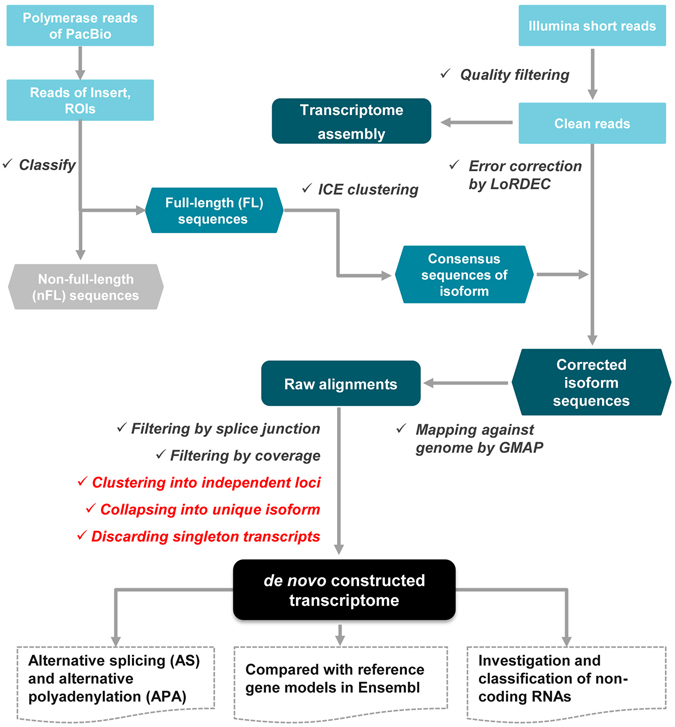
Pipeline of bioinformatic analyses. The processing steps are individually ticked, and among which the clustering, collapsing and filtering of GMAP alignments were conducted using our in-house scripts (in red).

References

    1. Carneiro M, et al. Rabbit genome analysis reveals a polygenic basis for phenotypic change during domestication. Science. 2014;345:1074–1079. doi: 10.1126/science.1253714. - DOI - PMC - PubMed
    1. Mapara, M., Thomas, B. S. & Bhat, K. M. Rabbit as an animal model for experimental research. Dent. Res. J.9, 111–118 (2012). - PMC - PubMed
    1. Shiomi, M. Rabbit Biotechnology (eds Houdebine, L.-M. & Fan, J.) 49–63 (Springer Netherlands, 2009).
    1. Calasans-Maia MD, Monteiro ML, Áscoli FO, Granjeiro JM. The rabbit as an animal model for experimental surgery. Acta Cir. Bras. 2009;24:325–328. doi: 10.1590/S0102-86502009000400014. - DOI - PubMed
    1. Wang Z, Gerstein M, Snyder M. RNA-Seq: a revolutionary tool for transcriptomics. Nat. Rev. Genet. 2009;10:57–63. doi: 10.1038/nrg2484. - DOI - PMC - PubMed

Publication types

Substances